

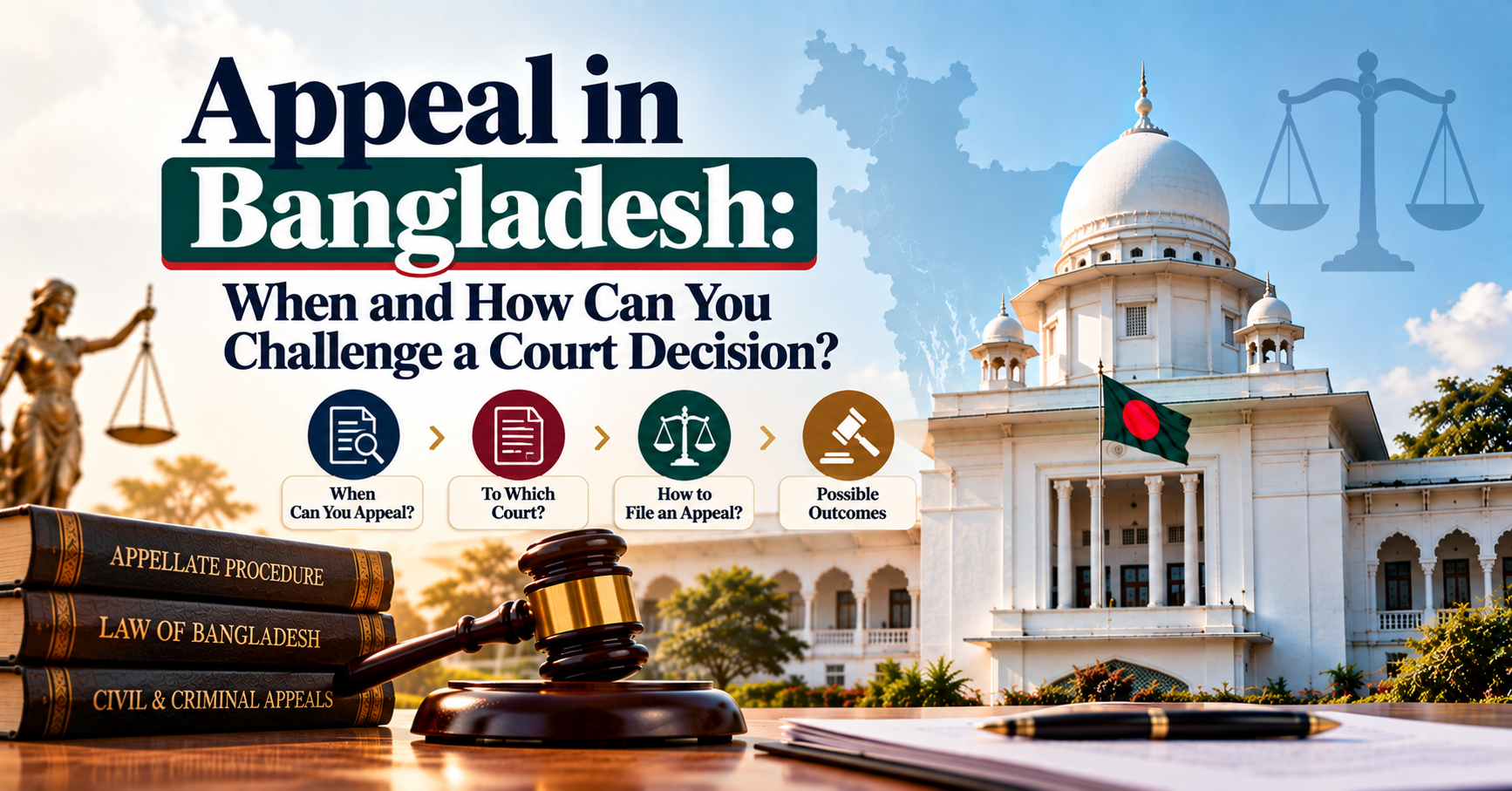
Appeal in Bangladesh: When and How Can You Challenge a Court Decision?
A court decision in Bangladesh is not always the final stage of a legal dispute. Depending on the type of case, the court that delivered the decision, and the applicable law, a party may have a legal right to appeal, seek revision, or apply for review.
An appeal in Bangladesh is a legal proceeding through which a higher court examines a judgment, decree, order, or sentence of a lower court within the scope permitted by law. However, the right to appeal is not automatic in every case. The Constitution and relevant statutes determine whether an appeal is available, where it must be filed, and what issues the appellate court can consider.
This guide explains when you can appeal a court decision in Bangladesh, where an appeal should be filed, the difference between appeal, revision and review, the basic appeal procedure, limitation periods, and what can happen after an appeal is filed.
What Is an Appeal in Bangladesh?
An appeal is a legal remedy through which a party asks a higher court to examine a decision of a lower court.
Depending on the type of case, an appeal may challenge:
- A civil judgment
- A civil decree
- A criminal conviction
- A criminal sentence
- A criminal acquittal where the law permits
- Certain interlocutory or procedural orders
- Decisions of specialised courts or tribunals where the relevant statute provides an appeal
The scope of an appeal depends on the applicable legislation.
An appeal should therefore not be understood simply as an opportunity to restart a case from the beginning. The appellate court's powers and the grounds on which it can interfere depend on the particular type of appeal.
Main Laws Governing Appeals in Bangladesh
Appeals in Bangladesh are governed by different laws depending on the case.
Important sources include:
Code of Civil Procedure, 1908
The CPC contains provisions governing civil appeals, including first appeals, second appeals and appeals from certain orders.
Code of Criminal Procedure, 1898
The CrPC contains provisions concerning criminal appeals, including appeals against convictions and certain other criminal orders.
Constitution of Bangladesh
The Constitution establishes the appellate jurisdiction of the Appellate Division of the Supreme Court and provides constitutional rules concerning appeals from the High Court Division.
Special Laws
Special legislation may create specific appellate rights for cases decided by specialised courts and tribunals.
The current statute applicable to the particular case should always be checked because legislative amendments can change appellate rights and procedures.
Is There a Right to Appeal Every Court Decision?
No.
The right to appeal is generally a statutory or constitutional right. A person cannot automatically appeal every order simply because they disagree with it.
Before filing an appeal, it is important to determine:
- Whether an appeal is legally available;
- Which court has appellate jurisdiction;
- Whether the decision is appealable;
- Whether leave to appeal is required;
- What grounds can be raised;
- What limitation period applies; and
- What documents must be filed.
This is particularly important for interlocutory orders, because not every procedural order is independently appealable.
Civil Appeal in Bangladesh
Civil appeals are primarily governed by the Code of Civil Procedure, 1908.
The CPC provides different forms of appellate remedies depending on the nature of the decision.
The principal categories include:
- First appeal
- Second appeal
- Appeal from certain orders
First Appeal
A first appeal is generally an appeal from an original decree, where the CPC or another applicable law provides such a remedy.
Under Section 96 of the CPC, an appeal lies from every decree passed by a court exercising original jurisdiction to the court authorised to hear appeals from that court, subject to the statutory exceptions. (bdlaws.minlaw.gov.bd)
A first appellate court may therefore have a broader role in examining the decision than a court exercising second appellate jurisdiction.
Depending on the case, the appellate court may consider:
- Questions of fact
- Evidence
- Questions of law
- Interpretation of documents
- Application of legal principles
The precise scope depends on the nature of the appeal and applicable law.
Second Appeal
A second appeal is more limited than a first appeal.
Section 100 of the CPC provides that a second appeal to the High Court Division lies in specified circumstances where the case involves a substantial question of law, subject to the statutory requirements. (bdlaws.minlaw.gov.bd)
This means a second appeal is not simply a second opportunity to re-argue every factual issue.
The appellant must identify the substantial question of law on which the appeal is based.
What Is a Substantial Question of Law?
A substantial question of law generally involves an important legal question requiring determination by the appellate court within the meaning of the governing statute.
Examples may include questions concerning:
- Interpretation of a statutory provision
- Application of an important legal principle
- Jurisdiction
- Legal validity of a particular approach taken by the lower court
Whether a particular question qualifies as a substantial question of law depends on the circumstances and applicable jurisprudence.
Appeal From Certain Orders
The CPC also permits appeals from specified orders.
Section 104 of the CPC identifies certain orders from which an appeal lies, subject to the statutory framework. (bdlaws.minlaw.gov.bd)
This is important because not every interim or procedural order is independently appealable.
A lawyer should therefore verify the specific statutory provision before treating an interlocutory order as appealable.
Civil Appeal to the High Court Division
Depending on which subordinate court issued the decision and the nature of the case, a civil appeal may reach the High Court Division of the Supreme Court of Bangladesh.
The High Court Division has appellate jurisdiction under the Constitution and various statutes.
The appropriate appellate forum depends on the statutory structure applicable to the particular case.
Criminal Appeal in Bangladesh
Criminal appeals are principally governed by the Code of Criminal Procedure, 1898, although special criminal statutes may establish different procedures.
A criminal appeal may arise from:
- Conviction
- Sentence
- Certain orders
- Acquittal, where legally permitted
The applicable appellate forum depends on the court that passed the decision and the relevant statutory provisions.
Appeal Against Criminal Conviction
A person convicted of a criminal offence may have a right to appeal depending on:
- The court that convicted the person;
- The offence;
- The sentence;
- The applicable provision of the CrPC; and
- Any special law governing the offence.
The appeal may challenge:
- The finding of guilt
- The interpretation of evidence
- The application of law
- The sentence
- Procedural irregularities
The exact scope depends on the applicable appellate provision.
Appeal Against Acquittal
The law also provides circumstances in which an acquittal may be challenged on appeal.
However, the availability and procedure for an appeal against acquittal depend on the statutory provision under which the acquittal was entered and the person or authority seeking to challenge it.
This is an area where the exact procedural provision should be checked rather than assuming that every acquittal can be appealed in the same way.
Criminal Appeal and the High Court Division
The High Court Division exercises criminal appellate jurisdiction under the Constitution and relevant legislation.
Criminal appeals reaching the High Court Division may involve matters such as:
- Conviction
- Sentence
- Acquittal where permitted
- Death sentences
- Other criminal orders specified by law
The appropriate procedure depends on the originating court and the applicable statute.
Death Sentence and High Court Division Confirmation
A particularly important rule applies to a death sentence passed by a Sessions Court.
The Bangladesh Judiciary explains that a death sentence passed by a Sessions Judge or Additional Sessions Judge is subject to confirmation by the High Court Division. (judiciary.gov.bd)
This is constitutionally and procedurally different from an ordinary criminal appeal because the sentence requires confirmation before it can be carried into effect.
Appeal to the Appellate Division
The Appellate Division of the Supreme Court of Bangladesh is the country's highest appellate court.
Article 103 of the Constitution governs its appellate jurisdiction.
Under Article 103, an appeal may lie from a judgment, decree, order or sentence of the High Court Division in circumstances specified by the Constitution. (bdlaws.minlaw.gov.bd)
Some appeals lie as of right, while in other cases leave to appeal is required.
Appeal as of Right
Article 103(2) identifies circumstances in which an appeal lies to the Appellate Division as of right.
These include specified situations involving:
- A substantial question of law concerning interpretation of the Constitution;
- Death sentences or sentences involving imprisonment for life in circumstances specified by the Constitution;
- Punishment for contempt of the High Court Division; and
- Other cases provided by an Act of Parliament.
The precise constitutional conditions must be examined in each case. (bdlaws.minlaw.gov.bd)
Leave to Appeal
Where an appeal does not fall within the categories where an appeal lies as of right, Article 103(3) provides that an appeal may be brought with the leave of the Appellate Division. (bdlaws.minlaw.gov.bd)
A petition for leave to appeal is therefore an important route for challenging certain High Court Division decisions.
The Appellate Division first determines whether leave should be granted. If leave is granted, the matter proceeds as an appeal according to the applicable rules.
Appeal vs Leave to Appeal
These terms should not be confused.
Appeal as of Right
The Constitution or statute directly provides a right of appeal when specified conditions are satisfied.
Leave to Appeal
The party must first obtain permission from the appellate court before the appeal can proceed.
The distinction is particularly important when challenging a decision of the High Court Division before the Appellate Division.
Procedure for Filing an Appeal in Bangladesh
Although the exact procedure differs between civil and criminal cases, a general appeal process can be understood through several steps.
Step 1: Obtain the Judgment or Order
The first step is to obtain a copy of the judgment, decree or order being challenged.
The appellant should carefully examine:
- Findings of fact
- Findings of law
- Evidence considered
- Reasons given by the court
- Relief granted or refused
- Date of judgment
- Date of decree, where relevant
The grounds of appeal should be based on identifiable legal or factual errors rather than simply disagreement with the outcome.
Step 2: Determine Whether an Appeal Is Available
Before preparing an appeal, identify the applicable provision.
For example:
- Civil first appeal → Section 96 CPC, where applicable
- Civil second appeal → Section 100 CPC
- Appeal from specified orders → Section 104 CPC
- Criminal appeal → relevant provisions of the CrPC
- Appeal to Appellate Division → Article 103 of the Constitution
Special statutes may provide different rules.
Step 3: Identify the Correct Appellate Court
The correct appellate court depends on the court that issued the original decision and the applicable law.
A simplified structure may look like:
Subordinate Civil/Criminal Court → Appropriate Appellate Court → High Court Division → Appellate Division
However, not every case follows this exact sequence.
Some cases may have specialised appellate routes, and some decisions may require leave to appeal rather than an automatic appeal.
Step 4: Check the Limitation Period
An appeal must generally be filed within the prescribed limitation period.
The limitation period depends on:
- Type of case
- Court that passed the decision
- Court receiving the appeal
- Nature of judgment or order
- Applicable statute
The Limitation Act, 1908 and relevant procedural legislation must be consulted.
The date from which limitation begins can also depend on the applicable legal provision and circumstances.
Because missing a limitation period can seriously affect an appeal, the deadline should be calculated carefully.
Step 5: Prepare the Memorandum of Appeal
A civil appeal is generally initiated through a memorandum of appeal.
The memorandum identifies the decision being challenged and the grounds on which the appellant seeks interference.
A properly drafted memorandum may identify errors such as:
- Incorrect application of law
- Misreading of evidence
- Failure to consider material evidence
- Incorrect finding on an issue
- Jurisdictional error
- Procedural irregularity
- Incorrect interpretation of a document
- Other legally recognised grounds
The grounds should be specific rather than simply stating that the judgment is "wrong."
Step 6: Attach Required Documents
Depending on the type of appeal, the filing may require documents such as:
- Certified copy of judgment
- Certified copy of decree
- Memorandum of appeal
- Relevant pleadings
- Evidence or exhibits where required
- Court-fee documents
- Application for condonation of delay, if necessary
- Stay application, where appropriate
- Other documents prescribed by the applicable rules
The precise filing requirements vary according to the appellate forum.
Step 7: Pay Applicable Court Fees
Applicable court fees must be paid according to the nature and valuation of the appeal and the governing law.
The requirements differ between different types of proceedings.
Step 8: File the Appeal
The appeal is submitted to the appropriate appellate court or filing office in accordance with the applicable procedural rules.
The court office may scrutinise the filing for procedural compliance.
If defects are identified, the appellant may need to correct them within the time allowed.
Stay of Judgment During Appeal
Filing an appeal does not automatically suspend the operation of every judgment or decree.
A party may need to apply for a stay of execution or operation of the decision.
In civil proceedings, Order XLI Rule 5 of the CPC addresses stay of proceedings or execution during an appeal, subject to the conditions specified by law. (bdlaws.minlaw.gov.bd)
The court considers the applicable legal requirements before granting a stay.
This distinction is important:
Appeal filed ≠ automatic stay
A separate application may be necessary.
What Happens After an Appeal Is Filed?
After filing, the appellate court may examine whether the appeal is procedurally maintainable.
Depending on the type of case, the process may involve:
- Filing and scrutiny
- Registration
- Admission or preliminary hearing
- Notice to the respondent
- Preparation of the record
- Hearing of the parties
- Examination of grounds of appeal
- Judgment of the appellate court
The exact procedure depends on the court and type of appeal.
Possible Outcomes of an Appeal
An appellate court may have several options depending on its statutory powers.
It may:
- Dismiss the appeal
- Allow the appeal
- Modify the judgment
- Vary the decree
- Set aside the decision
- Remand the case
- Order a retrial or reconsideration where legally permitted
- Grant another appropriate remedy
The exact powers depend on the relevant appellate statute and procedural rules.
What Is Remand?
A remand occurs when an appellate court sends a matter back to a lower court for further proceedings.
Remand may be appropriate in circumstances recognised by the CPC or other applicable law.
It does not necessarily mean that either party has finally won or lost the entire dispute.
Appeal vs Revision vs Review
These three remedies are frequently confused.
| Appeal | Revision | Review |
|---|---|---|
| Usually heard by a higher court | Supervisory jurisdiction in specified circumstances | Reconsideration by the same court |
| Available only where law provides | Available where statutory requirements are met | Available on legally recognised grounds |
| Scope depends on the type of appeal | Generally narrower than appeal | Narrow and limited |
| May examine facts and law in a first appeal | Primarily concerns specified legal/jurisdictional errors | Court reviews its own decision |
| Governed by relevant statute | Governed by relevant statute | Governed by applicable procedural law |
Understanding the distinction is essential before selecting a legal remedy.
What Is Revision in a Civil Case?
Section 115 of the CPC provides for revisional jurisdiction in specified circumstances.
Revision is generally concerned with situations where a subordinate court:
- Exercised jurisdiction not vested in it;
- Failed to exercise jurisdiction vested in it; or
- Acted illegally or with material irregularity in exercising its jurisdiction,
subject to the statutory conditions.
Revision is therefore not simply a substitute for an appeal.
What Is Review in a Civil Case?
A review permits a court to reconsider its own judgment or order in circumstances recognised by law.
The CPC provides a statutory framework for review.
A review is generally not intended to provide an unrestricted opportunity to re-argue the entire case.
Can You Appeal an Interim Order?
Not necessarily.
Some interim or interlocutory orders are appealable under specific provisions, while others are not independently appealable.
For civil cases, Section 104 and Order XLIII of the CPC contain provisions concerning appeals from specified orders. (bdlaws.minlaw.gov.bd)
The precise order must therefore be identified before deciding whether an appeal is available.
Can You Appeal a Settlement or Consent Judgment?
A judgment or decree based on consent may have restrictions on appeal.
The applicable procedural law should be examined to determine whether an appeal or another remedy is available.
This is another reason why obtaining legal advice before agreeing to a settlement or consent order can be important.
Can a Criminal Conviction Be Challenged?
Yes, where the applicable law provides an appellate remedy.
A convicted person may challenge the conviction, sentence, or both, depending on the relevant statutory provision.
The appeal may address:
- Evidence
- Legal interpretation
- Procedural irregularities
- Findings of fact
- Sentence
- Other recognised grounds
The appropriate appellate court depends on the court that delivered the conviction and the applicable law.
Can an Acquittal Be Challenged?
In certain circumstances, yes.
However, the right to challenge an acquittal is governed by specific statutory provisions and may depend on who is seeking the appeal and which court passed the acquittal.
It should not be assumed that every acquittal is appealable in the same way as a conviction.
What Happens if You Miss the Appeal Deadline?
Missing the statutory limitation period can create a serious procedural problem.
However, some laws allow a court to condone delay where legally prescribed conditions are satisfied and sufficient cause is established.
The availability of condonation depends on the applicable statute and circumstances.
An application for condonation should not be treated as an automatic extension of time.
Can an Appeal Be Filed Without a Lawyer?
The procedural rules may permit parties to appear personally in certain circumstances, but appellate litigation can involve complex questions concerning:
- Limitation
- Maintainability
- Grounds of appeal
- Evidence
- Statutory interpretation
- Appellate jurisdiction
- Procedural requirements
Professional legal assistance can therefore be particularly important when challenging a significant judgment, decree or criminal conviction.
Practical Checklist Before Filing an Appeal
Before challenging a court decision, check the following:
1. Obtain the Judgment
Get the official/certified copy of the decision.
2. Identify the Date
Record the relevant date for calculating limitation.
3. Identify the Original Court
Determine which court delivered the decision.
4. Check the Applicable Law
Find the statutory provision creating the right of appeal.
5. Identify the Appellate Court
Confirm where the appeal must be filed.
6. Calculate Limitation
Determine the applicable deadline.
7. Identify Grounds
Clearly identify the factual, legal or procedural errors being challenged.
8. Prepare Documents
Collect the judgment, decree, pleadings and other required records.
9. Consider a Stay
If enforcement of the judgment could cause immediate consequences, determine whether an application for stay is legally available.
10. Obtain Legal Advice
For complex matters, consult an advocate familiar with the relevant appellate jurisdiction.
Simplified Appeal Process in Bangladesh
The general process can be visualised as:
Court Decision
↓
Obtain Judgment/Decree
↓
Check Right of Appeal
↓
Identify Appellate Court
↓
Calculate Limitation
↓
Prepare Grounds of Appeal
↓
Prepare Memorandum and Documents
↓
Pay Applicable Fees
↓
File Appeal
↓
Scrutiny/Registration
↓
Admission/Hearing
↓
Notice to Respondent
↓
Final Hearing
↓
Appellate Judgment
↓
Further Appeal/Revision/Review, if legally available
Frequently Asked Questions About Appeals in Bangladesh
How do I appeal a court decision in Bangladesh?
First determine whether the decision is appealable, identify the appropriate appellate court, calculate the limitation period, obtain the relevant judgment or decree, prepare the grounds of appeal and required documents, pay applicable fees, and file the appeal according to the applicable procedural rules.
Is every court decision appealable?
No. The right to appeal depends on the Constitution or applicable statute.
How many appeals can be filed in a civil case?
There is no universal number applicable to every civil case. Some cases may have a first appeal and, subject to statutory requirements, a second appeal. Other cases may have different appellate structures.
What is a second appeal in Bangladesh?
A second appeal under Section 100 of the CPC generally involves a substantial question of law and is more limited than a first appeal. (bdlaws.minlaw.gov.bd)
Can I appeal a High Court Division decision?
Depending on the case, an appeal may lie to the Appellate Division either as of right under Article 103(2) or with leave under Article 103(3). (bdlaws.minlaw.gov.bd)
Does filing an appeal stop execution of a judgment?
Not automatically in every civil case. A separate stay application may be necessary, subject to the applicable law and court order. Order XLI Rule 5 of the CPC addresses stay during appeal. (bdlaws.minlaw.gov.bd)
What is the difference between appeal and revision?
An appeal is a statutory appellate remedy, while revision is a more limited supervisory jurisdiction available under specified legal conditions.
What is the difference between appeal and review?
An appeal is generally heard by a higher court, whereas review involves reconsideration by the same court under legally recognised grounds.
Conclusion
An appeal in Bangladesh is an important legal remedy for challenging a court decision, but the right to appeal depends on the Constitution and applicable legislation. Civil appeals are primarily governed by the Code of Civil Procedure, 1908, while criminal appeals are governed principally by the Code of Criminal Procedure, 1898. Special laws may establish separate appellate procedures.
The basic process involves obtaining the judgment or decree, determining whether an appeal is available, identifying the correct appellate court, checking limitation, preparing the grounds of appeal, filing the necessary documents and pursuing the appellate hearing.
It is also important to distinguish an appeal from revision and review, because each remedy has a different legal purpose and scope.
For anyone researching appeal in Bangladesh, civil appeal procedure, criminal appeal in Bangladesh, first appeal, second appeal, High Court appeal, Appellate Division appeal, leave to appeal, limitation for appeal, or challenging a court judgment, the official statutory texts and current court rules should be consulted before taking legal action.
Authoritative sources: Laws of Bangladesh — Code of Civil Procedure, 1908 · Laws of Bangladesh — Code of Criminal Procedure, 1898 · Constitution of Bangladesh — Laws of Bangladesh · Bangladesh Judiciary