

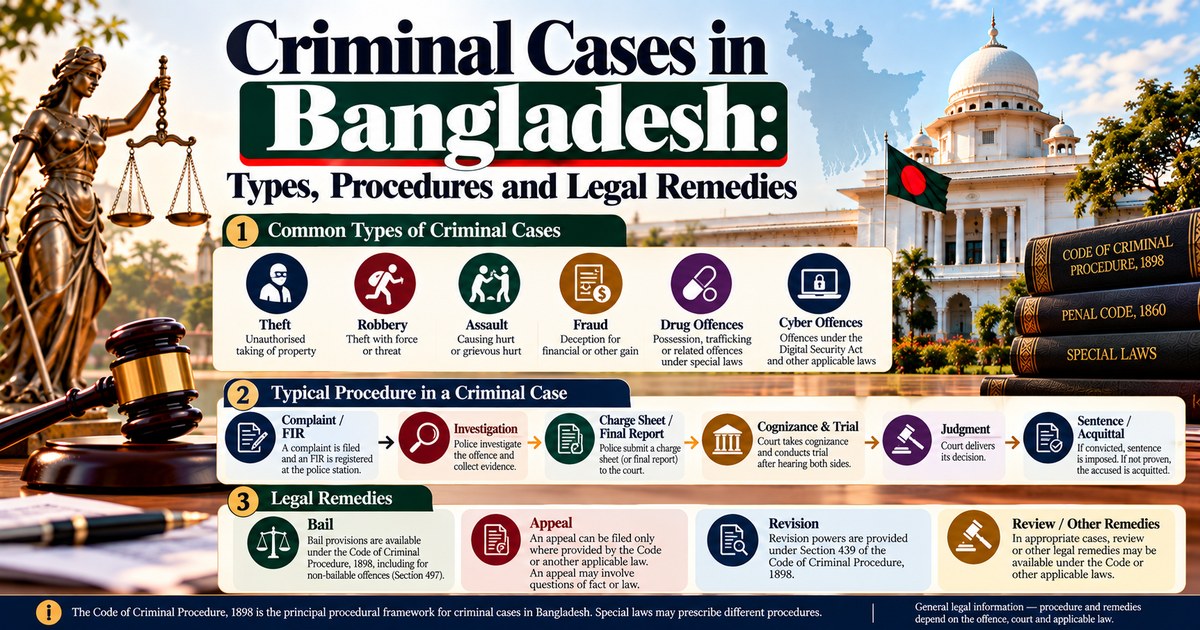
Criminal Cases in Bangladesh: Types, Procedures and Legal Remedies
A criminal case in Bangladesh is a legal proceeding concerning an act or omission treated as an offence under applicable criminal law. Criminal proceedings may involve the police, prosecution, accused person, witnesses and criminal courts, and can result in outcomes ranging from discharge or acquittal to conviction and punishment.
The principal procedural law is the Code of Criminal Procedure, 1898 (CrPC), while the Penal Code, 1860 contains many of the country's general criminal offences and punishments. Other special laws also create offences and prescribe separate procedures for particular matters.
This guide explains the types of criminal cases in Bangladesh, how a criminal case starts, the major stages of criminal proceedings, bail, trial procedure, possible outcomes and legal remedies available to an accused or other affected party.
What Is a Criminal Case in Bangladesh?
A criminal case is a proceeding in which a person is accused of committing an offence punishable under criminal law.
Examples can include allegations involving:
Murder or culpable homicide
Theft
Robbery
Cheating
Criminal breach of trust
Criminal intimidation
Hurt and assault
Forgery
Criminal misappropriation
Sexual offences
Offences involving property
Offences against public order
Offences under special criminal legislation
The Penal Code, 1860 contains a broad range of offences, while numerous special statutes also establish criminal offences and procedures.
Types of Criminal Cases in Bangladesh
Criminal proceedings can arise in different ways depending on the offence and the applicable law.
1. Police Cases
A criminal proceeding may begin with information provided to the police regarding a cognizable offence.
Section 154 of the CrPC provides the procedure for recording information relating to a cognizable offence at a police station.
This is commonly associated with what is popularly called an FIR or First Information Report.
The filing of an FIR does not itself establish the guilt of the accused. It begins the criminal investigation process.
2. Complaint Cases
A criminal proceeding may also originate from a complaint presented before a competent Magistrate.
Under section 190 of the CrPC, an empowered Magistrate may take cognizance of an offence upon:
A complaint of facts constituting the offence
A police report
Information from another person, or the Magistrate's own knowledge or suspicion, subject to the statutory requirements
A complaint case therefore does not necessarily begin with an FIR.
3. Special-Law Criminal Cases
Bangladesh has numerous special laws dealing with particular offences.
Depending on the legislation, these cases may have:
Special courts or tribunals
Special investigation procedures
Different rules of evidence or procedure
Different punishment provisions
Special appeal or revision mechanisms
Therefore, the procedure for a particular criminal case should always be checked against the specific law creating the offence, rather than relying solely on the general CrPC.
Criminal Courts in Bangladesh
Section 6 of the CrPC provides that, apart from the Supreme Court and courts constituted under other laws, there are two principal classes of criminal courts:
Courts of Session
Courts of Magistrates
The Code further identifies Judicial Magistrates and Executive Magistrates, with several classes of Judicial Magistrates.
The court competent to conduct a particular trial depends on the offence, applicable law and sentencing jurisdiction.
Magistrate Courts
Magistrates deal with many criminal proceedings and trials within the jurisdiction assigned to them by law.
Depending on the case, proceedings may involve:
Taking cognizance
Summons or warrants
Bail
Inquiry
Framing of charge
Recording evidence
Judgment
Sessions Courts
More serious offences may be tried by a Court of Session where the law gives that court jurisdiction.
In a Sessions trial, the prosecution is conducted by a Public Prosecutor. Section 265A of the CrPC expressly provides for this arrangement.
How Does a Criminal Case Start in Bangladesh?
A criminal case may begin through different routes.
A simplified process is:
Occurrence of alleged offence → Information/complaint → Investigation or Magistrate proceedings → Cognizance → Appearance/arrest/bail → Discharge or charge → Evidence → Examination of accused/defence → Arguments → Judgment → Appeal/revision or other remedy
The exact sequence depends on the type of case.
Step 1: Reporting the Offence
For a cognizable offence, information may be provided to the police.
Under section 154 CrPC, information relating to a cognizable offence given orally to the officer in charge of a police station must be reduced to writing, read over to the informant and signed by the person giving it.
For a non-cognizable offence, section 155 contains a different procedure, including reference to the Magistrate.
Step 2: Police Investigation
After a cognizable offence is reported, the police may investigate according to the CrPC.
Section 157 provides for investigation where the officer in charge has reason to suspect the commission of an offence that the police are empowered to investigate.
The investigation may involve:
Visiting the place of occurrence
Examining witnesses
Collecting documents
Collecting physical or electronic evidence
Recovering relevant objects
Arresting an accused where legally authorised
Recording relevant statements
Obtaining expert evidence where necessary
The objective is to investigate the allegations and collect evidence relevant to the offence.
Step 3: Investigation Report
After investigation, the police generally submit a report under section 173 CrPC.
Section 173 requires the investigation to be completed without unnecessary delay and provides for submission of a report to the Magistrate empowered to take cognizance on a police report.
Depending on the evidence and applicable procedure, the matter may proceed further against the accused, or the investigation may produce a result that does not support prosecution against a particular person.
Interim Investigation Report
The law now also contains section 173A, which permits an interim investigation report in specified circumstances.
Where such a report indicates insufficient evidence against an accused, the supervising police authority may direct submission of the report to the Magistrate, who may discharge that accused if the statutory conditions are satisfied. The investigation can nevertheless continue against other accused persons, and a person's name may subsequently be included if sufficient substantive evidence emerges.
Step 4: Taking Cognizance by the Court
Taking cognizance is an important stage in criminal proceedings.
Under section 190 CrPC, specified Magistrates may take cognizance upon:
A complaint
A police report
Certain other information or their own knowledge/suspicion as permitted by law
A Court of Session generally does not take cognizance as a court of original jurisdiction unless the accused has been sent to it by a Magistrate, subject to statutory exceptions. Section 193 addresses this issue.
Step 5: Summons, Warrant or Appearance
Depending on the case, the court may issue appropriate process requiring the accused to appear.
The procedure can involve:
Summons
Warrant
Appearance before the court
Arrest and production before the court
The precise procedure depends on the nature of the offence and the circumstances of the case.
Step 6: Arrest and the Rights of an Accused
Arrest does not mean that a person has been convicted.
The Constitution of Bangladesh provides important safeguards concerning arrest and detention.
Article 33 provides, among other protections, that an arrested person must be informed of the grounds of arrest as soon as may be and cannot be denied the right to consult and be defended by a legal practitioner of their choice. An arrested and detained person must generally be produced before the nearest Magistrate within 24 hours, excluding necessary journey time, unless further detention is authorised by a Magistrate.
The Constitution also provides protections concerning criminal trials and punishment, including the right of an accused person to a speedy and public trial by an independent and impartial court or tribunal established by law.
Step 7: Bail
Bail is one of the most important issues in criminal proceedings.
The CrPC distinguishes between bailable and non-bailable offences and contains provisions governing release on bail.
Bail in Bailable Offences
Section 496 provides the statutory framework concerning bail in bailable cases.
Bail in Non-Bailable Offences
Section 497 deals with bail in non-bailable cases.
The availability of bail depends on the statutory provisions, facts of the case, nature of the allegations, evidence and applicable judicial principles.
Bail Before the High Court Division or Court of Session
Section 498 provides powers concerning bail to the High Court Division and Court of Session, subject to the statutory framework.
Bail should therefore not be treated as an automatic acquittal. It is a decision concerning the accused's release during the proceedings.
Step 8: Discharge or Framing of Charge
After the relevant preliminary stages, the court may consider whether the case should proceed to trial.
Discharge in Magistrate Cases
Section 241A provides that where the Magistrate considers the charge groundless after considering the record and documents and hearing the prosecution and accused, the accused may be discharged with reasons recorded.
Framing of Charge
Under section 242, where the Magistrate considers that there is ground for presuming that the accused committed an offence, a formal charge is framed and the accused is asked whether they admit the offence.
Discharge in Sessions Cases
Section 265C provides for discharge in a Sessions trial where, after considering the record, documents and submissions, the Court considers that there is no sufficient ground for proceeding against the accused.
If the case is not discharged, the applicable procedure proceeds toward framing of charge and trial.
Step 9: Recording of Evidence
Once a criminal trial proceeds, evidence becomes a central part of the case.
Evidence may include:
Testimony of prosecution witnesses
Documentary evidence
Physical evidence
Medical evidence
Expert evidence
Electronic or digital evidence where legally admissible
Other evidence permitted by law
The prosecution bears the responsibility of proving the criminal charge according to the applicable law.
The defence has the opportunity to challenge the prosecution evidence and present its case according to the applicable procedure.
Step 10: Cross-Examination
Where witnesses testify, the opposing side may have the right to cross-examine them according to the rules applicable to the proceeding.
Cross-examination can be important because it may test:
Accuracy of testimony
Consistency
Personal knowledge
Credibility
Contradictions
Identification
Documentary support
Circumstances surrounding the alleged offence
Step 11: Defence of the Accused
After the prosecution evidence, the accused is given the opportunity to respond according to the applicable procedure.
The defence may challenge the prosecution's evidence and may produce evidence where appropriate.
The constitutional framework also protects an accused person from being compelled to be a witness against himself. Article 35(4) expressly provides this protection.
Step 12: Arguments
After the evidence is completed, the parties may present their legal arguments.
The prosecution generally explains why the evidence satisfies the requirements for conviction.
The defence may argue, among other things, that:
The prosecution failed to establish the required elements
Witness testimony is unreliable or inconsistent
Evidence is insufficient
The accused has been wrongly implicated
A legal defence applies
Required procedural safeguards were not followed
The precise scope of argument depends on the case.
Step 13: Judgment
At the conclusion of the trial, the court delivers judgment.
Section 366 CrPC provides that judgment in a trial before a Criminal Court of original jurisdiction is pronounced or its substance explained in open court, either immediately after the trial or at a subsequent notified time.
The possible result may include:
Acquittal
Conviction
Sentence
Discharge at an earlier stage
Other orders authorised by law
What Happens After Conviction?
If an accused is convicted, the court may impose the punishment prescribed by the applicable law.
Depending on the offence and statute, punishment may include:
Imprisonment
Fine
Imprisonment and fine
Other legally prescribed consequences
The applicable punishment depends on the specific offence and governing legislation.
For example, the Penal Code contains different punishment provisions for different offences, including offences against the human body, property and public order.
What Happens After Acquittal?
An acquittal generally means that the accused has not been convicted in that proceeding.
However, the law provides circumstances in which an appeal against acquittal may be available.
Section 417 CrPC contains provisions concerning appeals against acquittal, including appeals by the Government through the Public Prosecutor in specified circumstances and certain rights of appeal in complaint cases.
Therefore, an acquittal does not mean that every possible legal proceeding necessarily ends immediately.
Legal Remedies in Criminal Cases in Bangladesh
A criminal judgment or order may, depending on the circumstances, be challenged through several legal remedies.
1. Appeal
An appeal is a statutory remedy.
Section 404 CrPC provides that no appeal lies from a judgment or order of a Criminal Court except where provided by the Code or another applicable law.
An appeal may challenge issues such as:
Conviction
Sentence
Certain acquittals
Other appealable orders
The appellate court has powers prescribed by law, including powers concerning the conviction, acquittal, sentence or retrial in appropriate cases.
2. Revision
Revision is a separate supervisory remedy and is not simply another form of appeal.
The High Court Division and other courts have revisional powers under the CrPC in circumstances provided by law.
Revision may become relevant where there is a question concerning the correctness, legality or propriety of a proceeding, finding, sentence or order within the statutory framework.
3. Inherent Power of the High Court Division
Section 561A CrPC preserves the inherent power of the High Court Division to make orders necessary:
To give effect to an order under the Code
To prevent abuse of the process of a court
Otherwise to secure the ends of justice
This jurisdiction is distinct from an ordinary appeal and is exercised according to established legal principles.
4. Review
Review is not a general substitute for an appeal.
Whether review is available depends on the particular court, proceeding and applicable law. A lawyer should identify the precise statutory or constitutional basis before pursuing such a remedy.
Appeal vs Revision vs Inherent Jurisdiction
| Remedy | General purpose | Important point |
|---|---|---|
| Appeal | Challenge a decision where statute provides an appeal | Statutory right |
| Revision | Supervisory examination of specified proceedings/orders | Not simply a second appeal |
| Section 561A | Prevent abuse of process or secure ends of justice | Inherent High Court Division jurisdiction |
| Review | Reconsideration where applicable law permits | Limited remedy, not a substitute for appeal |
The availability and scope of each remedy depend on the specific order, stage and governing law.
Can a Criminal Case Be Quashed?
In appropriate circumstances, proceedings may be challenged before the High Court Division under its jurisdiction, including the inherent jurisdiction preserved by section 561A CrPC.
However, quashing is not an automatic remedy simply because an accused disputes the allegations.
The court examines whether the circumstances justify intervention under the applicable legal principles, including considerations concerning abuse of the court process and the ends of justice.
What Is the Difference Between a Criminal Case and a Civil Case?
The fundamental distinction is the nature of the legal wrong and the remedy sought.
| Criminal case | Civil case |
|---|---|
| Concerns an offence | Generally concerns private rights and obligations |
| State prosecution may be involved | Usually initiated by a claimant/plaintiff |
| Can result in criminal punishment | Usually results in civil remedies |
| Bail may become relevant | Bail generally does not operate in the same way |
| Conviction/acquittal may result | Judgment/decree may result |
| CrPC and relevant penal/special laws apply | CPC and relevant substantive laws commonly apply |
A single dispute can sometimes produce both civil and criminal proceedings, depending on the facts and applicable law.
How Long Does a Criminal Case Take in Bangladesh?
There is no single fixed duration for every criminal case.
The time may depend on:
Investigation
Arrest and bail proceedings
Service of process
Number of accused
Number of witnesses
Availability of witnesses
Documentary evidence
Expert evidence
Applications filed by the parties
Court schedule
Complexity of the case
Appeals or revisions
The Constitution recognises an accused person's right to a speedy and public trial, but this does not mean that every criminal case will conclude within a particular number of days or months.
What Should an Accused Person Do After Learning About a Criminal Case?
A person who learns that a criminal case has been filed against them should generally take the matter seriously and obtain legal advice promptly.
Important practical steps may include:
Obtain the case number and court information.
Find out the sections of law alleged.
Obtain available copies of the FIR, complaint or relevant court documents.
Consult a qualified criminal lawyer.
Determine whether arrest or bail issues arise.
Preserve relevant documents and evidence.
Avoid destroying, altering or fabricating evidence.
Comply with lawful court orders.
Discuss possible discharge, defence or other remedies with counsel.
Consider appeal or revision if an adverse order is passed and the law permits it.
What Should a Complainant or Victim Do?
A complainant or victim should also preserve relevant evidence and documentation.
This may include:
Medical records
Photographs
Videos
Messages
Emails
Financial records
Contracts
Receipts
Witness information
Previous complaints
Relevant court documents
Evidence should be preserved in its original form where possible.
A complainant should also understand that making an allegation is not the same as proving a criminal offence. The prosecution must establish the case according to the applicable law and evidentiary requirements.
Common Mistakes in Criminal Cases
Ignoring a Summons or Court Order
Ignoring court proceedings can create additional legal complications.
Assuming FIR Means Conviction
An FIR records information about an alleged cognizable offence. It is not a judicial finding of guilt.
Treating Bail as Acquittal
Bail concerns release during proceedings. It does not determine whether the accused is guilty.
Destroying Evidence
Destroying, altering or fabricating evidence can create additional legal consequences.
Giving False Information
A person should obtain legal advice before making statements or taking steps that could create further legal exposure.
Waiting Until the Last Moment to Seek Legal Advice
Criminal proceedings can involve time-sensitive decisions concerning arrest, bail, evidence and legal remedies.
Important Legal Rights of an Accused Person
The Constitution provides several important safeguards.
These include:
Protection concerning the grounds of arrest
Right to consult and be defended by a legal practitioner of choice
Production before a Magistrate within the constitutional time framework
Right to a speedy and public trial by an independent and impartial court or tribunal
Protection against being compelled to be a witness against oneself
Protection against double punishment for the same offence
Protection against torture or cruel, inhuman or degrading punishment or treatment
These constitutional safeguards operate alongside the statutory criminal procedure.
Frequently Asked Questions
What is a criminal case in Bangladesh?
A criminal case is a proceeding concerning an alleged offence punishable under criminal law. The Penal Code, 1860 and numerous special laws contain criminal offences, while the CrPC generally provides the procedural framework.
How is a criminal case started in Bangladesh?
It may begin through police information concerning a cognizable offence, a complaint before a Magistrate, or another legally recognised process. Section 190 CrPC identifies several bases upon which a Magistrate may take cognizance.
What is an FIR?
An FIR generally refers to the information recorded under section 154 CrPC concerning a cognizable offence. It initiates the relevant police-investigation process but does not itself establish guilt.
What is the difference between a police case and a complaint case?
A police case generally originates from information given to the police concerning a cognizable offence, while a complaint case may originate through a complaint presented before a Magistrate. The applicable procedure depends on the circumstances.
Can a person be arrested without being convicted?
Yes. Arrest and conviction are legally different concepts. Arrest may occur during investigation or proceedings where authorised by law, but guilt must be determined through the applicable judicial process.
What rights does an arrested person have in Bangladesh?
Article 33 of the Constitution provides safeguards concerning the grounds of arrest, access to legal counsel and production before a Magistrate within the prescribed constitutional period.
What is bail?
Bail is the legal mechanism through which an accused person may be released from custody subject to the applicable statutory requirements and conditions. The CrPC contains different provisions for bailable and non-bailable offences.
Can a criminal case be dismissed before trial?
In appropriate circumstances, an accused may be discharged at a preliminary stage. For example, section 241A provides for discharge in Magistrate cases where the statutory conditions are satisfied, while section 265C provides for discharge in Sessions cases in specified circumstances.
What happens after the police investigation?
The police generally submit a report under section 173 CrPC. The court then deals with the matter according to the applicable procedure, including cognizance and subsequent proceedings where appropriate.
Can an accused appeal against conviction?
An appeal may be available where the CrPC or another applicable law provides for one. Section 404 establishes that appeals from criminal judgments or orders must have a statutory legal basis.
What is criminal revision?
Revision is a supervisory legal remedy available under the statutory framework in specified circumstances. It is different from an ordinary appeal.
What is section 561A of the CrPC?
Section 561A preserves the inherent power of the High Court Division to make orders necessary to give effect to the Code, prevent abuse of the process of a court or otherwise secure the ends of justice.
Can a criminal case and civil case exist at the same time?
Yes, depending on the facts and applicable law. The same underlying events can sometimes give rise to both criminal liability and separate civil rights or remedies.
Final Takeaway
A criminal case in Bangladesh can involve several stages, beginning with an FIR, complaint or other legally recognised initiation process and potentially continuing through investigation, cognizance, bail, discharge or charge, evidence, arguments, judgment and appellate or revisional proceedings.
The most important points to remember are:
Criminal offences arise under the Penal Code and other special laws.
The CrPC provides the principal general procedural framework.
Criminal cases may begin through police information or a complaint before a Magistrate.
Arrest does not mean conviction.
Bail and acquittal are legally different concepts.
An accused has constitutional protections concerning arrest, legal representation and fair criminal proceedings.
Discharge may be available at specified stages.
Convictions and certain other decisions may be challenged through appeal or other statutory remedies.
The High Court Division has inherent jurisdiction under section 561A in appropriate cases.
The exact procedure depends on the offence, court, evidence and applicable special legislation.
Because criminal law can involve serious consequences, anyone involved as an accused, complainant or victim should obtain case-specific advice from a qualified advocate rather than relying solely on a general online guide.
Authoritative Legal Sources
Code of Criminal Procedure, 1898 — Bangladesh Laws
Penal Code, 1860 — Bangladesh Laws
Constitution of Bangladesh — Bangladesh Laws
Bangladesh Judiciary — Fundamental Rights
Disclaimer: This article provides general legal information about criminal proceedings in Bangladesh and is not a substitute for case-specific legal advice. Criminal laws and procedures may be amended, and special laws may prescribe different procedures. The applicable law should be verified at the time of taking legal action.