

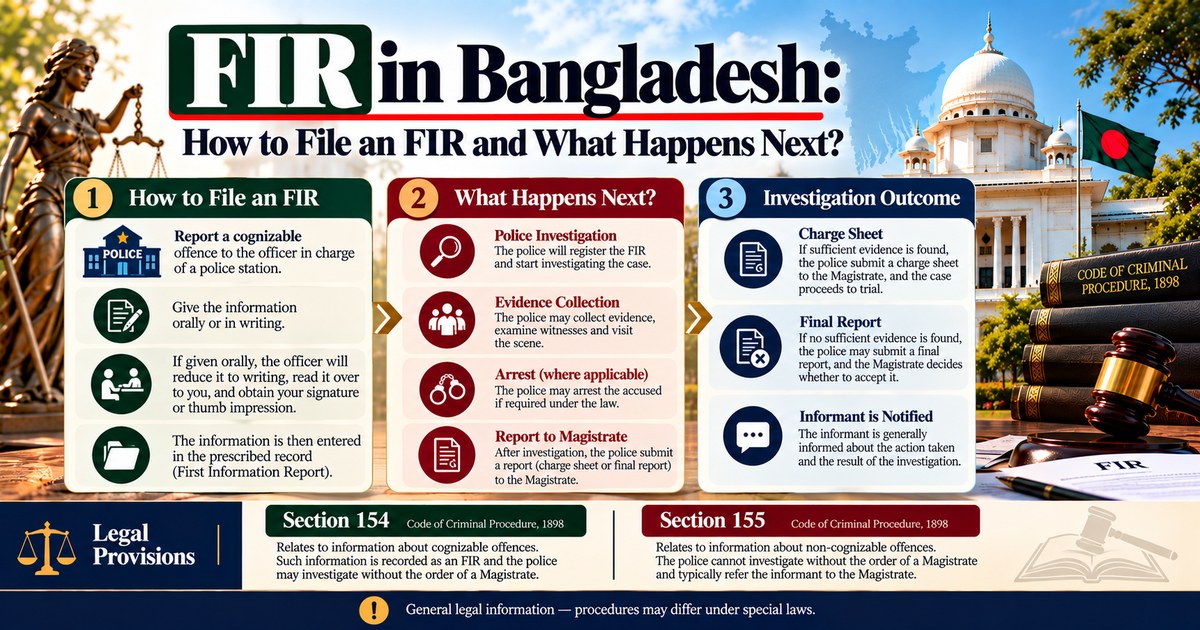
FIR in Bangladesh: How to File an FIR and What Happens Next?
If you are the victim of a crime or have information about an alleged criminal offence, one of the first legal steps may be to approach the police and provide information about the incident. In Bangladesh, this process is commonly associated with filing an FIR (First Information Report).
An FIR is particularly important in cases involving cognizable offences. Section 154 of the Code of Criminal Procedure, 1898 (CrPC) provides the statutory framework for recording information relating to a cognizable offence at a police station. The law also distinguishes cognizable offences from non-cognizable offences and provides different procedures for each.
However, filing an FIR does not mean that the accused has been found guilty. An FIR starts or supports the criminal investigation process; guilt can only be determined through the applicable judicial process.
This guide explains how to file an FIR in Bangladesh, what information should be included, what happens after an FIR is registered, what happens during police investigation, and what legal options may be available if the police do not take appropriate action.
What Is an FIR in Bangladesh?
An FIR is commonly understood as the First Information Report concerning a cognizable offence.
Section 154 CrPC provides that when information relating to the commission of a cognizable offence is given orally to the officer in charge of a police station, it must be reduced to writing by the officer or under their direction. It must then be read over to the informant and signed by the person giving the information, with its substance entered in the prescribed police record.
In simple terms:
Alleged cognizable offence → Information to police → FIR recorded → Police investigation
An FIR is therefore an important starting point for a police-investigation process.
What Is a Cognizable Offence?
Whether an FIR can be registered under section 154 depends in part on whether the alleged offence is cognizable.
The CrPC defines a cognizable offence as an offence for which a police officer may, according to the Second Schedule or another applicable law, arrest without warrant.
The classification of an offence should therefore be checked against the applicable criminal law rather than assumed from the seriousness of the allegation alone.
Who Can File an FIR?
The person providing the information to the police is commonly called the informant.
Depending on the circumstances, the informant may be:
The victim
A family member
A person who witnessed the incident
Another person who has information about the alleged offence
Another person legally entitled to provide the information
The informant does not necessarily have to be the victim personally.
What matters is that the information concerns an alleged offence and is provided through the legally applicable procedure.
Where Should an FIR Be Filed?
An FIR is generally made at the police station having jurisdiction over the relevant area, subject to the applicable law and circumstances.
Section 156 CrPC provides that an officer in charge of a police station may investigate a cognizable case that a court having jurisdiction over the local area would have power to inquire into or try.
Jurisdiction can sometimes become complicated where:
The offence occurred in more than one location
Different parts of the offence occurred in different places
The consequences occurred in another location
The applicable special law contains different jurisdictional provisions
If there is uncertainty about jurisdiction, legal advice can help determine the appropriate procedural route.
How to File an FIR in Bangladesh
A simplified process is:
Prepare accurate information → Approach the appropriate police station → Provide the information → Police record it under section 154 where applicable → Read and verify the written information → Sign it → Obtain the relevant case/reference details → Investigation follows
Step 1: Prepare the Facts
Before going to the police station, organise the essential facts.
Write down:
Date of the incident
Approximate time
Exact or identifiable location
What happened
Names of persons involved, if known
Names of witnesses, if known
Description of injuries or property damage
Relevant documents
Relevant photographs or videos
Relevant electronic communications
Other information that may help identify the alleged offence
The information should be truthful and based on facts known to the informant.
Step 2: Approach the Police Station
Provide the information to the officer in charge or the appropriate police officer at the relevant police station.
If the information concerning a cognizable offence is given orally, section 154 requires the police to reduce it to writing, read it over to the informant and obtain the informant's signature.
Step 3: Carefully Check the Recorded Information
If your information has been written down by the police, carefully check the recorded version.
Make sure important facts have not been incorrectly recorded or omitted.
Particular attention should be paid to:
Names
Dates
Times
Location
Description of the incident
Relevant property
Injuries
Identity of suspects
Witness information
Under section 154, information given orally must be read over to the informant before it is signed.
Step 4: Sign the Information
The statutory procedure requires the person giving the information to sign it after it has been reduced to writing and read over where the information was given orally.
Do not sign a document containing information that you know is incorrect.
Step 5: Keep the Case Information
After registration, keep the relevant information relating to the police case, including the case number and police-station details.
These details may later be required for:
Court proceedings
Bail applications
Legal consultations
Obtaining documents
Following the investigation
Other legal remedies
What Information Should an FIR Contain?
There is no need to fill an FIR with unnecessary legal arguments.
The important thing is to provide a clear and accurate factual account.
Depending on the circumstances, relevant information may include:
Identity of the Informant
Include the informant's relevant identifying details.
Date and Time
State when the incident occurred, as accurately as possible.
Place of Occurrence
Identify where the alleged offence occurred.
Description of the Incident
Explain what happened in chronological order.
Identity of Suspected Persons
Provide names and identifying information where known.
Witness Information
Provide the names or identifying information of people who may have relevant knowledge.
Evidence
Mention relevant evidence such as:
Documents
Photographs
Videos
CCTV footage
Messages
Emails
Medical records
Financial records
Other relevant materials
The precise evidence required depends on the alleged offence.
Should You Mention the Exact Section of Law?
It is generally more important for the informant to accurately describe the facts than to attempt to determine every applicable legal provision independently.
The police and later the court determine the legal classification based on the facts and applicable law.
Incorrectly naming a legal section does not necessarily determine the ultimate legal classification of the case.
A lawyer can help identify potentially applicable provisions where the circumstances are complicated.
Can an FIR Be Filed Orally?
Yes.
Section 154 specifically provides for information relating to a cognizable offence being given orally to the officer in charge of a police station. In that situation, the information must be reduced to writing, read over to the informant and signed.
Therefore, the law does not require the initial information to always originate as a document personally drafted by the informant.
Can an FIR Be Filed in Writing?
Yes.
Section 154 also covers information given in writing. The substance must be entered into the prescribed police record.
A written complaint can therefore be presented to the police, subject to the applicable procedure.
What Happens After an FIR Is Filed?
Filing an FIR is generally only the beginning of the criminal process.
A simplified sequence is:
FIR → Investigation → Evidence collection → Police report → Court proceedings → Trial → Judgment
The exact procedure depends on the offence and circumstances.
Step 1: Police Investigation
For a cognizable case, section 156 allows the officer in charge of a police station to investigate without obtaining an order from a Magistrate, provided the statutory jurisdictional requirements are satisfied.
The investigation may involve:
Visiting the place of occurrence
Examining witnesses
Collecting documents
Collecting physical evidence
Recovering relevant objects
Examining electronic evidence
Taking statements
Obtaining medical or expert evidence where appropriate
Identifying suspected persons
Taking lawful measures concerning arrest where the statutory requirements are met
The purpose is to investigate the allegations and collect relevant evidence.
Step 2: Police Report to the Magistrate
Section 157 provides that where the police have reason to suspect the commission of an offence they are empowered to investigate, the officer in charge must send a report to the Magistrate empowered to take cognizance and proceed with the investigation according to law.
This illustrates that an FIR is not itself the final criminal proceeding.
It is part of the process through which the alleged offence enters the criminal justice system.
Step 3: Arrest, Where Legally Permitted
An FIR does not automatically mean that every accused person must be arrested.
Arrest powers are governed by the CrPC and other applicable laws.
The current section 54 framework contains specific conditions governing when police may arrest without a warrant, including different requirements depending on the potential punishment for the alleged cognizable offence and the circumstances making arrest necessary.
Therefore:
FIR ≠ Automatic Arrest
Whether an arrest is lawful depends on the applicable statutory requirements and circumstances.
Step 4: Bail
If an accused is arrested or otherwise required to seek release from custody, the provisions concerning bail may become relevant.
The CrPC distinguishes between bailable and non-bailable offences and provides separate statutory rules concerning bail.
The availability of bail depends on the offence, facts, evidence, procedural stage and applicable law.
Step 5: Police Report After Investigation
Section 173 CrPC provides that an investigation under the relevant chapter should be completed without unnecessary delay and that, when completed, the officer in charge should forward a report to the appropriate Magistrate. The report contains prescribed information about the parties, nature of the information and persons acquainted with the circumstances, among other matters.
The police report is therefore an important stage after the FIR and investigation.
What Is a Charge Sheet?
A charge sheet is commonly used to describe a police report indicating that, after investigation, there is a basis for proceeding against an accused person.
However, the terminology and precise procedural consequences depend on the applicable law and court process.
The important distinction is:
FIR → Information about alleged offence
Investigation → Police collect evidence
Police report → Investigation findings are submitted to court
Charge → Court formally identifies the accusation to be tried
An FIR is therefore not the same as a charge sheet.
Can the Police Submit a Report Against an Accused?
Yes.
Following investigation, the police may submit the report required under section 173.
The ultimate judicial process does not simply depend on the title of the police report. The Magistrate and, where applicable, the trial court deal with the matter according to law.
What Is an Interim Investigation Report?
Bangladesh's current CrPC also contains section 173A, introduced by the 2026 amendment.
Under section 173A, before completion of an investigation, specified senior police authorities may require an interim investigation report. Where that report shows insufficient evidence against an accused, the supervising authority may direct submission of the report to the Magistrate, who may discharge that accused if satisfied and subject to the statutory conditions. The investigation may continue against other accused persons, and a person discharged at this stage may subsequently be included in the final police report if sufficient substantive evidence emerges.
This is an important recent development in Bangladesh's criminal procedure.
Does an FIR Prove the Accused Is Guilty?
No.
This is one of the most important points to understand.
An FIR contains information about an alleged offence.
It is not:
A conviction
A final finding of guilt
Conclusive proof of the allegations
A substitute for trial
The prosecution must establish criminal liability according to the applicable law and evidence.
Therefore:
FIR ≠ Conviction
FIR ≠ Proof of Guilt
What If the Police Refuse to Register an FIR?
This can be a serious procedural issue.
Where information concerns a cognizable offence, section 154 establishes the statutory framework for recording that information. If the police do not take appropriate action, the circumstances should be examined carefully.
Section 156(3) provides that a Magistrate empowered under section 190 may order an investigation of a cognizable case.
Depending on the circumstances, a person may therefore have legal options involving the Magistrate.
The appropriate remedy can depend on:
The nature of the alleged offence
Whether it is cognizable
What was reported to police
Whether the police made any entry
Whether an investigation has begun
Whether a complaint has already been filed
Whether a special law applies
A lawyer can help determine the appropriate procedural step.
What If the Police Say the Offence Is Non-Cognizable?
The procedure is different.
Section 155 CrPC provides that when information concerns a non-cognizable offence, the police are to enter the substance of the information in the prescribed record and refer the informant to the Magistrate. Police generally cannot investigate a non-cognizable case without the order of a competent Magistrate, subject to the statutory framework.
Therefore, a person should first determine whether the alleged offence is legally classified as cognizable.
FIR vs GD: What Is the Difference?
An FIR and a General Diary (GD) entry are not the same thing.
An FIR under section 154 concerns information relating to a cognizable offence.
A GD entry serves a different recording function within the police system.
Therefore:
GD ≠ FIR
Making a GD entry does not automatically mean that an FIR has been registered.
Where a person believes that a cognizable offence has occurred, they should understand the distinction and take the appropriate legal step.
Can an FIR Be Filed Against an Unknown Person?
Yes, an informant can provide information about an offence even where the identity of the offender is not yet known.
The investigation may then seek to identify the person responsible.
An FIR should not contain a person's name merely because the informant wants someone accused. The information should be based on facts honestly known to the informant.
Can More Than One Person Be Named in an FIR?
Potentially, yes.
Where the facts support allegations against multiple persons, the information may identify them.
However, simply naming a person in an FIR does not establish their guilt.
Each person's potential criminal liability must ultimately be assessed according to the evidence and applicable law.
Can an FIR Be Changed Later?
An FIR is an important initial record of information and should be accurate when given.
If additional facts emerge during investigation, those matters can be dealt with through the investigation and subsequent legal process.
A person should not attempt to fabricate, manipulate or deliberately distort facts merely to strengthen a case.
Where an important factual error exists in the original information, legal advice should be obtained concerning the appropriate way to address it.
Can an FIR Be Withdrawn?
There is no simple general rule that an informant can always "withdraw an FIR" merely by asking the police to cancel it.
Once a criminal case is registered, the investigation and subsequent judicial process are governed by law.
The possibility of ending or altering proceedings depends on:
The offence
Stage of investigation
Evidence
Applicable law
Whether the offence is compoundable
Court jurisdiction
Any special statutory provisions
In appropriate cases, other legal remedies may be available.
Can an FIR Be Quashed?
In appropriate circumstances, criminal proceedings may be challenged before the High Court Division under its applicable jurisdiction.
Section 561A CrPC preserves the inherent power of the High Court Division to make orders necessary to give effect to the Code, prevent abuse of the process of a court or otherwise secure the ends of justice.
However, quashing is not an automatic consequence of filing an application. The court considers the facts and applicable legal principles.
What Evidence Should You Preserve After Filing an FIR?
Evidence can become extremely important during investigation and trial.
Depending on the case, preserve:
Original documents
Receipts
Contracts
Bank records
Medical reports
Photographs
Videos
CCTV footage
Emails
Text messages
Social-media communications
Call-related records where lawfully obtained
Location-related records where relevant
Names and contact details of witnesses
Do not edit, fabricate or destroy evidence.
Where electronic evidence is important, preserving the original data and metadata where possible can be particularly useful.
What Should You Do After Filing an FIR?
After the FIR is registered, consider taking the following practical steps:
1. Keep the Case Details
Record the police station, case number and relevant dates.
2. Preserve Evidence
Keep original documents and relevant digital evidence safely.
3. Maintain a Chronology
Prepare a timeline of the events while the details are fresh.
4. Identify Witnesses
Maintain accurate information about people who may have relevant knowledge.
5. Keep Medical Records
If injuries are involved, preserve medical reports, prescriptions and related records.
6. Consult a Lawyer Where Necessary
A lawyer can help explain:
Applicable offences
Investigation procedure
Bail issues
Evidence
Court proceedings
Possible legal remedies
7. Avoid Contact That Could Complicate the Case
Particularly in contentious criminal matters, avoid threats, intimidation or attempts to influence witnesses.
Common Mistakes When Filing an FIR
Including False Information
Knowingly making false allegations can create legal consequences.
Exaggerating the Incident
The safest approach is to provide an accurate factual account rather than exaggerating allegations.
Omitting Important Facts
Important information should be communicated clearly.
Signing Without Reading
Where information is reduced to writing under section 154, the informant should read or have it read over before signing.
Assuming FIR Means Conviction
It does not.
Assuming FIR Automatically Means Arrest
It does not.
Destroying Evidence
This can seriously damage a case and may create additional legal issues.
Ignoring Legal Notices or Court Orders
Once the matter enters the judicial process, court documents should be addressed promptly.
FIR Filing Checklist in Bangladesh
Before approaching the police, prepare:
Informant's identification details
Date and time of incident
Place of incident
Clear factual description
Names of suspected persons, if known
Witness information
Injury details
Property details
Relevant documents
Photographs/videos
Electronic evidence
Medical records, where applicable
Any previous relevant police or court records
The exact requirements depend on the nature of the alleged offence.
FIR vs Criminal Complaint
An FIR should also be distinguished from a criminal complaint before a Magistrate.
| FIR | Criminal Complaint |
|---|---|
| Given to police | Presented to Magistrate |
| Primarily associated with cognizable offences | Complaint procedure under CrPC |
| Section 154 is central | Sections 190, 200 and 202 may become relevant |
| Police investigation normally follows | Magistrate may conduct or direct inquiry/investigation as provided by law |
| Police report may follow investigation | Judicial complaint process follows |
A criminal complaint is legally defined as an allegation made orally or in writing to a Magistrate seeking action under the CrPC, excluding a police report.
How Long Does FIR Investigation Take?
There is no single universal period that applies to every FIR.
Section 173 states that an investigation under the relevant chapter should be completed without unnecessary delay and that a police report should be forwarded upon completion.
The actual duration may depend on:
Number of accused
Number of witnesses
Availability of witnesses
Volume of evidence
Medical or forensic examination
Digital evidence
Property recovery
Inter-district or international elements
Complexity of the alleged offence
Court-related proceedings
Therefore, it is not appropriate to promise that every FIR will be investigated within a particular number of days.
Does the FIR End When the Police Submit a Report?
No.
The police report is an important stage after investigation, but the criminal proceeding may continue before the court.
Depending on the case, subsequent stages can include:
Police report → Cognizance → Appearance/production → Discharge or charge → Evidence → Arguments → Judgment → Appeal/revision or other remedy
The exact procedure depends on the offence and applicable law.
What Happens if There Is Not Enough Evidence?
The consequences depend on the stage and applicable law.
The 2026 amendment introducing section 173A provides an interim-investigation mechanism under which, in specified circumstances, an accused may be discharged if an interim report shows insufficient evidence, while the investigation can continue against others and the person's name can later be included if sufficient substantive evidence emerges.
The final outcome of a criminal proceeding depends on the evidence and judicial process.
Frequently Asked Questions
What is an FIR in Bangladesh?
An FIR is commonly understood as the first formal police record of information concerning a cognizable offence. Section 154 CrPC sets out the procedure for recording such information.
Which section of the law deals with FIRs?
Section 154 of the Code of Criminal Procedure, 1898 deals with information relating to cognizable offences given to the officer in charge of a police station.
Can I file an FIR orally?
Yes. Section 154 expressly provides for information given orally to the officer in charge, which must then be reduced to writing, read over to the informant and signed.
Can I submit a written FIR?
Written information concerning a cognizable offence can be provided to the police, subject to the applicable procedure under section 154.
Does filing an FIR mean the accused is guilty?
No. An FIR records information about an alleged offence. Guilt must be determined through the applicable criminal justice process.
Does an FIR automatically lead to arrest?
No. Arrest without warrant is governed by statutory requirements. The current section 54 framework contains specific conditions concerning arrest in cognizable cases.
What happens after an FIR is filed?
The police may investigate the alleged cognizable offence. Under section 157, the officer in charge proceeds with investigation where there is reason to suspect an offence within their investigative power.
What happens after the investigation?
The police generally submit a report under section 173 CrPC to the appropriate Magistrate after completing the investigation.
What if the police refuse to register an FIR?
Where the alleged offence is cognizable, section 154 provides the relevant statutory framework. Depending on the circumstances, a Magistrate may also have power under section 156(3) to order an investigation.
Can an FIR be filed for a non-cognizable offence?
The procedure is different. Section 155 requires the police to enter information concerning a non-cognizable offence and refer the informant to the Magistrate; police investigation generally requires a Magistrate's order.
Can an FIR be filed against an unknown person?
Yes. The identity of the alleged offender does not necessarily have to be known before information about the offence can be provided to the police.
Is an FIR the same as a criminal complaint?
No. An FIR is associated with information provided to the police concerning a cognizable offence, while a criminal complaint is an allegation made to a Magistrate seeking action under the CrPC.
Is an FIR the same as a GD?
No. An FIR and a General Diary entry have different legal and procedural functions.
Can an FIR be cancelled?
There is no universal rule allowing an informant simply to cancel an FIR on request. The available mechanisms depend on the offence, evidence, stage of proceedings and applicable law.
Can an FIR be quashed?
In appropriate circumstances, criminal proceedings may be challenged before the High Court Division under its applicable jurisdiction, including the inherent jurisdiction preserved by section 561A CrPC. Whether intervention is appropriate depends on the facts and law.
How long does an FIR case take?
There is no universal duration. Investigation should be completed without unnecessary delay under section 173, but the actual time depends on the complexity of the case, evidence, witnesses and other circumstances.
Final Takeaway
An FIR in Bangladesh is an important part of the criminal justice process, particularly where information concerns a cognizable offence.
Under section 154 CrPC, information about a cognizable offence given to the officer in charge of a police station must be recorded according to the statutory procedure. The police may then investigate under sections 156 and 157, collect evidence and ultimately submit a report under section 173.
The most important points are:
An FIR concerns information about an alleged cognizable offence.
It can be based on information given orally or in writing.
The information should be accurate and factual.
The informant should carefully verify the written information before signing.
Filing an FIR does not establish the accused's guilt.
An FIR does not automatically require arrest.
Police investigation follows according to the applicable law.
A police report is submitted after investigation.
If the police do not take appropriate action, legal remedies may be available, including approaching a competent Magistrate in appropriate circumstances.
Recent amendments to the CrPC have introduced additional investigation and arrest-related provisions that should be considered when dealing with a current case.
Because criminal proceedings can have significant consequences, a person involved in an FIR should consider obtaining advice from a qualified criminal lawyer in Bangladesh, particularly where arrest, bail, serious offences, disputed evidence or court proceedings are involved.
Authoritative Legal Sources
Code of Criminal Procedure, 1898 — Bangladesh Laws
Section 154 — Information in Cognizable Cases
Section 173 — Report of Police Officer
Code of Criminal Procedure (Amendment) Act, 2026
Disclaimer: This article provides general legal information about FIR procedure in Bangladesh and is not a substitute for case-specific legal advice. Criminal procedure may differ under special legislation, and the applicable law should be verified at the time of taking legal action.