

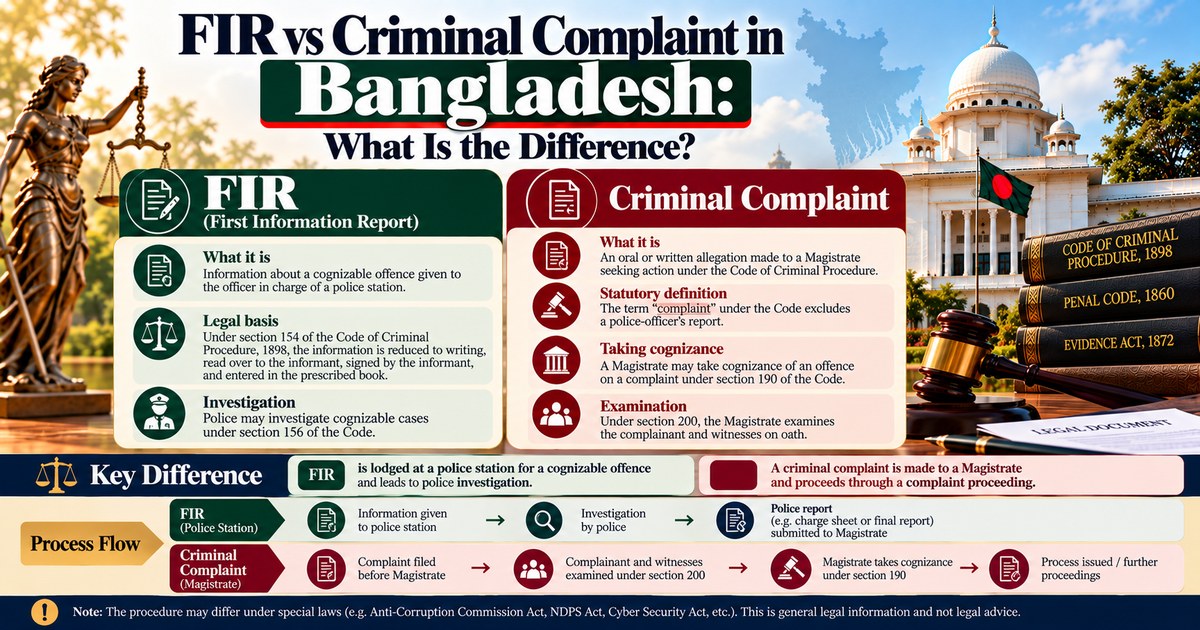
FIR vs Criminal Complaint in Bangladesh: What Is the Difference?
When a person becomes the victim of a crime in Bangladesh, one of the first questions is often whether they should file an FIR at the police station or submit a criminal complaint before a Magistrate.
Although the terms are sometimes used interchangeably in everyday conversation, an FIR and a criminal complaint are legally different. The distinction is important because they are made to different authorities, follow different procedural routes, and can lead to investigation or court proceedings in different ways.
Under the Code of Criminal Procedure, 1898 (CrPC), information relating to a cognizable offence is recorded by the police under section 154, while the Code separately defines a "complaint" as an allegation made orally or in writing to a Magistrate with a view to taking action under the Code.
This guide explains the difference between an FIR and a criminal complaint in Bangladesh, how each process works, when each may be used, and what can happen after filing.
What Is an FIR in Bangladesh?
FIR commonly means First Information Report.
In Bangladesh, the statutory provision most closely associated with an FIR is section 154 of the Code of Criminal Procedure, 1898.
Section 154 provides that when information relating to the commission of a cognizable offence is given orally to the officer in charge of a police station, the information must be reduced to writing by the officer or under their direction, read over to the informant and signed by the person giving it. The substance is then entered in the prescribed police record.
An FIR is therefore essentially the formal recording of information concerning a cognizable offence that triggers the police-investigation process.
What Is a Cognizable Offence?
The CrPC defines a cognizable offence as an offence for which, according to the Second Schedule or another applicable law, a police officer may arrest without warrant.
Whether an offence is cognizable depends on the applicable criminal law and classification.
What Is a Criminal Complaint?
A criminal complaint is legally different from an FIR.
Section 4(h) of the CrPC defines "complaint" as an allegation made orally or in writing to a Magistrate, with a view to the Magistrate taking action under the Code, alleging that a person, whether known or unknown, has committed an offence.
Importantly, the statutory definition expressly states that a complaint does not include a report made by a police officer.
In simple terms:
FIR → Police
Criminal complaint → Magistrate
That is the fundamental distinction.
FIR vs Criminal Complaint: Key Differences
| Issue | FIR | Criminal Complaint |
|---|---|---|
| Made before | Police | Magistrate |
| Main statutory provision | Section 154 CrPC | Sections 190 and 200 CrPC, among others |
| Usually concerns | Cognizable offence | Allegation of an offence brought before Magistrate |
| Investigation | Police investigation may follow | Magistrate may proceed under complaint procedure and may order inquiry/investigation in appropriate circumstances |
| Who records/receives it? | Officer in charge of police station | Magistrate |
| Initial purpose | Set the criminal investigation in motion | Seek judicial action regarding alleged offence |
| Police involvement | Usually central from the beginning | May arise later depending on the Magistrate's order/procedure |
| Result | May lead to police report and subsequent court proceedings | May lead to issuance of process, inquiry/investigation, or other proceedings |
The exact procedure can vary depending on the offence and any applicable special law.
FIR vs Complaint: The Most Important Legal Difference
The most important distinction is who receives the information and what statutory process follows.
FIR
An FIR is associated with information given to the police concerning a cognizable offence under section 154 CrPC.
Criminal Complaint
A complaint is an allegation presented to a Magistrate under the complaint procedure.
Section 190 CrPC allows specified Magistrates to take cognizance of an offence upon receiving a complaint, upon a police report, or in certain circumstances upon other information or the Magistrate's own knowledge or suspicion.
Therefore, "complaint" and "FIR" are not two names for the same document.
How Does an FIR Work in Bangladesh?
A simplified FIR-based process can be represented as:
Offence → Information to police → FIR → Police investigation → Police report → Magistrate takes cognizance → Court proceedings → Trial → Judgment
The exact sequence can vary depending on the case.
Step 1: Information Is Given to the Police
The informant provides information about the alleged cognizable offence.
If the information is given orally, section 154 requires the police to reduce it to writing, read it over to the informant and obtain the informant's signature.
Step 2: Police Investigation
After receiving information concerning a cognizable offence, the police may investigate according to the CrPC.
Section 157 provides for investigation where the officer in charge has reason to suspect the commission of an offence that they are empowered to investigate.
The investigation may involve:
Examining witnesses
Visiting the place of occurrence
Collecting documents
Collecting physical evidence
Recovering relevant objects
Recording statements
Taking other investigative steps authorised by law
Step 3: Police Report
Following investigation, the police may submit a report under section 173 CrPC.
The subsequent judicial process depends on the contents of the report and the court's consideration of the matter.
How Does a Criminal Complaint Work?
The complaint procedure follows a different route.
A simplified process is:
Alleged offence → Complaint before Magistrate → Examination/inquiry where applicable → Cognizance → Process or further inquiry/investigation → Court proceedings → Trial → Judgment
Step 1: Complaint Before the Magistrate
The complainant presents the allegation to a Magistrate who is legally empowered to take cognizance.
Section 190(1)(a) expressly allows a Magistrate to take cognizance upon receiving a complaint of facts constituting an offence.
Step 2: Examination of the Complainant
Section 200 CrPC provides that a Magistrate taking cognizance on complaint generally examines the complainant and witnesses present, if any, on oath, subject to the statutory exceptions. The substance of the examination is recorded and signed as required by law.
This is an important difference from an ordinary FIR-based process, which begins with information being recorded by the police.
Step 3: Further Inquiry or Investigation
The Magistrate may, in appropriate circumstances, postpone issuing process against the person complained against.
Section 202 permits the Magistrate, for reasons recorded in writing, to inquire into the case or direct an inquiry or investigation for the purpose of determining the truth or falsehood of the complaint, subject to the statutory requirements.
Step 4: Further Proceedings
Depending on the facts and the applicable law, the Magistrate may proceed with the complaint according to the CrPC.
The court may ultimately issue process against the accused if the legal requirements are satisfied.
Does an FIR Automatically Mean a Criminal Case Has Been Proved?
No.
An FIR records information concerning an alleged cognizable offence. It is not a judgment and does not establish that the accused is guilty.
The police must investigate the allegations, and the court ultimately determines criminal liability according to the applicable law and evidence.
Therefore:
FIR ≠ Conviction
FIR ≠ Proof of Guilt
FIR = Formal recording of information concerning an alleged cognizable offence
Does Filing a Criminal Complaint Mean the Accused Is Guilty?
No.
A complaint is an allegation presented to the Magistrate. The filing of a complaint does not itself establish criminal liability.
The Magistrate must follow the applicable legal procedure, and if the matter proceeds to trial, guilt must be determined according to the applicable law and evidence.
Therefore:
Complaint ≠ Conviction
A person named in a complaint remains an accused unless and until guilt is established through the applicable judicial process.
Can an FIR Be Filed for a Non-Cognizable Offence?
The procedure is different.
Section 155 CrPC provides that when information is given to the officer in charge of a police station regarding a non-cognizable offence, the officer must enter the substance of the information in the prescribed record and refer the informant to the Magistrate.
The distinction between cognizable and non-cognizable offences is therefore important when deciding what procedural route is available.
Can a Criminal Complaint Be Filed Without an FIR?
Yes.
A criminal complaint before a Magistrate is a separate mechanism from an FIR.
The CrPC expressly allows a Magistrate to take cognizance upon receiving a complaint under section 190(1)(a).
Therefore, an FIR is not a mandatory prerequisite for every criminal proceeding.
However, whether a particular dispute should proceed through a police case, complaint case or another statutory mechanism depends on the facts and applicable law.
What Happens If the Police Do Not Record an FIR?
This is an important practical issue.
Where the allegations concern a cognizable offence, section 154 provides the statutory framework for recording the information.
The CrPC also provides that a Magistrate empowered under section 190 may order an investigation under the relevant provisions. Section 156(3) is particularly important in this context.
The appropriate legal step depends on:
Nature of the alleged offence
Whether it is cognizable
What information was submitted
Whether the police have already taken action
The available evidence
The applicable special law
A person should obtain legal advice before deciding which procedural remedy to pursue.
Can a Magistrate Order a Police Investigation?
Yes, in circumstances provided by law.
Section 156(3) CrPC permits a Magistrate empowered under section 190 to order an investigation of a cognizable case in accordance with the statutory framework.
This illustrates why the distinction between a police case and a complaint case is not always absolute in terms of what ultimately happens: a complaint before a Magistrate can, in appropriate circumstances, lead to police investigation.
FIR vs Complaint: Which One Should You File?
There is no universal answer.
The appropriate route depends on the nature of the offence and the circumstances of the dispute.
An FIR may be relevant when:
The allegation concerns a cognizable offence.
Police investigation is appropriate.
Immediate investigative steps may be required.
The facts fall within the police's investigative jurisdiction.
A complaint before a Magistrate may be relevant when:
The complainant seeks to invoke the Magistrate's jurisdiction.
The matter is appropriate for the complaint procedure.
The statutory requirements for a complaint case are satisfied.
The complainant seeks judicial action in circumstances where the complaint route is legally available.
The choice should be based on the law rather than simply which process appears faster or easier.
Can the Same Incident Lead to Both an FIR and a Complaint?
Potentially, yes, but the procedural consequences depend heavily on the facts.
For example, an allegation may initially be brought to the police, while a complainant may subsequently approach a Magistrate concerning the same underlying events.
However, a person should not assume that filing multiple proceedings concerning the same facts is automatically permissible or strategically appropriate.
Questions of:
Prior proceedings
Cognizance
Investigation
Jurisdiction
Abuse of process
Double jeopardy
Special statutory procedures
may become relevant.
Legal advice should therefore be obtained before initiating parallel proceedings.
FIR vs Criminal Complaint: Procedure Comparison
FIR Route
1. Alleged cognizable offence
↓
2. Information provided to police
↓
3. FIR recorded under section 154
↓
4. Police investigation
↓
5. Police report
↓
6. Magistrate's cognizance where applicable
↓
7. Trial proceedings
↓
8. Judgment
Complaint Route
1. Alleged offence
↓
2. Complaint presented before Magistrate
↓
3. Magistrate considers complaint
↓
4. Examination under section 200 where applicable
↓
5. Inquiry/investigation under section 202 where appropriate
↓
6. Further judicial process
↓
7. Trial where required
↓
8. Judgment
These are simplified diagrams. The actual procedure can differ depending on the offence and applicable law.
FIR vs GD: Are They the Same?
No.
An FIR and a General Diary (GD) entry are not the same thing.
An FIR under section 154 concerns information relating to the commission of a cognizable offence and triggers the statutory police-investigation framework.
A GD entry is a different type of police record and may document information or events that do not necessarily constitute an FIR.
Therefore:
GD ≠ FIR
A person should not assume that making a GD automatically means an FIR has been registered.
FIR vs Complaint vs GD
| Feature | FIR | Criminal Complaint | GD |
|---|---|---|---|
| Primary authority | Police | Magistrate | Police |
| Main purpose | Record information about cognizable offence | Seek judicial action concerning alleged offence | Record information/events in police diary |
| Automatically a trial? | No | No | No |
| Police investigation | Usually associated with FIR-based investigation | May occur depending on Magistrate's order/procedure | Not necessarily |
| Main legal framework | Section 154 CrPC | Sections 190, 200, 202 etc. | Police administrative/procedural framework |
What Information Should an FIR Contain?
An FIR should accurately communicate the essential facts of the alleged cognizable offence.
Depending on the circumstances, relevant information may include:
Date and time of occurrence
Location
Description of the incident
Identity of suspected persons, if known
Names of witnesses, if relevant
Description of injuries or property damage
Available documentary or electronic evidence
Other facts relevant to the alleged offence
The information should be truthful and accurate.
A person should avoid knowingly providing false or fabricated information.
What Information Should a Criminal Complaint Contain?
A complaint should clearly state the facts on which the complainant relies and identify the alleged offence where appropriate.
It may contain:
Identity of complainant
Identity of accused, if known
Date and place of occurrence
Description of the alleged conduct
Witness information
Documentary evidence
Supporting records
Nature of the alleged offence
Relief or judicial action sought
Because the complaint initiates a judicial process, it should be prepared carefully.
Can a Complaint Be Oral?
Yes.
The statutory definition of "complaint" expressly contemplates an allegation made orally or in writing to a Magistrate.
However, the practical procedure and documentation depend on the circumstances and court process.
Is a Complaint the Same as a Charge Sheet?
No.
These are entirely different procedural concepts.
Complaint
An allegation made to a Magistrate seeking action under the CrPC.
Charge Sheet/Police Report
A report submitted by police after investigation under the applicable procedure.
Therefore:
Complaint ≠ Charge Sheet
FIR ≠ Charge Sheet
The police investigation and subsequent report are separate stages.
FIR vs Complaint vs Charge Sheet
| Document/proceeding | Generally initiated by | Main function |
|---|---|---|
| FIR | Informant through police | Records information about alleged cognizable offence |
| Criminal complaint | Complainant | Brings allegation before Magistrate |
| Police report/charge sheet | Police after investigation | Reports investigation findings to court |
| Charge | Court | Formally specifies the accusation to be tried |
The terminology should not be used interchangeably.
What Happens After an FIR?
An FIR may be followed by police investigation.
The police may:
Examine witnesses
Collect evidence
Visit the scene
Record relevant statements
Recover material evidence
Take lawful investigative measures
Arrest an accused where legally authorised
Submit a report after investigation
The ultimate result depends on the evidence and applicable law.
What Happens After a Complaint?
A Magistrate may:
Examine the complainant and witnesses where required
Consider the materials submitted
Conduct or order an inquiry
Direct investigation where legally authorised
Issue process where statutory requirements are satisfied
Dismiss the complaint where the legal requirements for proceeding are not met
Section 202 specifically allows postponement of process and inquiry or investigation in appropriate circumstances.
Can an FIR Be Cancelled?
An FIR does not automatically disappear simply because the accused disputes it.
Depending on the circumstances, a criminal proceeding may be challenged through appropriate legal mechanisms, including proceedings before the High Court Division where the law permits.
The exact remedy depends on:
Nature of the offence
Stage of investigation
Evidence
Police report
Court proceedings
Applicable statutory provisions
A person facing an FIR should therefore obtain case-specific legal advice rather than assuming that an FIR can simply be withdrawn.
Can a Criminal Complaint Be Dismissed?
Yes.
A complaint does not automatically result in a criminal trial.
The Magistrate must follow the applicable procedure and determine whether the matter should proceed.
Depending on the circumstances and applicable provisions, the complaint may not proceed to issuance of process or trial.
What Is the Role of the Magistrate in a Complaint Case?
The Magistrate plays a central role.
Under section 190, specified Magistrates may take cognizance upon receiving a complaint.
Under section 200, the Magistrate generally examines the complainant and relevant witnesses on oath when taking cognizance on complaint, subject to statutory exceptions.
Under section 202, the Magistrate may in appropriate circumstances postpone issuing process and conduct or direct an inquiry or investigation.
Thus, a complaint case is not simply a document being deposited with the court. It initiates a statutory judicial process.
What Is the Role of the Police in an FIR Case?
The police generally play the central investigative role in an FIR-based cognizable case.
Their responsibilities may include investigating the alleged offence, collecting evidence and submitting the appropriate report to the court.
However, police powers are subject to the CrPC, other applicable laws and constitutional safeguards.
Does Filing an FIR Mean the Police Must Arrest the Accused?
Not necessarily.
Whether an accused can or should be arrested depends on the offence, applicable law, circumstances and statutory requirements.
An FIR is not itself an automatic order of arrest.
Similarly:
FIR ≠ Arrest
Arrest ≠ Conviction
These concepts should be kept legally separate.
Does Filing a Complaint Mean the Accused Will Be Arrested?
No.
A complaint does not automatically result in arrest.
The Magistrate must follow the applicable statutory procedure, and the legal requirements governing process, summons, warrants and arrest must be considered.
What Is Better: FIR or Criminal Complaint?
The question should not be treated as a simple choice of which process is "better."
The appropriate procedure depends on:
Type of offence
Whether it is cognizable
Available evidence
Police jurisdiction
Applicable special legislation
Whether investigation is required
Stage of the dispute
Procedural history
A qualified criminal lawyer can determine which legal route is appropriate after examining the facts.
Common Mistakes to Avoid
Calling Every Police Complaint an FIR
Not every communication to the police is necessarily an FIR.
Treating FIR as Proof of Guilt
An FIR is an allegation/information record, not a conviction.
Confusing Complaint with Charge Sheet
A complaint and police report are different procedural documents.
Assuming Arrest Is Automatic
Registration of an FIR does not by itself mean that every named person must automatically be arrested.
Filing False Information
False or fabricated allegations can create additional legal consequences.
Ignoring Court Notices
Once judicial proceedings begin, a person should take court notices and summons seriously and obtain appropriate legal advice.
Frequently Asked Questions
Is an FIR the same as a criminal complaint in Bangladesh?
No. An FIR is associated with information given to police concerning a cognizable offence under section 154 CrPC. A criminal complaint is an allegation made orally or in writing to a Magistrate under the statutory complaint procedure.
Which section of the CrPC deals with FIRs?
Section 154 of the Code of Criminal Procedure, 1898 deals with information relating to cognizable offences given to the officer in charge of a police station.
Which section defines a criminal complaint?
Section 4(h) CrPC defines "complaint" as an allegation made orally or in writing to a Magistrate seeking action under the Code, excluding a police report.
Which section allows a Magistrate to take cognizance on a complaint?
Section 190(1)(a) allows specified Magistrates to take cognizance upon receiving a complaint of facts constituting an offence.
Can I file a criminal complaint without filing an FIR?
Yes. A complaint before a Magistrate is a separate statutory route and does not necessarily require a prior FIR.
Can a Magistrate order police investigation after receiving a complaint?
In circumstances provided by law, yes. Section 156(3) permits an empowered Magistrate to order an investigation of a cognizable case, while section 202 provides another mechanism for inquiry or investigation after a complaint in specified circumstances.
Does an FIR prove that the accused committed the offence?
No. An FIR records information concerning an alleged offence. Guilt must be determined through the applicable criminal justice process.
Can an FIR be filed for every offence?
No. The procedure depends on whether the alleged offence is cognizable, non-cognizable or governed by a special law. Section 155 provides a different procedure for information concerning non-cognizable offences.
What happens if the police do not take action on a cognizable offence?
Depending on the circumstances, the complainant may have legal remedies, including approaching an appropriate Magistrate under the CrPC. Section 156(3) is one statutory mechanism that may become relevant.
Is a GD the same as an FIR?
No. A GD entry and an FIR serve different purposes and have different legal significance.
Can the same incident result in both a police case and a complaint case?
Potentially, but the legal consequences depend on the facts and procedural history. Parallel proceedings should not be initiated casually without considering the applicable law.
Does filing an FIR automatically mean the accused will be arrested?
No. Arrest depends on the applicable law and circumstances. Registration of an FIR is not itself an automatic arrest order.
Final Takeaway
The difference between an FIR and a criminal complaint in Bangladesh can be summarised simply:
FIR → Information given to police concerning a cognizable offence → Police investigation
Criminal complaint → Allegation presented to Magistrate → Judicial complaint procedure
Section 154 CrPC governs the recording of information concerning cognizable offences, while section 4(h) defines a complaint as an allegation made to a Magistrate. Section 190 then provides the basis on which specified Magistrates may take cognizance, and sections 200 and 202 establish important parts of the complaint procedure.
Neither an FIR nor a complaint by itself proves guilt. The ultimate outcome depends on the investigation, evidence, applicable law and judicial proceedings.
If you are deciding whether to approach the police or a Magistrate, the correct procedure depends on the specific facts, the classification of the alleged offence and any special law that applies. A qualified advocate should review those circumstances before legal action is taken.
Authoritative Legal Sources
Code of Criminal Procedure, 1898 — Bangladesh Laws
Section 154 — Information in Cognizable Cases
Section 190 — Cognizance of Offences by Magistrates
Section 200 — Examination of Complainant
Section 202 — Postponement for Issue of Process
Disclaimer: This article provides general information about criminal procedure in Bangladesh and is not a substitute for case-specific legal advice. Criminal procedure may differ under special legislation, and applicable laws and procedures should be verified at the time of taking legal action.