

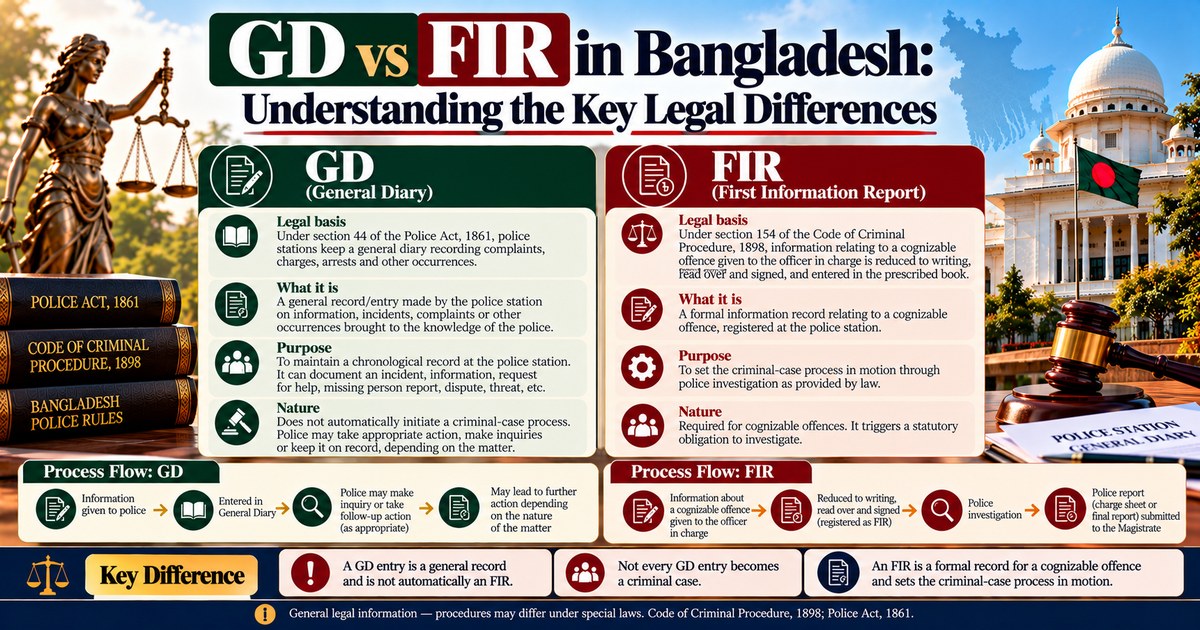
GD vs FIR in Bangladesh: Understanding the Key Legal Differences
When a person faces a crime, threat, loss of property, suspicious activity or another incident requiring police attention in Bangladesh, two terms frequently arise: GD (General Diary) and FIR (First Information Report).
Although both are associated with the police, a GD and an FIR serve different legal and procedural purposes. A GD is primarily a police diary entry used to record occurrences, complaints, information and other matters brought to the police station. An FIR, in the context of Bangladesh criminal procedure, refers to information concerning a cognizable offence recorded under section 154 of the Code of Criminal Procedure, 1898 (CrPC).
Understanding the difference is important because making a GD does not automatically mean that an FIR has been registered, and filing an FIR does not itself establish that an accused person is guilty.
This guide explains the difference between GD vs FIR in Bangladesh, when each may be appropriate, what happens after making a GD or FIR, and what legal options may be available when police action is required.
What Is a GD in Bangladesh?
GD stands for General Diary.
The General Diary is a police record maintained at police stations. The Police Regulations, Bengal provide for the maintenance of the General Diary and state that occurrences brought to the knowledge of police officers are to be entered in the diary. The regulations also contemplate recording complaints and charges, whether cognizable or non-cognizable, as well as information concerning arrests, property taken into police possession and witnesses examined.
Therefore, a GD is broader than an FIR.
A person may make a GD to formally bring an event or concern to the attention of the police and create an official police record.
Examples can include:
Lost documents
Lost mobile phone
Lost identification papers
Missing belongings
Threatening behaviour
Suspicious circumstances
Information about a potentially concerning incident
Other matters that a person wants formally recorded by police
However, whether a particular matter should result in an FIR depends on the nature of the facts and whether a cognizable offence has been disclosed.
What Is an FIR in Bangladesh?
FIR commonly means First Information Report.
Section 154 of the CrPC provides the procedure for information relating to the commission of a cognizable offence.
Where such information is given orally to the officer in charge of a police station, it must be reduced to writing, read over to the informant and signed by the person giving it. The substance must then be entered in the prescribed police record.
An FIR is therefore connected to the formal criminal-investigation process for a cognizable offence.
A simplified sequence is:
Cognizable offence → Information to police → FIR → Investigation → Police report → Court proceedings
What Is a Cognizable Offence?
The CrPC defines a cognizable offence as an offence for which a police officer may arrest without warrant according to the Second Schedule or another applicable law.
Whether an offence is cognizable is determined by the applicable law.
This distinction is important because section 154 concerns information relating to cognizable offences, while section 155 establishes a different procedure for non-cognizable offences.
GD vs FIR: Key Differences
| Feature | GD | FIR |
|---|---|---|
| Full form | General Diary | First Information Report |
| Main function | Records occurrences, information, complaints and other police-station matters | Records information relating to a cognizable offence under section 154 CrPC |
| Maintained by | Police station | Police station |
| Legal basis | Police regulations and applicable laws | Section 154 CrPC |
| Covers | A broad range of police-related information | Information concerning a cognizable offence |
| Automatically starts criminal investigation? | No | Generally initiates the statutory investigation process for the cognizable case |
| Can relate to non-criminal matters? | Yes, depending on the circumstances | No; section 154 concerns cognizable offences |
| Leads automatically to arrest? | No | No |
| Proves guilt? | No | No |
| May become relevant in court? | Yes, depending on the circumstances | Yes, as part of the criminal case record |
The most important point is:
GD is a broader police record. FIR is a specific statutory recording of information concerning a cognizable offence.
GD vs FIR: The Legal Difference
The distinction becomes clearer when the relevant laws are examined.
GD
The General Diary records information and occurrences brought to the police station. Police Regulations, Bengal require police stations to maintain the diary and record relevant complaints, charges and other occurrences.
FIR
Section 154 CrPC specifically addresses information concerning the commission of a cognizable offence.
Therefore, a GD is not simply a "weaker FIR."
They are different records serving different functions.
Is a GD a Criminal Case?
Not necessarily.
Making a GD does not automatically mean that a criminal case has been registered.
For example, a person may make a GD after losing:
A passport
National identification documents
A mobile phone
Educational certificates
Other important belongings
The GD creates an official record of the information provided to police.
Whether a criminal case follows depends on the facts and applicable law.
Is an FIR a Criminal Case?
An FIR is part of the criminal case process involving information concerning a cognizable offence, but it is important not to confuse the FIR with the entire criminal proceeding.
After an FIR, the police may investigate under the CrPC. Section 156 permits police to investigate cognizable cases without a Magistrate's order, subject to the statutory requirements.
The investigation may subsequently result in a police report under section 173.
Therefore:
FIR → Investigation → Police report → Court process
An FIR is an important beginning of the process, not the final outcome.
When Should You Make a GD?
A GD may be appropriate where you want the police to formally record an incident or information but the circumstances do not necessarily require registration of an FIR at that point.
Examples may include:
Lost Documents
If important documents are lost, a GD may create an official record of the loss.
Lost Mobile Phone
A person may report a lost phone to the police and have the information recorded.
Threats or Suspicious Conduct
Where a person has received threats or has concerns about an incident, a GD may provide an official record.
However, if the facts disclose a cognizable criminal offence, simply making a GD should not be treated as automatically replacing the procedure under section 154.
Missing Property
A GD may be useful for recording the disappearance or loss of property, depending on the circumstances.
The appropriate procedure depends on whether the facts disclose a criminal offence and the classification of that offence.
When Is an FIR Appropriate?
An FIR is associated with information concerning a cognizable offence.
Examples of allegations that may involve cognizable offences can include certain cases involving:
Serious physical violence
Robbery
Theft
Certain forms of cheating
Serious property offences
Other offences classified as cognizable under the applicable law
The exact classification must be checked against the relevant law and the facts of the incident.
A person should not assume that an offence is cognizable simply because it appears serious.
Can a GD Be Converted Into an FIR?
There is no universal rule that every GD is automatically "converted" into an FIR.
The legal outcome depends on the information recorded, the facts disclosed and the applicable criminal procedure.
If information ultimately discloses a cognizable offence, the statutory requirements concerning registration and investigation may become relevant.
Therefore, it is more accurate to say that a GD entry can become relevant to subsequent criminal proceedings where the facts disclose an offence, rather than saying that every GD automatically becomes an FIR.
Can You File Both a GD and an FIR?
Potentially, yes, depending on the circumstances.
For example, a person may first make a GD regarding an incident and subsequently provide information concerning a cognizable offence.
However, a person should not assume that filing multiple records concerning the same incident is always necessary or appropriate.
The correct procedure depends on:
Nature of the incident
Whether an offence has occurred
Whether it is cognizable
Whether an FIR has already been registered
What information is already recorded
Whether investigation has begun
GD vs FIR: What Happens After Each?
After a GD
A GD entry may simply remain a record of the information.
Depending on its contents and circumstances, police may:
Make inquiries
Contact the person who reported the matter
Take preventive measures where legally authorised
Conduct further verification
Take action under another applicable law
Register an FIR if the information discloses a cognizable offence and the statutory requirements are met
A GD does not automatically result in a criminal investigation.
After an FIR
A cognizable case may proceed to police investigation.
Under section 157 CrPC, where the officer in charge has reason to suspect the commission of an offence that they are empowered to investigate, the police proceed with investigation and report to the appropriate Magistrate.
The investigation may involve:
Visiting the place of occurrence
Examining witnesses
Collecting documents
Recovering evidence
Recording relevant statements
Examining physical or electronic evidence
Taking lawful measures concerning suspected persons
Preparing the police report
Does a GD Lead to Arrest?
No.
A GD itself is not an arrest order.
Arrest is governed by the applicable law and statutory requirements.
A person should not assume that making a GD automatically gives police authority to arrest another person.
Does an FIR Automatically Lead to Arrest?
No.
Registration of an FIR does not automatically mean that every person named in it must be arrested.
The law governing arrest must be considered separately.
The current CrPC contains specific statutory conditions governing arrest without warrant.
Therefore:
FIR ≠ Automatic Arrest
Does a GD Prove a Crime Happened?
No.
A GD records information brought to the police.
The entry itself does not establish the truth of every allegation contained in it.
The significance of a GD depends on the circumstances and the purpose for which it is used.
Does an FIR Prove the Accused Is Guilty?
No.
An FIR records information concerning an alleged cognizable offence.
It is not:
A conviction
A final judgment
Conclusive proof of guilt
The allegations must be investigated and, where the case proceeds to trial, determined through the judicial process.
Therefore:
FIR ≠ Conviction
GD vs FIR: Which One Is More Serious?
It is not legally accurate to treat the issue simply as "GD = less serious" and "FIR = more serious."
The real distinction is function and legal procedure.
A GD can concern a very important matter, while an FIR specifically concerns information relating to a cognizable offence and may initiate the statutory investigation process.
The seriousness of the underlying incident should be assessed according to the facts and applicable law, not simply by whether a GD or FIR exists.
GD vs FIR: Which One Should You File?
The answer depends on the facts.
A GD may be appropriate when:
You need to formally record a loss.
You have information that should be brought to police attention.
You are concerned about a particular incident but the legal classification is not yet clear.
You want an official record of an event.
The circumstances do not presently require an FIR.
An FIR may be appropriate when:
The facts disclose a cognizable offence.
The matter requires criminal investigation.
The statutory requirements of section 154 apply.
If you are unsure whether the incident constitutes a cognizable offence, consulting a lawyer can help identify the appropriate legal procedure.
What Information Should Be Included in a GD?
A GD should provide a clear and factual description of the matter.
Depending on the circumstances, include:
Name and contact information
Date of incident
Approximate time
Location
Description of what happened
Description of lost or missing property
Identifying information about the property
Names of relevant persons, if known
Witness information
Relevant documents
Other information that may assist police
Avoid exaggerating or knowingly providing false information.
What Information Should an FIR Contain?
Section 154 requires information concerning a cognizable offence to be recorded according to the statutory procedure.
A practical factual account may include:
Date and time
Location
Description of the alleged offence
Persons involved
Witnesses
Injuries
Property affected
Relevant documents
Photographs or video
Other available evidence
The focus should be on accurate facts, not unnecessary legal arguments.
Can a GD Be Made Online in Bangladesh?
Bangladesh Police has introduced digital services through its official platforms, and the availability of online GD-related services can depend on the current police system and type of report.
Because digital procedures can change, users should check the current official Bangladesh Police service rather than relying on outdated instructions.
Bangladesh Police — Official Website
Where the matter concerns an alleged cognizable offence requiring an FIR, a person should not assume that an online GD substitutes for the statutory FIR procedure.
Can an FIR Be Filed Online?
The availability of digital reporting or police services may depend on the current system and type of offence.
An online reporting mechanism, where available, should not automatically be treated as legally identical to registration of an FIR under section 154.
For a current case, confirm with the relevant police authority whether the information has actually been registered as an FIR/case under the applicable law.
What If Police Only Record a GD When You Believe an FIR Is Required?
This is an important situation.
If the facts disclose a cognizable offence, section 154 CrPC provides the statutory framework for recording the information.
If appropriate police action is not taken, the circumstances should be documented and legal advice should be obtained.
Section 156(3) CrPC provides that a Magistrate empowered under section 190 may order an investigation of a cognizable case.
The appropriate remedy depends on the particular facts.
What If the Matter Is Non-Cognizable?
Section 155 CrPC provides a separate procedure for information concerning a non-cognizable offence.
The police are required to enter the substance of the information and refer the informant to the Magistrate. Police generally cannot investigate a non-cognizable case without an order from a competent Magistrate, subject to the statutory framework.
Therefore, not every criminal allegation results in an FIR under section 154.
GD vs FIR vs Criminal Complaint
It is also important to distinguish both GD and FIR from a criminal complaint before a Magistrate.
| GD | FIR | Criminal Complaint |
|---|---|---|
| Police diary entry | Police record of information concerning cognizable offence | Allegation presented to Magistrate |
| Broad recording function | Criminal investigation function | Judicial complaint procedure |
| Police station | Police station | Magistrate |
| Does not automatically start investigation | Investigation may follow | Magistrate may proceed under complaint procedure |
| Police regulations are important | Section 154 CrPC | Sections 190, 200 and 202 CrPC may apply |
The CrPC defines a "complaint" as an allegation made orally or in writing to a Magistrate seeking action under the Code, excluding a police report.
GD vs FIR vs Charge Sheet
These terms are also frequently confused.
GD
A police diary entry recording an occurrence, complaint, charge or other relevant information.
FIR
Information concerning a cognizable offence recorded under section 154 CrPC.
Charge Sheet
A police report submitted after investigation where the applicable procedure supports prosecution of the accused.
These are three different stages or records.
A simplified sequence may be:
Incident → GD or FIR, depending on circumstances → Investigation → Police report → Court proceedings
But not every incident follows this exact sequence.
Is a GD Useful as Evidence?
A GD entry can be relevant in later proceedings depending on the facts, purpose and applicable evidentiary rules.
However, making a GD does not automatically prove the truth of everything stated in it.
Its evidentiary significance must be assessed in the context of the particular case.
Can a GD Help Establish That You Reported an Incident Earlier?
Potentially, yes.
A GD creates an official police record of information communicated to the police.
The existence and contents of the entry may therefore become relevant where the timing of a report or prior communication is disputed.
However, the legal significance of the entry depends on the facts and evidentiary rules applicable to the proceeding.
What Should You Do After Making a GD?
After making a GD, keep the relevant reference or GD number and preserve any documents associated with the report.
Depending on the nature of the incident:
Keep the GD number safely.
Preserve relevant documents.
Keep photographs or electronic evidence.
Record important dates.
Follow up with the police where appropriate.
Seek legal advice if the matter develops into a criminal case.
If a cognizable offence has occurred, determine whether an FIR should also be registered.
What Should You Do After an FIR Is Registered?
After an FIR is registered:
Keep the case number and police-station details.
Preserve all relevant evidence.
Maintain a chronology of events.
Identify potential witnesses.
Preserve medical or financial records where relevant.
Cooperate with lawful investigative procedures.
Obtain legal advice if you are an accused person or if the matter is legally complex.
Monitor subsequent court proceedings where applicable.
Common Mistakes About GD and FIR
Mistake 1: Thinking Every GD Is an FIR
It is not.
Mistake 2: Thinking an FIR Is a Conviction
It is not.
Mistake 3: Thinking an FIR Automatically Means Arrest
It does not.
Mistake 4: Assuming a GD Automatically Starts a Criminal Investigation
It does not necessarily do so.
Mistake 5: Treating GD and FIR as Interchangeable
They have different legal and procedural functions.
Mistake 6: Giving False Information
A person should provide accurate information to the police and avoid fabricating allegations.
Mistake 7: Ignoring the Classification of the Offence
Whether an offence is cognizable or non-cognizable can significantly affect the applicable procedure.
Frequently Asked Questions
What is the difference between GD and FIR in Bangladesh?
A GD is a General Diary entry used by police to record occurrences, complaints, charges and other information brought to the police station. An FIR is the statutory recording under section 154 CrPC of information concerning a cognizable offence.
Is a GD the same as an FIR?
No. They are different police records with different legal functions.
Does a GD become an FIR automatically?
No. A GD does not automatically become an FIR. If the facts disclose a cognizable offence, the applicable statutory procedure concerning registration and investigation must be followed.
Does an FIR automatically lead to arrest?
No. Arrest is governed by separate statutory requirements.
Does a GD start a criminal case?
Not necessarily. A GD primarily records information. Whether a criminal case is registered depends on the nature of the information and applicable law.
Can I make a GD for a lost mobile phone?
A person may report the loss of a mobile phone to the police and have the matter recorded. The appropriate procedure may differ if the circumstances indicate theft or another criminal offence.
Can I make a GD for a lost passport or ID document?
A person may report the loss of important documents to police, subject to the current procedures of the relevant authority and police service.
Can I make a GD if someone threatens me?
A person can bring threats to the attention of police and request that the matter be recorded. If the facts disclose a cognizable offence or another offence requiring a specific procedure, the appropriate legal process may differ.
Can a GD be used in court?
A GD entry may become relevant to court proceedings depending on the facts and applicable evidentiary rules. Its existence does not automatically prove the truth of every statement contained in it.
Can an FIR be filed after making a GD?
Potentially, yes, where the facts disclose a cognizable offence and the statutory requirements for an FIR are satisfied.
What happens if the police refuse to register an FIR?
Where information concerns a cognizable offence, section 154 provides the relevant statutory framework. Depending on the circumstances, a Magistrate may have power under section 156(3) to order an investigation.
What happens if the offence is non-cognizable?
Section 155 CrPC provides that the information should be entered and the informant referred to the Magistrate; police investigation generally requires a Magistrate's order.
Is an FIR more serious than a GD?
The terms should not be treated simply as levels of seriousness. They serve different legal purposes. An FIR is specifically connected to information concerning a cognizable offence, while a GD is a broader police record.
What is the difference between FIR and a criminal complaint?
An FIR is recorded by police in relation to information concerning a cognizable offence. A criminal complaint is an allegation made to a Magistrate seeking action under the CrPC.
What is the difference between GD and a criminal complaint?
A GD is a police-station diary entry, whereas a criminal complaint is a judicial proceeding initiated before a Magistrate under the applicable provisions of the CrPC.
Final Takeaway
The difference between GD and FIR in Bangladesh can be summarised as follows:
GD → General police record of an occurrence, complaint, charge or other information
FIR → Statutory recording of information concerning a cognizable offence under section 154 CrPC
A GD does not automatically start a criminal investigation, while an FIR concerning a cognizable offence is connected to the police investigation process under the CrPC. Sections 154–157 establish important parts of that framework.
The key points are:
GD and FIR are not the same document.
A GD has a broader recording function.
An FIR concerns information relating to a cognizable offence.
A GD does not automatically become an FIR.
An FIR does not automatically result in arrest.
Neither a GD nor an FIR proves someone's guilt.
Non-cognizable offences follow a different statutory procedure.
A Magistrate may have powers under section 156(3) where appropriate.
The correct procedure depends on the facts and classification of the alleged offence.
If you are unsure whether an incident requires a GD, FIR or complaint before a Magistrate, the appropriate legal route should be determined from the specific facts and applicable law.
Authoritative Legal Sources
Code of Criminal Procedure, 1898 — Bangladesh Laws
Section 154–157 CrPC — Information to Police and Investigation
Bangladesh Police — Official Website
Police Regulations, Bengal — Bangladesh Police
Disclaimer: This article provides general legal information about GDs and FIRs in Bangladesh and is not a substitute for case-specific legal advice. Criminal procedure may differ under special legislation, and the applicable law and current police procedures should be verified before taking legal action.