

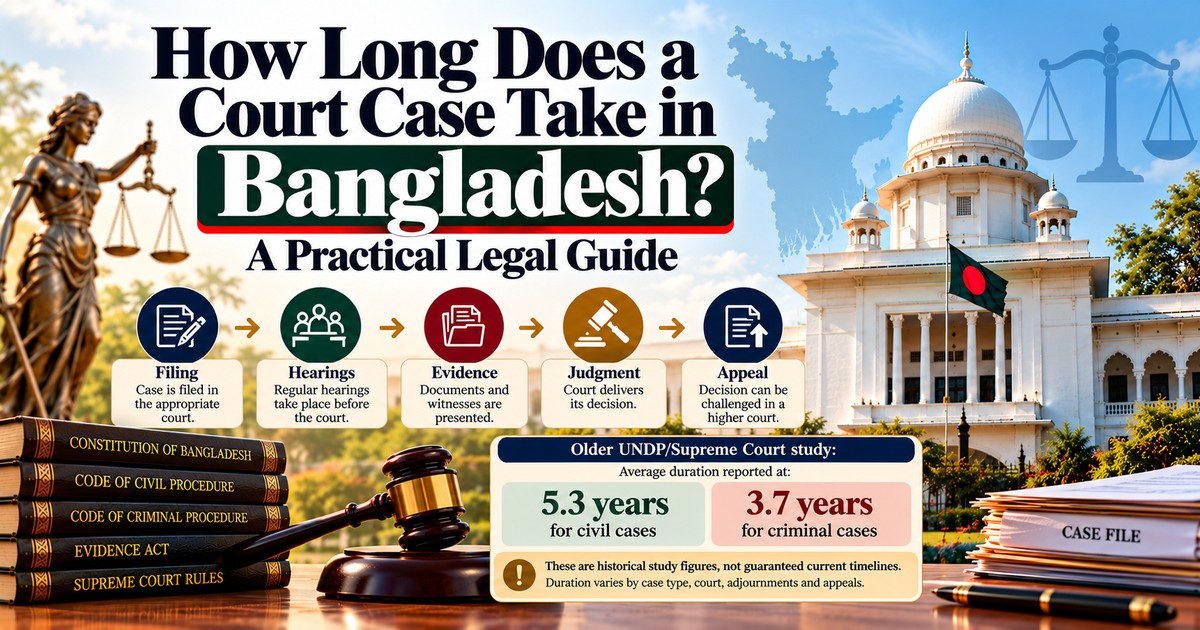
How Long Does a Court Case Take in Bangladesh? A Practical Legal Guide
How Long Does a Court Case Take in Bangladesh? A Practical Legal Guide
One of the most common questions people ask after becoming involved in litigation is: “How long does a court case take in Bangladesh?”
There is no single answer. The duration of a case depends on the type of case, court, complexity of the dispute, number of parties, evidence, witness availability, adjournments, investigation, service of summons, interim applications, appeals and the overall procedural history.
A straightforward matter may be resolved relatively quickly, while a contested civil or criminal case can continue for several years and may take substantially longer if it proceeds through multiple appellate stages.
Bangladesh law establishes procedures and time limits for particular steps, but these should not be confused with a guaranteed deadline for completing an entire case. The Code of Civil Procedure, Code of Criminal Procedure and Limitation Act regulate different stages of litigation, while the actual duration depends heavily on the circumstances of each proceeding.
How Long Does a Court Case Take in Bangladesh?
As a practical matter, there is no universal fixed time limit for all court cases in Bangladesh.
A case may take:
several months in a relatively simple matter;
a few years in a contested case;
considerably longer where there are numerous witnesses, complex evidence, procedural disputes or repeated appeals.
These are practical ranges rather than statutory deadlines.
The important point is that filing a case does not mean that a judgment will necessarily be delivered within a predetermined period.
The duration depends on the procedural steps required and how the particular case progresses through the court system.
Why Do Court Cases Take So Long?
A court case involves multiple procedural stages. Delay can occur at almost any stage.
Common factors include:
service of summons or notices;
appearance of parties;
filing of written statements or objections;
framing of issues or charges;
investigation;
collection and production of evidence;
examination and cross-examination of witnesses;
adjournments;
interlocutory applications;
absence of parties or witnesses;
disputes over documents;
transfer of proceedings;
applications concerning jurisdiction;
appeals;
revisions;
reviews; and
execution of the final judgment or decree.
The law itself recognizes numerous procedural mechanisms that can affect the progress of a case. For example, civil appellate procedure contains provisions concerning adjournment and other steps that can extend the procedural timeline.
Does Every Case Follow the Same Timeline?
No.
The timeline differs substantially depending on whether the matter is:
a civil case;
a criminal case;
a family case;
a commercial dispute;
a writ petition;
an appeal;
a revision;
a review;
a cheque dishonour case; or
a case governed by a special statute.
Different legislation may establish different procedures and time requirements.
How Long Does a Civil Case Take in Bangladesh?
A civil case in Bangladesh can take anywhere from months to several years, depending on its complexity and procedural history.
A typical contested civil suit may involve:
filing of the plaint;
issuance and service of summons;
appearance of the defendant;
filing of written statement;
framing of issues;
evidence of the plaintiff;
cross-examination;
evidence of the defendant;
cross-examination;
arguments;
judgment; and
decree.
The actual duration can increase substantially where there are multiple defendants, disputed documents, numerous witnesses or repeated applications.
Stages of a Civil Case and Their Potential Duration
| Stage | What Happens | Possible Effect on Duration |
|---|---|---|
| Filing | Plaint is presented | Usually initial stage |
| Summons | Defendant is notified | Delay may occur if service is difficult |
| Written statement | Defendant responds | May require additional procedural steps |
| Issues | Court identifies disputed questions | Depends on case complexity |
| Evidence | Witnesses and documents are presented | Often one of the longest stages |
| Cross-examination | Opposing party questions witnesses | Duration depends on number of witnesses |
| Arguments | Lawyers present legal submissions | Usually after evidence closes |
| Judgment | Court decides the case | Date depends on court and circumstances |
| Execution | Successful party seeks enforcement | Can become a separate stage |
The evidence stage can be particularly time-consuming in a heavily contested civil dispute.
How Long Does a Criminal Case Take in Bangladesh?
A criminal case can also vary substantially in duration.
Depending on the type of case, the process may involve:
complaint or FIR;
investigation;
arrest or bail proceedings;
submission of police report or other relevant process;
cognizance;
appearance of the accused;
discharge consideration where applicable;
framing of charge;
prosecution evidence;
cross-examination;
defence evidence where applicable;
examination or questioning of the accused under the applicable procedure;
arguments;
judgment; and
appeal or other post-judgment proceedings.
For Sessions trials, the CrPC specifically provides for consideration of the case, discharge where appropriate, framing of charge and subsequent prosecution evidence.
How Long Can a Criminal Investigation Take?
The investigation period depends on the nature of the offence, evidence, number of accused persons, witnesses, documents and investigating requirements.
An investigation may become more complicated where:
numerous accused are involved;
witnesses are difficult to locate;
documentary evidence must be collected;
forensic evidence is required;
financial records must be examined;
the alleged offence occurred over an extended period; or
evidence is located in different places.
The investigation is therefore an important part of the overall timeline of a criminal case.
How Long Does a Trial Take After Investigation?
There is no single period applicable to every criminal trial.
Once the case reaches the trial stage, the court may need to hear multiple witnesses and consider documentary and other evidence.
For example, where an accused pleads not guilty, the prosecution may need to produce its witnesses for examination and cross-examination. The court may then consider defence evidence where applicable before hearing final arguments.
The CrPC provides detailed procedures for these stages rather than establishing one universal duration for every trial.
How Long Does a Family Court Case Take?
Family cases can involve matters such as:
dissolution of marriage;
dower;
maintenance;
restitution of conjugal rights;
custody or guardianship-related disputes; and
other matters falling within the relevant family-law jurisdiction.
The duration depends on the specific claim, whether the parties reach settlement, the evidence required and whether further proceedings are initiated.
Where the dispute is resolved through settlement, the matter may conclude substantially earlier than a fully contested case.
How Long Does a Property Case Take?
Property disputes can be particularly complex because they may involve:
title;
possession;
inheritance;
mutation;
land records;
boundaries;
multiple owners;
registered deeds;
previous litigation; and
questions concerning limitation.
A property case involving several documents and parties can therefore take considerably longer than a straightforward dispute.
Interim applications concerning possession, injunctions or other property-related issues can also add procedural stages.
How Long Does a Writ Petition Take?
A writ petition before the High Court Division can sometimes be resolved more quickly than a heavily contested civil trial, particularly where the issue is primarily legal and does not require extensive oral evidence.
However, there is no universal fixed duration.
The timeline can depend on:
urgency;
constitutional or statutory issues;
availability of records;
response from the respondents;
disputed facts;
interim orders;
affidavits;
number of parties; and
subsequent appeals.
A writ proceeding involving extensive factual disputes may require significantly more judicial consideration than a straightforward legal question.
How Long Does an Appeal Take?
An appeal can itself take substantial time.
A civil appeal may involve:
filing the memorandum of appeal;
admission or preliminary consideration;
preparation and transmission of records;
service of notice;
hearing;
adjournments;
examination of the lower court record; and
judgment.
The Code of Civil Procedure contains detailed rules governing the appellate process, including notice, hearing and adjournment.
A party should therefore not assume that a successful appeal will automatically result in an immediate final resolution.
How Long Does a Revision Case Take?
A revision is generally narrower than an appeal, but it can still take time.
The duration depends on:
whether a Rule is issued;
whether the lower court record is required;
the number of parties;
interim applications;
adjournments;
complexity of the legal issue; and
whether further proceedings follow the revisional decision.
A revision therefore cannot be assigned one universal timeframe.
How Long Does a Review Petition Take?
A review is generally a limited remedy directed toward reconsideration of a judgment or order on recognized grounds.
The time required depends on:
the court involved;
the grounds for review;
procedural requirements;
whether notice is required;
the complexity of the issue; and
the court's schedule.
The Limitation Act separately provides limitation rules for review applications and allows certain extensions where the statutory requirements concerning sufficient cause are satisfied.
Why Adjournments Can Affect Case Duration
An adjournment means postponement of a proceeding to another date.
Adjournments can arise for various reasons, including:
absence of a party;
absence of a lawyer;
unavailability of a witness;
incomplete service;
need to produce documents;
pending applications;
illness;
transfer of a case;
other procedural circumstances.
Not every adjournment is caused by the same party, and the court controls whether an adjournment is granted.
Repeated postponements can nevertheless increase the overall duration of a contested case.
Witness Availability and Evidence
Evidence is often one of the most time-consuming parts of litigation.
A case may require:
numerous witnesses;
expert evidence;
documentary evidence;
cross-examination;
production of official records; or
examination of disputed documents.
If a witness repeatedly fails to appear, the court may need to take additional procedural steps to secure attendance.
This can significantly affect the timeline.
Service of Summons Can Cause Delay
Before a defendant or accused person can properly participate in certain proceedings, service of summons or other process may be required.
The criminal procedure framework contains detailed rules concerning service of summons, including additional electronic modes that may be directed by the court under the amended law.
If the correct person cannot readily be located or service is unsuccessful, additional steps may be necessary.
What Happens If an Accused Person Absconds?
An accused person who absconds can create additional procedural complications.
The CrPC contains provisions permitting trial in absentia in defined circumstances where an accused has absconded or is concealing themselves and the statutory requirements are satisfied. The current law also provides for publication and, in appropriate cases, publication through specified government websites.
Thus, the absence of an accused does not necessarily mean that criminal proceedings must remain permanently suspended.
Appeals Can Make a Case Much Longer
A judgment at the trial level may not necessarily be the end of the dispute.
Depending on the applicable law, a party may have access to:
first appeal;
second appeal;
revision;
review; or
further appellate proceedings.
Each additional stage can extend the overall time required to achieve a final resolution.
This is particularly important in civil litigation, where the original suit and subsequent appellate proceedings should be viewed as separate stages of the broader dispute.
What Is the Difference Between Case Duration and Final Resolution?
This distinction is important.
A case may receive a trial judgment, but the dispute may continue through an appeal.
Similarly, even after a final decree, the successful party may need to initiate or continue execution proceedings to obtain the practical benefit of the judgment.
Therefore:
Trial completed ≠ dispute necessarily finished.
A realistic assessment should consider the possibility of post-judgment proceedings.
Execution of a Decree Can Take Additional Time
Winning a civil case does not always mean that the successful party immediately receives the money, property or other relief awarded by the court.
Depending on the judgment, the successful party may need to pursue execution proceedings.
For example, enforcement may involve:
recovery of money;
attachment of property;
delivery of possession;
sale of attached property; or
enforcement of another form of decree.
Consequently, the total time from filing the original case to obtaining practical relief can be longer than the time required to obtain the judgment itself.
Factors That Can Make a Case Faster
Several circumstances may reduce the time required to resolve a case.
1. Settlement Between the Parties
If the parties reach a lawful settlement, a contested proceeding may conclude without completing every stage of trial.
2. Limited Number of Witnesses
A case involving only a few witnesses may proceed more efficiently than one involving dozens of witnesses.
3. Clear Documentary Evidence
Where the central facts can be established through undisputed documents, the court may not need extensive oral evidence.
4. Limited Legal Issues
A case involving a narrow legal question may require less evidence than a complex factual dispute.
5. Cooperation of the Parties
Prompt compliance with procedural directions and attendance can reduce unnecessary delay.
Factors That Can Make a Case Take Longer
A case may take longer where there are:
multiple parties;
numerous witnesses;
disputed documents;
complicated questions of law;
repeated applications;
difficulties serving parties;
unavailable witnesses;
changes of legal representation;
interim injunction proceedings;
investigation-related complications;
appeals and revisions; or
execution proceedings.
Can a Lawyer Guarantee How Long a Case Will Take?
A lawyer generally cannot responsibly guarantee the exact time required to complete a court case.
A lawyer can estimate a likely range after examining:
the court;
case type;
procedural stage;
number of parties;
evidence;
previous orders;
pending applications; and
potential appeals.
But court schedules and procedural developments can change the actual timeline.
A promise that a contested case will definitely finish by a particular date should therefore be treated cautiously unless a specific statutory or judicial deadline applies.
How Can You Reduce Unnecessary Delay?
A litigant cannot control every factor affecting a court case, but several practical steps can help avoid avoidable delays.
Keep Documents Organized
Maintain:
pleadings;
orders;
notices;
contracts;
receipts;
correspondence;
evidence; and
previous judgments.
Attend Court When Required
Failure to appear when personal attendance is required can result in additional procedural complications.
Ensure Witnesses Are Available
Where witnesses are important, their availability should be coordinated with the case schedule.
Respond Promptly to Your Lawyer
Delays in providing documents or instructions can affect preparation.
Avoid Unnecessary Applications
Applications that do not materially advance the case may add procedural steps.
Understand the Entire Litigation Strategy
Before filing a case, consider not only the trial but also possible:
appeals;
revisions;
reviews; and
execution proceedings.
Can a Court Case Be Settled Before Judgment?
Yes, depending on the nature of the dispute and applicable law.
Settlement can sometimes substantially reduce the time and expense of litigation.
However, the settlement should be legally valid, properly documented and presented to the court in accordance with the applicable procedure.
Whether settlement is available or appropriate depends on the nature of the case.
Does Filing a Case Automatically Stop the Other Party?
No.
Filing a lawsuit does not automatically provide every form of interim protection.
Where immediate protection is required, a party may need to apply for appropriate interim relief, such as an injunction or stay, under the applicable law.
Such applications may themselves affect the procedural timeline.
Are There Statutory Time Limits for Court Cases?
There are many specific procedural and limitation periods, but that does not mean every case must be completed within a fixed number of days or months.
For example, the Limitation Act prescribes periods for filing different suits, appeals and applications. It also provides a framework for exclusion of certain periods and, in specified circumstances, extension where sufficient cause is established.
A limitation period is therefore different from a deadline for the court to finish the entire case.
What Is the Difference Between Limitation and Trial Duration?
This distinction is frequently misunderstood.
Limitation determines how long a person generally has to institute a particular suit or application.
Trial duration refers to how long the court proceeding takes after it has been instituted.
For example, a limitation period may require a claim to be filed within a particular statutory period, but once filed, the case may take substantially longer to reach judgment.
The Limitation Act generally requires courts to dismiss claims filed after the prescribed limitation period, subject to statutory exceptions.
Practical Timeline: What Should a Litigant Expect?
Instead of relying on a single number, it is more useful to think about litigation in stages.
Civil Case
Filing → Service → Written Statement → Issues → Evidence → Arguments → Judgment → Appeal/Revision → Execution
Criminal Case
FIR/Complaint → Investigation → Police Report/Proceedings → Cognizance → Charge/Discharge → Prosecution Evidence → Defence → Arguments → Judgment → Appeal/Revision
Each arrow represents a separate procedural stage that can take different amounts of time.
Can an Old Case Be Expedited?
In appropriate circumstances, a party may seek an order or procedural direction for earlier hearing or disposal where the law and circumstances justify it.
However, expedited hearing is not automatic.
The availability of such relief depends on:
the nature of the case;
statutory provisions;
urgency;
court directions;
interests of justice; and
the existing procedural position.
A lawyer can advise whether an application for expedited hearing is appropriate in a particular case.
Frequently Asked Questions About Court Case Duration in Bangladesh
How long does a court case take in Bangladesh?
There is no fixed duration for every case. A simple matter may finish within months, while a contested civil or criminal case can take several years or longer, particularly if appeals or other proceedings follow.
How long does a civil case take in Bangladesh?
It depends on the complexity of the dispute, number of parties and witnesses, evidence, adjournments and appellate proceedings. A contested civil case can take several years.
How long does a criminal case take in Bangladesh?
The duration depends on the investigation, number of accused, witnesses, evidence, trial procedure and any subsequent appeal or revision.
Why do court cases take so long?
Common reasons include service difficulties, investigation, evidence, witness availability, adjournments, interlocutory applications, procedural disputes and appeals.
Can a court case be completed within one year?
Some cases may be resolved within a year, particularly where they are relatively straightforward or settled. However, there is no guarantee that a contested case will conclude within one year.
Can a lawyer guarantee a case will finish by a specific date?
No responsible estimate can guarantee the exact completion date of a contested case. The timeline depends on the court, procedural developments and circumstances beyond the lawyer's control.
Does an appeal restart the entire case?
Not necessarily. An appeal is a separate appellate proceeding governed by the applicable law. Its scope depends on the type of appeal and the issues raised.
Does winning a case mean I immediately receive the money or property?
Not necessarily. Depending on the nature of the judgment, execution proceedings may be necessary to enforce the decree.
Can a case be settled before judgment?
Yes, where settlement is legally permissible and the parties agree to resolve the dispute.
Can a case be expedited?
In appropriate circumstances, a party may seek earlier hearing or disposal, but such relief depends on the applicable law, facts and court's directions.
What is the fastest way to resolve a legal dispute?
The answer depends on the nature of the dispute. Where legally appropriate, negotiation, mediation or settlement may avoid the time required for a fully contested trial. However, some disputes require formal judicial determination.
How can I find out how long my particular case may take?
A realistic estimate requires reviewing the case type, court, case number, current stage, number of witnesses, pending applications and whether an appeal is likely. A lawyer handling the matter can provide a case-specific assessment based on those factors.
Conclusion
How long does a court case take in Bangladesh? There is no single timeframe that applies to every legal proceeding.
The duration depends on the type of case, court, complexity of the dispute, number of parties, evidence, witnesses, investigation, procedural applications, adjournments and whether the judgment is challenged through an appeal, revision or review.
A civil case may proceed through filing, summons, pleadings, issues, evidence, arguments, judgment and execution, while a criminal case may involve investigation, cognizance, charge or discharge, prosecution evidence, defence, arguments and judgment. The Code of Criminal Procedure establishes these procedural stages, but does not provide one universal completion period for every criminal case.
It is also important to distinguish limitation periods from case duration. Limitation determines when a claim or application must be filed; it does not necessarily determine how quickly the court must dispose of it.
For anyone involved in litigation, the most useful approach is therefore to ask not simply “How many years will my case take?”, but:
What stage is my case currently at?
How many procedural stages remain?
Are there pending applications?
How many witnesses and documents are involved?
Is an appeal likely?
Will execution proceedings be necessary?
Is settlement legally possible?
Understanding these factors provides a much more realistic picture of the time required to resolve a court dispute in Bangladesh.
Authoritative Legal Sources
Code of Civil Procedure, 1908 — Bangladesh Laws
Code of Criminal Procedure, 1898 — Bangladesh Laws