

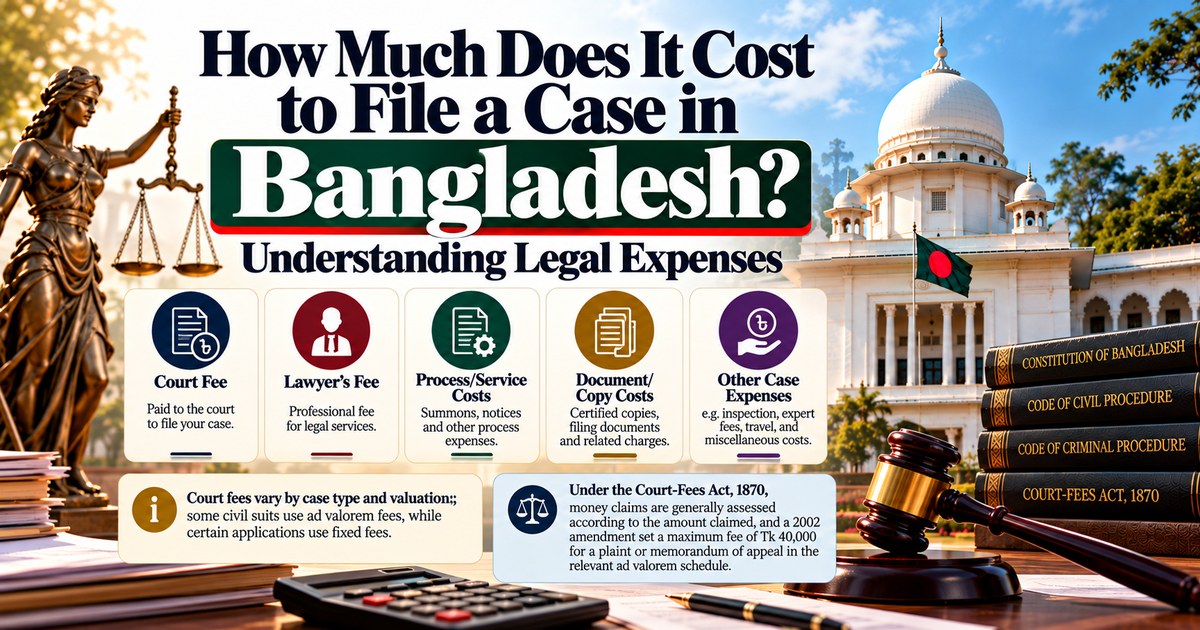
How Much Does It Cost to File a Case in Bangladesh? Understanding Legal Expenses
Filing a case in Bangladesh involves more than simply paying a court fee. The total cost may include court fees, lawyer’s fees, process and service charges, document and affidavit expenses, certified-copy fees, expert or witness expenses, and other litigation-related costs.
There is no single fixed amount that applies to every case. The cost depends on the type of case, court, value of the claim, complexity of the dispute, number of hearings, documents involved, and whether the matter proceeds to appeal or execution.
This practical guide explains the major expenses involved in filing and pursuing a case in Bangladesh and what a litigant should consider before starting legal proceedings.
What Determines the Cost of a Case in Bangladesh?
The cost of litigation generally depends on several factors:
Type of case
Court where the case is filed
Value of the claim or property involved
Applicable court fee
Lawyer’s professional fee
Number of hearings
Number of witnesses and documents
Need for expert evidence
Applications filed during the proceedings
Appeals, revisions or reviews
Execution of the judgment or decree
Therefore, two cases filed in Bangladesh may have substantially different total costs even if they are brought in the same court.
1. Court Fees
One of the most important official expenses is the court fee.
The principal legislation governing court fees is the Court-fees Act, 1870. The amount payable depends on the nature of the proceeding and, in many civil suits, the value of the relief claimed. For example, the Act provides that money suits are generally assessed according to the amount claimed, while certain suits involving declarations, injunctions, accounts and other reliefs are assessed according to the value assigned to the relief.
This means that a person filing a civil suit cannot necessarily determine the court fee simply by looking at the type of case. The valuation and nature of the relief are important.
Is Court Fee the Same for Every Case?
No.
For example:
| Type of proceeding | General basis of cost |
|---|---|
| Money claim | Generally related to amount claimed |
| Damages/compensation claim | Generally related to amount claimed |
| Property-related suit | May depend on applicable valuation rules |
| Declaration/injunction | Depends on applicable statutory valuation |
| Appeal | Applicable court fee depends on the nature of the appeal |
| Criminal case | Generally different from a civil money suit; other procedural expenses may arise |
| Writ petition | Court and procedural fees depend on the applicable rules and proceeding |
The exact amount should be calculated under the applicable law and court rules before filing.
2. Court Fees Can Depend on the Value of the Claim
For certain civil proceedings, court fees are calculated on an ad valorem basis, meaning the fee is connected to the value of the subject matter or relief.
Section 7 of the Court-fees Act contains specific rules for calculating fees for different categories of suits.
For example, in a suit for money, damages or compensation, the statutory basis is generally the amount claimed.
For declaratory relief, injunctions and certain other forms of relief, the Act contains separate valuation rules.
This is why it is important to determine the correct legal relief before estimating the cost of filing a civil case.
3. Lawyer’s Fees
For many litigants, the advocate’s professional fee is one of the largest components of litigation expense.
Unlike statutory court fees, lawyer’s fees are not a single universal amount applicable to every case.
A lawyer may structure fees in different ways, including:
Initial consultation fee
Drafting fee
Filing fee
Appearance fee per hearing
Fixed fee for a particular stage
Professional fee for the entire case
Separate fee for appeal or revision
Separate fee for applications and urgent proceedings
The amount may depend on:
Experience of the lawyer
Location and court
Complexity of the dispute
Nature of the case
Amount involved
Number of parties
Number of hearings expected
Whether the matter reaches a higher court
Important Tip
Before engaging a lawyer, ask for a clear explanation of:
The initial professional fee
What services are included
Whether appearance fees are separate
Whether drafting is included
Whether applications require additional fees
Whether appeal/revision fees are separate
Which court-related expenses are payable separately
This can prevent misunderstandings about litigation expenses later.
4. Filing and Process Expenses
Filing a civil suit involves procedural requirements in addition to the basic court fee.
Under the current CPC First Schedule, a civil suit is instituted by presenting a plaint to the court or designated officer, together with copies for service on the defendants. The rules also provide for payment of the applicable court fee for service of summons when the plaint is filed.
Therefore, litigants may incur expenses relating to:
Copies of plaint
Summons
Service of process
Registered post or other permitted modes of service
Photocopying
Printing
Affidavits
Attestation
Documentation
The exact amount varies according to the case and applicable procedural requirements.
5. Document and Affidavit Costs
A case may require numerous documents.
Common expenses can include:
Photocopying
Printing
Scanning
Notarisation where legally appropriate
Affidavit preparation
Attestation
Translation
Certified copies
Document compilation
These individual expenses may appear small, but they can become significant in complicated litigation involving a large documentary record.
6. Certified Copies of Court Documents
During litigation, a party may need certified copies of:
Judgments
Orders
Decrees
Depositions
Exhibits
Other documents forming part of the court record
The applicable fees depend on the relevant rules and type of document.
Certified copies can become particularly important when preparing an appeal, revision or review application.
7. Witness and Evidence-Related Expenses
Some cases require substantial evidence.
Possible expenses may include:
Witness transportation
Witness-related expenses
Expert opinion
Technical reports
Medical evidence
Property valuation
Survey or measurement
Forensic examination
Other professional evidence
These costs are highly case-specific.
A straightforward dispute involving a few documents may require relatively little evidence-related expenditure, whereas a complicated property, commercial, technical or financial dispute may require considerably more.
8. Expert Fees
Certain cases require professional expertise.
For example, a court dispute may involve:
Engineers
Surveyors
Accountants
Valuers
Medical professionals
Forensic experts
Technical specialists
If expert evidence or an expert report becomes necessary, the cost of litigation can increase significantly.
9. Criminal Case Expenses
The cost structure of a criminal case is different from that of a civil money suit.
A criminal case may involve expenses relating to:
Lawyer’s fees
Bail applications
Legal consultations
Certified copies
Documentation
Witness-related expenses
Applications during trial
Appeal or revision
The amount of court fee involved cannot simply be calculated in the same manner as a civil suit for recovery of money.
The actual cost depends heavily on the nature of the offence, court, procedural stage and legal representation required.
10. Bail Can Create Additional Legal Expenses
If an accused person requires bail, there may be additional professional and procedural costs.
For example, the lawyer may need to prepare and argue:
Regular bail application
Bail application before a higher court
Bail-related applications
Applications for modification or extension of conditions
These expenses are separate from the general cost of defending the criminal case.
11. Writ Petition Costs
A writ petition before the High Court Division involves a different procedural framework from an ordinary civil suit.
The total expense may include:
Advocate’s professional fee
Drafting and preparation
Court-related fees
Affidavit expenses
Printing and documentation
Certified copies
Urgent application expenses where applicable
The cost may also increase if the matter requires repeated hearings or additional applications.
12. Appeal, Revision and Review Increase the Overall Cost
Winning or losing at the first stage does not necessarily end litigation.
A party may have a legally available remedy such as:
Appeal
Revision
Review
Each additional proceeding can create additional legal expenses.
For example, the cost of a civil dispute may involve:
Trial Court → First Appeal → Higher Appeal/Revision → Further proceedings where legally available
Consequently, the original filing cost should not always be treated as the total cost of resolving the dispute.
13. Execution Costs
Winning a case and actually obtaining the benefit of the judgment are not always the same thing.
For example, after obtaining a money decree, the successful party may still need to initiate or continue execution proceedings if the judgment debtor does not voluntarily comply.
This can result in additional:
Lawyer’s fees
Court fees or process expenses
Execution-related applications
Process-service expenses
Documentation costs
Therefore, a realistic litigation budget should consider the possibility of execution proceedings.
14. Can a Person File a Case Without Paying the Full Court Fee?
In certain circumstances, the law provides mechanisms for persons without sufficient means to sue as paupers.
Order XXXIII of the CPC contains provisions concerning suits by indigent persons. The current First Schedule also provides that, where an application is admitted, the plaintiff is not liable to pay court fee in the ordinary manner for the relevant proceedings, subject to the provisions of the law.
However, this does not necessarily mean that every person with financial difficulty automatically receives exemption from court fees.
The statutory requirements and court's determination must be considered.
15. Does Winning the Case Mean You Get All Your Legal Costs Back?
Not necessarily.
A court may make an order concerning costs, but a litigant should not assume that every taka spent on lawyers, documents and other litigation expenses will automatically be recovered from the opposing party.
The treatment of costs depends on the applicable procedural law, the court's order and the circumstances of the case.
Therefore:
Your actual litigation expenditure ≠ automatically the amount recoverable as costs.
16. What Is the Cheapest Type of Case to File?
There is no universal answer.
A case that appears inexpensive to file may become expensive because of:
Numerous hearings
Difficulty serving the opposite party
Large amounts of evidence
Expert witnesses
Interim applications
Appeals
Execution proceedings
Conversely, a case with a higher initial filing fee may potentially be resolved more efficiently.
The initial filing cost should therefore not be confused with the total cost of litigation.
17. A Practical Litigation Budget
Before filing a case, consider dividing the expected expenses into several categories:
| Expense category | What to consider |
|---|---|
| Court fee | Statutory fee applicable to the proceeding |
| Lawyer’s fee | Drafting, filing, appearances and other professional services |
| Process fee | Summons and service-related expenses |
| Documents | Printing, copying and preparation |
| Affidavit | Preparation and applicable charges |
| Certified copies | Judgments, orders and other records |
| Evidence | Witnesses, experts and technical reports |
| Applications | Interim or procedural applications |
| Appeal | Possible higher-court proceedings |
| Execution | Expenses after obtaining a decree/order |
This approach provides a much more realistic picture than asking only, “How much is the court fee?”
18. Questions to Ask Your Lawyer Before Filing
Before starting litigation, consider asking your lawyer:
1. What type of case should be filed?
The legal remedy affects both procedure and cost.
2. What is the estimated initial cost?
Ask for an approximate breakdown rather than a single figure.
3. What is included in the professional fee?
Clarify whether drafting, filing, appearances and applications are included.
4. Are hearing fees separate?
Some lawyers may charge separately for appearances.
5. What additional expenses are likely?
Ask about documents, process service, affidavits and certified copies.
6. What could happen if the case goes to appeal?
A dispute can become substantially more expensive if it continues in a higher court.
7. Is there a possibility of settlement?
In an appropriate dispute, settlement or alternative dispute resolution may reduce the time and expense associated with prolonged litigation.
19. How to Reduce Legal Expenses
Although litigation costs cannot always be predicted, certain steps can help control unnecessary expenditure.
Keep Documents Organised
Prepare a chronological file containing:
Agreements
Receipts
Notices
Correspondence
Bank records
Property documents
Previous court orders
Relevant photographs or electronic records
Good organisation can reduce unnecessary preparation time.
Discuss Fees Clearly
Ask for a written or otherwise clear understanding of the professional fee structure.
Avoid Unnecessary Applications
Procedural applications should be used where legally appropriate rather than simply increasing litigation activity.
Consider Settlement Where Appropriate
If the dispute can legally and practically be resolved through settlement or another dispute-resolution mechanism, this may reduce the expenses associated with prolonged proceedings.
Understand the Entire Litigation Strategy
Ask your lawyer about:
The main legal remedy
Likely procedural stages
Potential interim applications
Appeal possibilities
Execution issues
Understanding the complete process helps you plan financially.
20. Court Fee Is Not the Same as Total Case Cost
This distinction is extremely important.
Suppose someone asks:
“How much does it cost to file a case in Bangladesh?”
The answer cannot simply be one number.
The court fee is only one component.
The broader cost may be:
Court fee + lawyer’s fee + process expenses + documents + affidavits + evidence + applications + certified copies + possible appeal + execution
The actual amount depends on the individual case.
Frequently Asked Questions
How much does it cost to file a civil case in Bangladesh?
There is no single fixed amount for every civil case. Court fees depend on the nature and valuation of the relief under the applicable court-fee law, while lawyer’s fees and other litigation expenses vary according to the case.
Is court fee based on the amount claimed?
For certain suits, including money claims, the Court-fees Act provides for calculation according to the amount claimed. Different rules apply to different categories of relief.
Do criminal cases require court fees like civil money suits?
Criminal proceedings have a different cost structure and cannot generally be treated like a civil suit where court fees are calculated on the amount claimed.
How much does a lawyer charge for a case in Bangladesh?
There is no single nationwide professional fee applicable to every case. Fees can vary depending on the lawyer, court, case complexity, procedural stage and services required.
Are lawyer’s fees fixed by the government?
A litigant should not assume that there is one universal government-fixed fee applicable to every private advocate-client arrangement. The professional fee should be clarified with the lawyer before engagement.
Can a poor person file a case without paying court fees?
The CPC provides a procedure for certain persons without sufficient means to sue as indigent persons, subject to statutory requirements and the court's determination.
Do I have to pay all the costs when filing the case?
Not necessarily. Some expenses arise at filing, while others occur later during hearings, evidence, applications, appeals or execution.
Can I recover my legal expenses if I win?
A court may make an order concerning costs, but a successful litigant should not assume that every amount personally spent on litigation will automatically be recovered.
Is an appeal more expensive than the original case?
It can create additional expenses because a new stage of legal representation, preparation, documentation and applicable court fees may arise.
Can a case be settled to reduce legal expenses?
Depending on the nature of the dispute, settlement or an appropriate alternative dispute-resolution mechanism may reduce the need for prolonged litigation. Whether settlement is suitable depends on the facts and legal rights involved.
Final Takeaway
The cost of filing a case in Bangladesh cannot be represented by a single fixed amount.
The official court fee depends on the type of proceeding and applicable statutory valuation rules. In civil suits, the amount claimed or value of the relief can be particularly important.
But the real financial commitment can extend well beyond the initial filing fee.
A realistic litigation budget should consider:
Court fees + advocate’s fees + process expenses + documentation + evidence + applications + appeals + execution.
Before filing a case, it is therefore advisable to obtain a clear estimate of both the initial filing expenses and potential long-term litigation costs from a qualified lawyer.
Authoritative Legal Sources
Court-fees Act, 1870 — Bangladesh Laws
Court-fees Act — Official Bangladesh Laws Database
Code of Civil Procedure — First Schedule
Bangladesh Laws — Ministry of Law, Justice and Parliamentary Affairs
Important: Court fees, procedural rules and other legal requirements may be amended. The applicable law and court rules should be checked at the time of filing, and case-specific costs should be confirmed with a qualified advocate.