

How to File an FIR in Bangladesh: Step-by-Step Guide
How to File an FIR in Bangladesh: Step-by-Step Guide
If you have been the victim of a criminal offence in Bangladesh, one of the first legal questions is often: How do I file an FIR?
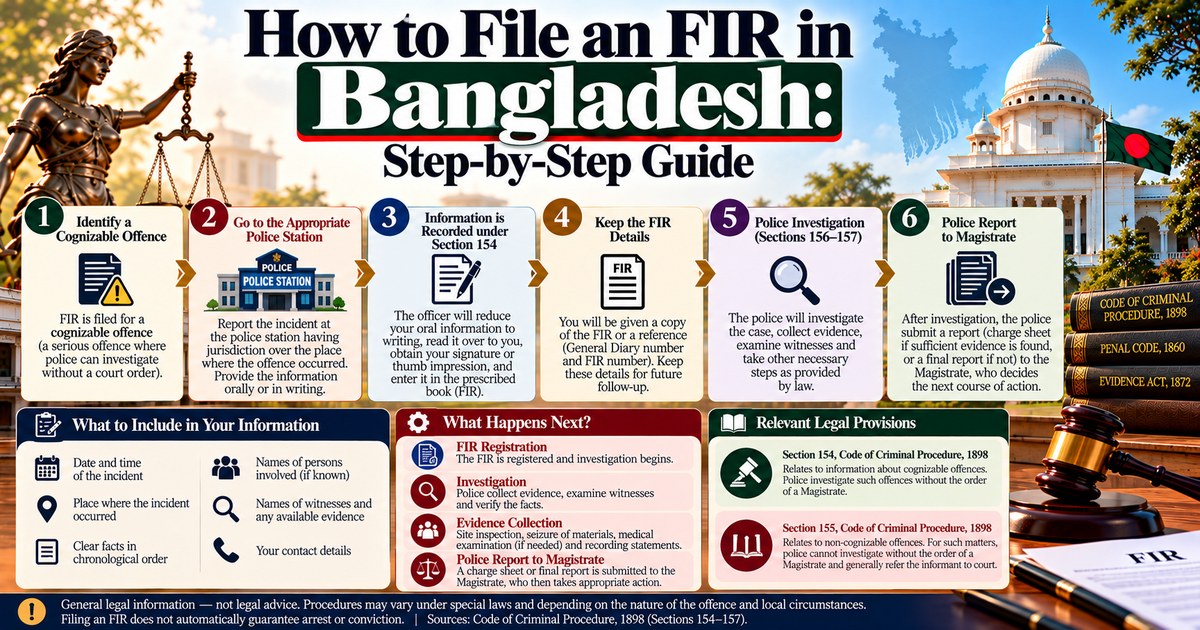
FIR generally refers to the First Information Report associated with information concerning a cognizable offence. Under section 154 of the Code of Criminal Procedure, 1898 (CrPC), information relating to the commission of a cognizable offence given to the officer in charge of a police station is to be recorded according to the statutory procedure.
Filing an FIR is an important step, but it is not the same as proving that an accused person is guilty. The FIR records information about an alleged offence; investigation, prosecution and judicial proceedings determine what happens afterward.
This step-by-step guide explains how to file an FIR in Bangladesh, what information to provide, what happens after registration, what to do if the police refuse to register the FIR, and how an FIR differs from a GD or criminal complaint.
What Is an FIR in Bangladesh?
An FIR is commonly understood as the First Information Report relating to a cognizable offence.
Section 154 CrPC provides that when information about a cognizable offence is given orally to the officer in charge of a police station, it must be reduced to writing, read over to the person giving the information and signed by that person. The substance is then entered in the prescribed police record.
In simple terms:
Alleged cognizable offence → Information to police → FIR → Investigation → Police report → Court proceedings
The FIR is therefore an important starting point for the police-investigation process.
What Is a Cognizable Offence?
Before discussing how to file an FIR, it is important to understand the term cognizable offence.
The CrPC defines a cognizable offence as an offence for which a police officer may arrest without warrant according to the Second Schedule or another law currently in force.
Whether a particular offence is cognizable depends on the applicable law and the specific facts.
Not every criminal allegation follows exactly the same procedure.
Who Can File an FIR?
The person providing the information is generally referred to as the informant.
Depending on the circumstances, the informant may be:
The victim
A family member
An eyewitness
Another person who has relevant information
A person otherwise entitled to provide the information
The informant does not necessarily have to be the person who personally suffered the alleged offence.
The important issue is whether the information concerns an offence and can properly be dealt with under the applicable criminal procedure.
Where Should You File an FIR?
An FIR is ordinarily dealt with through the police station having appropriate territorial jurisdiction over the alleged offence.
Section 156 CrPC provides that an officer in charge of a police station may investigate a cognizable case that falls within the local jurisdiction contemplated by the section.
Jurisdiction can become more complicated where:
The offence occurred in more than one location
Different acts occurred in different areas
The consequences occurred elsewhere
Several police-station areas are involved
A special law contains different jurisdictional provisions
If jurisdiction is disputed or unclear, obtaining legal advice can be useful.
How to File an FIR in Bangladesh: Step-by-Step
The basic process can be understood as follows:
Prepare the facts → Approach the appropriate police station → Provide the information → Police record it under section 154 where applicable → Check the written information → Sign it → Keep the case details → Police investigation begins
Step 1: Write Down the Important Facts
Before going to the police station, prepare a clear chronology of what happened.
Include, where applicable:
Date of the incident
Approximate time
Place of occurrence
Description of what happened
Names of persons involved
Identification details of suspected persons, if known
Names of witnesses
Nature of injuries
Description of damaged or stolen property
Relevant documents
Photographs
Videos
CCTV information
Messages or emails
Medical records
Other relevant evidence
The objective is to communicate accurate facts clearly.
You do not need to turn the FIR into a lengthy legal argument.
Step 2: Go to the Appropriate Police Station
Approach the relevant police station and provide the information to the officer in charge or appropriate police officer.
If the information concerns a cognizable offence, section 154 provides the statutory framework for recording it.
If you are unsure whether the alleged offence is cognizable, you can explain the facts to the police and, where necessary, seek advice from a lawyer.
Step 3: Submit the Information
The information may be provided in writing or orally.
Section 154 specifically contemplates information being given orally. When this happens, the police must reduce it to writing and read it over to the informant before obtaining the informant's signature.
If you have already prepared a written statement, provide it to the police and ensure that the relevant facts have been accurately recorded.
Step 4: Check the Written FIR Carefully
This is one of the most important practical steps.
Before signing, carefully check:
Your name
Address and contact information
Date
Time
Location
Description of the incident
Names of accused persons, if known
Names of witnesses
Description of injuries
Description of property
Other important factual details
If information was provided orally, section 154 requires it to be read over to the informant before signing.
Do not sign a document that contains information you know is inaccurate.
Step 5: Sign the Recorded Information
Where section 154 applies, the informant signs the written information after it has been recorded and read over.
This signature confirms the information provided to the police; it does not mean that the informant is determining the accused person's guilt.
Step 6: Keep the Case Details
After the FIR is registered, carefully preserve the relevant information, including:
Police station
Case number
Date of registration
Names of relevant officers
Applicable sections, if provided
Copies of documents received
Other reference information
These details may later be needed for court proceedings or legal consultations.
What Should an FIR Contain?
A good FIR should focus on material facts.
Identity of the Informant
Provide accurate identifying information.
Date and Time
State when the incident occurred as accurately as possible.
Place of Occurrence
Identify the location where the alleged offence occurred.
Description of the Incident
Explain what happened in a logical sequence.
Identity of Suspected Persons
If the suspected person is known, provide relevant identifying information.
If the offender is unknown, provide whatever information may assist identification.
Witnesses
Provide relevant witness information where available.
Injuries or Damage
Describe physical injuries or property damage where relevant.
Supporting Evidence
Mention available evidence such as:
Documents
Photographs
CCTV footage
Videos
Electronic communications
Medical reports
Financial records
Other relevant material
Do You Need to Know the Exact Legal Sections?
Not necessarily.
For most informants, the priority should be accurately describing what happened.
The police and courts determine the legal classification based on the facts and applicable law.
If you already know the potentially relevant legal provisions, they can be discussed with your lawyer, but an informant should not invent legal sections simply to make an allegation appear more serious.
Can an FIR Be Filed Orally?
Yes.
Section 154 expressly provides for information about a cognizable offence being given orally. The police must reduce the information to writing, read it over to the informant and obtain the informant's signature.
Therefore, the initial information does not necessarily have to be personally drafted by the informant.
Can an FIR Be Filed in Writing?
Yes.
Written information concerning a cognizable offence can be presented to the police, subject to the applicable procedure under section 154.
The important issue is that the information should accurately communicate the facts of the alleged offence.
What Happens After an FIR Is Filed?
Filing an FIR is generally only the beginning of the criminal process.
A simplified sequence is:
FIR → Police investigation → Evidence collection → Police report → Court proceedings → Trial → Judgment
The actual sequence can vary according to the offence and applicable law.
Step 7: Police Investigation
Section 156 CrPC permits the officer in charge of a police station to investigate a cognizable case without an order from a Magistrate, subject to the statutory jurisdictional requirements.
The investigation may involve:
Visiting the place of occurrence
Examining witnesses
Collecting documents
Collecting physical evidence
Recovering relevant objects
Examining electronic evidence
Recording statements
Obtaining medical or expert evidence
Identifying suspected persons
Taking other lawful investigative measures
The purpose of the investigation is to collect and evaluate information and evidence concerning the alleged offence.
Step 8: Police May Visit the Scene
Under section 157, when the officer in charge has reason to suspect the commission of an offence that the police are empowered to investigate, the officer proceeds with the investigation and may proceed to the place of occurrence or direct a subordinate officer to do so.
Depending on the case, investigators may examine:
The location
Physical surroundings
CCTV systems
Documents
Objects
Potential witnesses
Other relevant evidence
Step 9: Police May Examine Witnesses
During investigation, police may examine persons believed to be acquainted with the circumstances of the case.
Section 160 permits an investigating police officer, by written order, to require attendance of certain persons within the relevant police-station or adjoining-station area who appear to be acquainted with the circumstances of the case. Section 161 addresses examination of witnesses by police.
Witness cooperation can therefore become an important part of an investigation.
Step 10: Arrest May or May Not Occur
One common misconception is:
FIR = Automatic Arrest
That is incorrect.
An FIR does not itself constitute an automatic arrest order.
The law governing arrest must be considered separately.
The current section 54 CrPC contains specific statutory conditions governing arrest without warrant, including circumstances in which arrest may be necessary for investigation, prevention of further offences, preventing evidence from being tampered with or ensuring the accused's presence before the court.
Therefore, whether an accused is arrested depends on the applicable law and circumstances.
Step 11: Bail May Become Relevant
If a person is arrested or required to seek release from custody, the provisions concerning bail may become relevant.
The CrPC distinguishes between bailable and non-bailable offences.
The availability of bail depends on factors including:
Nature of the offence
Applicable statutory provisions
Facts of the case
Evidence
Stage of proceedings
Relevant judicial considerations
An FIR itself does not determine whether the accused will receive or be denied bail.
Step 12: Police Maintain an Investigation Diary
Police officers conducting an investigation are required to maintain a diary of the proceedings.
Section 172 provides for day-to-day entries concerning matters such as when information was received, when investigation began and ended, places visited and circumstances ascertained during investigation.
This investigation diary is different from the FIR itself.
Step 13: Police Submit a Report After Investigation
Section 173 CrPC provides that an investigation should be completed without unnecessary delay and that, after completion, the officer in charge forwards a report to the Magistrate empowered to take cognizance of the offence on a police report.
The report contains information prescribed by law, including the names of the parties, nature of the information and persons apparently acquainted with the circumstances of the case.
A copy of the police report may also be furnished to the accused on application before the commencement of the inquiry or trial, subject to the statutory provision concerning payment and exceptions.
What Is a Charge Sheet?
The term charge sheet is commonly used for a police report submitted after investigation where the evidence supports proceeding against the accused.
It is important to distinguish the stages:
FIR → Investigation → Police report → Court proceedings → Charge → Trial
An FIR is therefore not the same thing as a charge sheet.
What If the Investigation Finds Insufficient Evidence?
The outcome depends on the evidence and the stage of the proceeding.
The police report may reflect the investigative findings, and the court then deals with the matter according to law.
The current CrPC also contains additional provisions concerning interim investigation reports in specified circumstances.
Therefore, filing an FIR does not guarantee that the accused will ultimately be charged or convicted.
What If the Police Refuse to Register an FIR?
This is an important legal issue.
If the information concerns a cognizable offence, section 154 provides the statutory framework for recording the information.
Where a person believes the police have failed to take appropriate action, section 156(3) provides that a Magistrate empowered under section 190 may order an investigation of a cognizable case.
The appropriate legal step depends on the circumstances, including:
Nature of the alleged offence
Whether it is cognizable
What information was submitted
Whether police made any entry
Whether an investigation has started
Whether another proceeding has already been initiated
Whether a special law applies
A lawyer can help determine the appropriate remedy.
What If the Police Say the Offence Is Non-Cognizable?
The procedure is different.
Section 155 CrPC provides that where information relates to a non-cognizable offence, the police should enter the substance of the information in the prescribed record and refer the informant to the Magistrate.
Police generally cannot investigate a non-cognizable case without an order from a competent Magistrate, subject to the statutory framework.
This is why determining whether an offence is cognizable or non-cognizable is important.
FIR vs GD: What Is the Difference?
An FIR should not be confused with a General Diary (GD) entry.
The General Diary is a broader police record. Police Regulations, Bengal provide for recording occurrences brought to the knowledge of police officers, including complaints and charges whether cognizable or non-cognizable.
An FIR, on the other hand, is associated with information concerning a cognizable offence under section 154 CrPC.
Therefore:
GD ≠ FIR
A GD does not automatically mean that an FIR has been registered.
FIR vs Criminal Complaint
An FIR should also be distinguished from a criminal complaint before a Magistrate.
Under section 4(h) CrPC, a complaint is an allegation made orally or in writing to a Magistrate seeking action under the Code, excluding a police report.
In simplified terms:
FIR → Police
Criminal complaint → Magistrate
A Magistrate may also have power under section 156(3) to order an investigation of a cognizable case.
Can You File an FIR Against an Unknown Person?
Yes, the identity of the offender does not necessarily have to be known before information about an alleged offence can be given to the police.
If the offender is unknown, provide whatever identifying information is available, such as:
Physical description
Vehicle details
Location
CCTV information
Telephone or digital information
Other circumstances that may assist identification
The investigation may then attempt to identify the offender.
Can Several People Be Named in an FIR?
Potentially, yes.
If the facts support allegations involving multiple persons, their identities may be provided.
However, simply naming someone in an FIR does not establish that the person committed the offence.
Criminal responsibility ultimately depends on the evidence and applicable law.
Can You File an FIR Against a Company or Organisation?
The answer depends on the alleged offence and applicable law.
Some offences may be capable of being attributed to individuals acting for or through an organisation, while special laws may contain specific provisions concerning corporate or organisational liability.
The legal position should therefore be assessed according to the particular offence and governing statute.
Can an FIR Be Withdrawn?
There is no universal rule allowing an informant simply to withdraw an FIR whenever they choose.
Once an FIR has been registered, the investigation and subsequent proceedings are governed by law.
Whether proceedings can be ended, compounded or otherwise brought to an end depends on matters such as:
Nature of the offence
Whether the offence is compoundable
Stage of the case
Evidence
Applicable law
Court jurisdiction
A person should obtain legal advice rather than assuming that an FIR can simply be cancelled at the request of the informant.
Can an FIR Be Quashed?
In appropriate circumstances, criminal proceedings may be challenged before the High Court Division under its applicable jurisdiction.
Section 561A CrPC preserves the High Court Division's inherent power to make orders necessary to:
Give effect to an order under the Code
Prevent abuse of the process of a court
Otherwise secure the ends of justice
Whether such intervention is appropriate depends on the facts and applicable legal principles.
What Evidence Should You Preserve Before and After Filing an FIR?
Evidence can become extremely important during investigation and trial.
Depending on the nature of the case, preserve:
Original documents
Receipts
Contracts
Bank records
Medical reports
Photographs
Videos
CCTV footage
Emails
Text messages
Social-media communications
Relevant electronic files
Witness information
Do not alter, fabricate or destroy evidence.
Where electronic evidence is important, preserve the original material wherever possible.
What Should You Do After Filing an FIR?
After filing an FIR, consider the following practical steps.
Keep the Case Information
Record the police station, case number and registration date.
Preserve Evidence
Keep original documents and digital evidence safely.
Prepare a Timeline
Write down important events, dates and communications while they are still fresh in your memory.
Keep Witness Details
Record the names and contact details of relevant witnesses.
Preserve Medical Records
If the incident involved physical injury, retain medical reports, prescriptions and related documents.
Avoid Contact That Could Create Further Legal Problems
Do not threaten, intimidate or attempt to improperly influence witnesses or other parties.
Seek Legal Advice When Necessary
Legal assistance can be particularly important where:
Serious offences are alleged
Arrest is possible
Bail is required
Evidence is disputed
Multiple accused persons are involved
The police have not acted
Court proceedings have begun
Common Mistakes When Filing an FIR
1. Providing False Information
An FIR should contain truthful information.
2. Exaggerating the Facts
Stick to facts that are genuinely known to you.
3. Signing Without Checking
Carefully verify the recorded information before signing.
4. Naming People Without a Factual Basis
Do not identify someone as an offender merely because of suspicion unsupported by relevant facts.
5. Destroying Evidence
Preserve relevant evidence instead.
6. Assuming FIR Means Conviction
An FIR is only an allegation/information record.
7. Assuming FIR Automatically Means Arrest
Arrest is governed by separate legal requirements.
8. Ignoring the Difference Between GD and FIR
A GD entry does not automatically constitute an FIR.
FIR Filing Checklist
Before approaching the police, prepare:
Your identification details
Date of incident
Time of incident
Location
Clear factual description
Names of suspected persons, if known
Witness information
Injury details
Property details
Relevant documents
Photographs/videos
CCTV information
Electronic communications
Medical records
Previous relevant police or court information
Not every item will be relevant to every case.
Can You File an FIR Online in Bangladesh?
Bangladesh Police operates online services, including an official Online GD platform. The official platform states that citizens can use it to submit complaints concerning lost and found matters and other issues, with the relevant police station taking action according to the nature of the complaint.
However, an online GD service should not automatically be treated as legally identical to registration of an FIR under section 154 CrPC.
If you are reporting a serious criminal offence, confirm with the relevant police authority whether the information has actually been registered as a criminal case/FIR under the applicable law.
Bangladesh Police Official Website
Bangladesh Police Online GD Portal
How Long Does It Take to File an FIR?
The act of providing information to police can be relatively straightforward, but the overall criminal case is a separate matter.
There is no universal number of hours or days within which every FIR investigation will be completed.
Section 173 provides that investigations should be completed without unnecessary delay, after which the police submit the required report to the appropriate Magistrate.
The actual duration can depend on:
Number of accused
Number of witnesses
Availability of witnesses
Medical evidence
Forensic examination
Digital evidence
Property recovery
Complexity of the allegations
Geographic issues
Court proceedings
Therefore, no responsible legal guide should promise that every FIR case will finish within a fixed period.
What Happens After the Police Submit the Report?
The police report does not necessarily end the matter.
Depending on the case, subsequent proceedings may involve:
Police report → Cognizance → Appearance/production → Discharge or charge → Evidence → Arguments → Judgment → Appeal/revision or other remedy
The precise procedure depends on the offence, court and applicable law.
Frequently Asked Questions
What is an FIR in Bangladesh?
An FIR is commonly understood as the first formal police record of information concerning a cognizable offence. Section 154 CrPC provides the statutory framework for recording such information.
Which section of the law deals with FIRs in Bangladesh?
Section 154 of the Code of Criminal Procedure, 1898 deals with information relating to cognizable offences given to the officer in charge of a police station.
Can I file an FIR orally?
Yes. Section 154 expressly provides for oral information, which must be reduced to writing, read over to the informant and signed.
Can I submit a written FIR?
Yes. Written information concerning a cognizable offence may be provided to the police under the applicable procedure.
Do I have to be the victim to file an FIR?
Not necessarily. The person providing information to the police may be an informant other than the direct victim, depending on the circumstances.
Does filing an FIR mean the accused is guilty?
No. An FIR records information about an alleged offence. Guilt must be determined through the criminal justice process.
Does an FIR automatically lead to arrest?
No. Arrest is governed by separate statutory requirements. The current section 54 CrPC contains specific conditions concerning arrest without warrant.
What happens after filing an FIR?
Police may investigate the alleged cognizable offence under the applicable law. Section 157 provides for investigation where the police have reason to suspect the commission of an offence they are empowered to investigate.
What happens after the investigation?
The police generally submit a report under section 173 to the Magistrate empowered to take cognizance on a police report.
What if the police refuse to register an FIR?
If the information concerns a cognizable offence, section 154 provides the relevant statutory framework. Depending on the circumstances, section 156(3) allows an empowered Magistrate to order an investigation of a cognizable case.
What if the alleged offence is non-cognizable?
Section 155 provides a different procedure. Police generally require a Magistrate's order to investigate a non-cognizable case, subject to the statutory framework.
Can an FIR be filed against an unknown person?
Yes. Information about an alleged offence can be provided even if the identity of the offender is not yet known.
Can multiple people be named in an FIR?
Yes, where the facts provide a basis for identifying multiple suspected persons. However, naming someone does not establish guilt.
Is an FIR the same as a GD?
No. A GD is a broader police record, while an FIR concerns information relating to a cognizable offence under section 154 CrPC.
Is an FIR the same as a criminal complaint?
No. A criminal complaint is an allegation made to a Magistrate seeking action under the CrPC, whereas an FIR is associated with information given to police concerning a cognizable offence.
Can an FIR be withdrawn?
There is no universal rule allowing an informant simply to withdraw an FIR. The available legal mechanisms depend on the offence, stage of proceedings and applicable law.
Can an FIR be quashed?
In appropriate cases, criminal proceedings may be challenged before the High Court Division under its applicable jurisdiction. Whether such relief is available depends on the facts and law.
How long does an FIR case take?
There is no universal duration. Section 173 requires investigation to be completed without unnecessary delay, but the actual duration depends on the circumstances of the case.
Final Takeaway
Knowing how to file an FIR in Bangladesh is important when dealing with an alleged cognizable offence.
The basic process is:
1. Identify and record the facts
2. Approach the appropriate police station
3. Provide information concerning the alleged offence
4. Ensure the information is accurately recorded
5. Read and verify the written information
6. Sign it where required
7. Keep the case details
8. Cooperate with the investigation
9. Preserve relevant evidence
10. Seek appropriate legal remedies if the police do not take required action
Under section 154 CrPC, information concerning a cognizable offence is recorded through the statutory FIR procedure. Sections 156 and 157 provide important provisions concerning police investigation, while section 173 governs the police report after investigation.
Most importantly, an FIR is not a conviction. It records information concerning an alleged offence and may initiate the investigation process. The ultimate outcome depends on the investigation, evidence, applicable law and judicial proceedings.
If you are involved in an FIR involving arrest, serious criminal allegations, bail, disputed evidence or ongoing court proceedings, obtaining advice from a qualified criminal lawyer in Bangladesh is advisable.
Authoritative Legal Sources
Code of Criminal Procedure, 1898 — Bangladesh Laws
Section 154–157 — FIR and Investigation
Section 54 — Arrest Without Warrant
Bangladesh Police — Official Website
Bangladesh Police Online GD Portal
Disclaimer: This article provides general legal information about FIR procedure in Bangladesh and is not a substitute for case-specific legal advice. Criminal procedure may vary under special legislation, and the applicable law and current police procedures should be verified before taking legal action.