

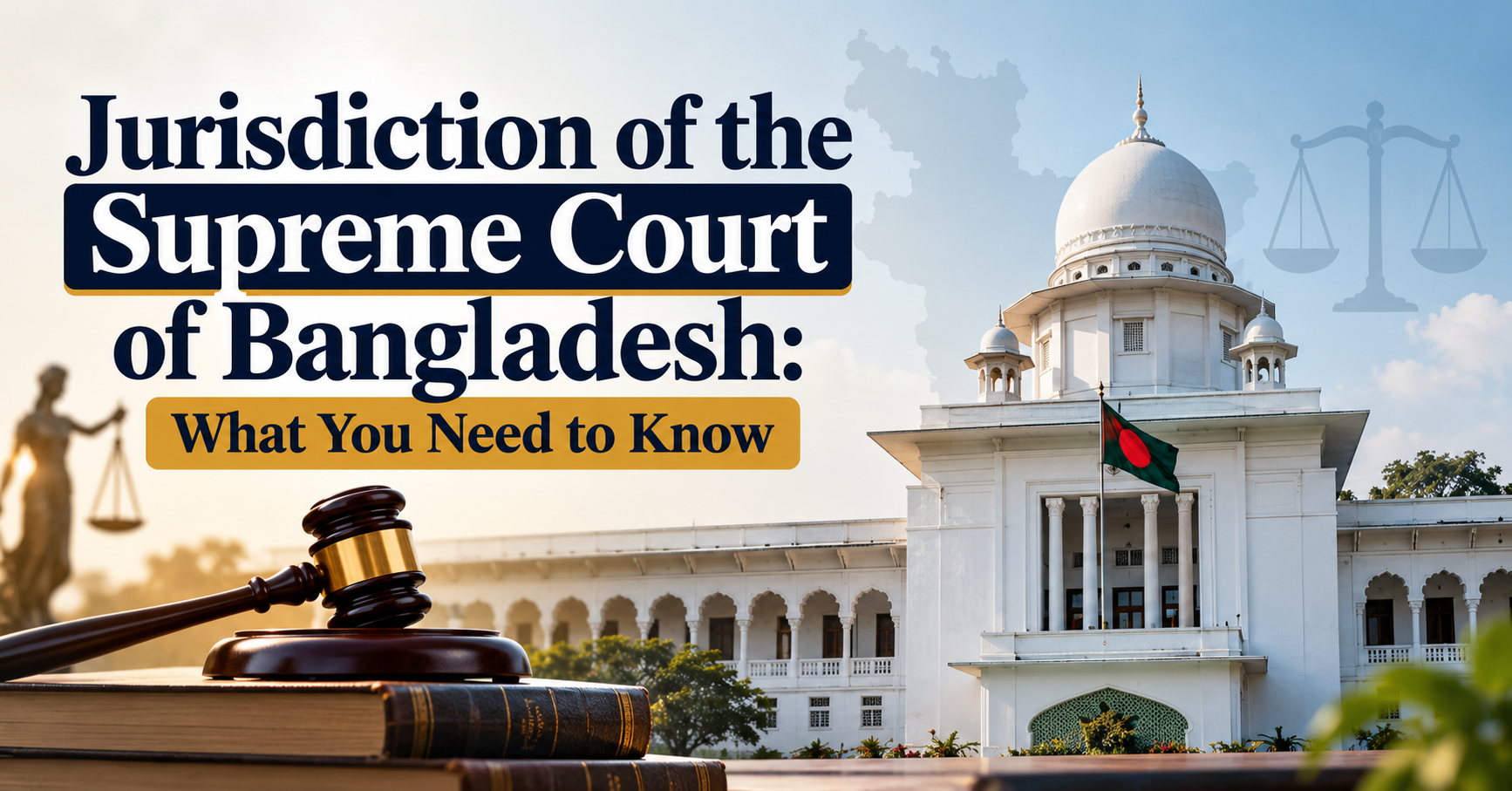
Jurisdiction of the Supreme Court of Bangladesh: What You Need to Know
Jurisdiction of the Supreme Court of Bangladesh: What You Need to Know
The Supreme Court of Bangladesh is the highest court in the country’s judicial system and plays a central role in interpreting the Constitution, protecting fundamental rights, hearing appeals, and supervising subordinate courts and tribunals. Its jurisdiction is primarily derived from the Constitution of the People’s Republic of Bangladesh as well as laws enacted by Parliament. Supreme Court of Bangladesh
For students of law, lawyers, legal professionals, researchers, and anyone seeking to understand the Bangladesh judicial system, knowing the jurisdiction of the Supreme Court is essential.
What Is the Supreme Court of Bangladesh?
Under Article 94 of the Constitution of Bangladesh, there is a Supreme Court of Bangladesh consisting of two divisions:
- High Court Division
- Appellate Division
Although both are parts of the Supreme Court, they exercise different types of jurisdiction. The High Court Division generally deals with constitutional remedies, original matters, appeals, revisions, and supervision of subordinate courts, while the Appellate Division primarily functions as the country's highest appellate court. Bangladesh Laws
This distinction is important when determining which Supreme Court division has jurisdiction over a particular legal matter.
Jurisdiction of the High Court Division
The jurisdiction of the High Court Division (HCD) is principally established under Article 101 of the Constitution. It may exercise original, appellate, and other jurisdictions and powers conferred by the Constitution or by other laws. Bangladesh Laws
Its major areas of jurisdiction include the following.
1. Original Jurisdiction
Original jurisdiction means that the High Court Division can hear certain matters as a court of first instance rather than hearing them as an appeal from a lower court.
The High Court Division has specific original jurisdiction under the Constitution and various statutes. These include constitutional matters and certain company, admiralty, succession, and other matters provided by legislation. Supreme Court of Bangladesh
This means that not every case must begin in a subordinate court before reaching the High Court Division. In matters where the Constitution or legislation grants original jurisdiction, proceedings may commence directly before the High Court Division.
2. Writ Jurisdiction Under Article 102
One of the most significant aspects of the jurisdiction of the High Court Division is its constitutional writ jurisdiction.
Under Article 102, the High Court Division may issue appropriate directions or orders for the enforcement of fundamental rights guaranteed under Part III of the Constitution. It can also exercise judicial review in appropriate circumstances. Bangladesh Laws
Writ jurisdiction is particularly important when a person challenges the legality of an action, decision, or failure to act by a public authority.
Depending on the circumstances, constitutional remedies may involve issues concerning:
- Fundamental rights
- Exercise of public power
- Legality of administrative decisions
- Jurisdictional errors
- Failure to perform a legal duty
- Unlawful actions by public authorities
The Supreme Court's official explanation identifies Article 102 as the constitutional basis for enforcing fundamental rights and exercising judicial review through the High Court Division. Supreme Court of Bangladesh
3. Appellate Jurisdiction of the High Court Division
The High Court Division also has appellate jurisdiction where the Constitution or legislation gives it authority to hear appeals.
Various laws provide the High Court Division with appellate jurisdiction over decisions of subordinate courts, tribunals, and other judicial bodies. The Supreme Court identifies provisions of the Code of Civil Procedure, 1908, Code of Criminal Procedure, 1898, and other legislation as sources of such jurisdiction. Supreme Court of Bangladesh
Therefore, the High Court Division does not only deal with constitutional petitions. It also plays an important role in the appellate structure of Bangladesh's civil and criminal justice system.
4. Revisional Jurisdiction
The High Court Division may exercise revisional jurisdiction over certain decisions of subordinate courts.
For civil matters, Section 115 of the Code of Civil Procedure, 1908 provides a basis for revisional jurisdiction. In criminal matters, Section 439 of the Code of Criminal Procedure, 1898 provides revisional powers.
The Supreme Court also identifies Section 561A of the Code of Criminal Procedure as providing inherent powers to the High Court Division in appropriate circumstances, including preventing abuse of the process of a court or securing the ends of justice. Supreme Court of Bangladesh
5. Superintendence and Control Over Subordinate Courts
The High Court Division has an important supervisory role over courts and tribunals subordinate to it.
Under Article 109 of the Constitution, the High Court Division has superintendence and control over all courts and tribunals subordinate to it. Bangladesh Laws
This constitutional power contributes to maintaining judicial discipline, procedural consistency, and proper administration of justice within the subordinate judiciary.
6. Transfer of Cases
The High Court Division can also transfer certain cases from subordinate courts.
Under Article 110 of the Constitution, where a pending case involves a substantial question of law concerning the interpretation of the Constitution or a point of general public importance necessary for deciding the case, the High Court Division may withdraw the case from the subordinate court. It may decide the case itself or determine the relevant legal question and return the case with directions based on its judgment. Bangladesh Laws
This mechanism allows important constitutional or public-interest questions to receive authoritative consideration by the High Court Division.
Jurisdiction of the Appellate Division
The Appellate Division is the highest appellate forum within the Supreme Court of Bangladesh.
Its principal appellate jurisdiction comes from Article 103 of the Constitution. It hears and determines appeals from judgments, decrees, orders, or sentences of the High Court Division. Bangladesh Laws
However, an appeal does not automatically lie in every case. The Constitution distinguishes between situations where an appeal lies as of right and cases where leave to appeal is required.
1. Appeals as of Right
Under Article 103, an appeal to the Appellate Division lies as of right in specified circumstances.
These include cases where the High Court Division:
- Certifies that the case involves a substantial question of law concerning the interpretation of the Constitution;
- Confirms a sentence of death or sentences a person to death or imprisonment for life;
- Imposes punishment for contempt of the High Court Division; or
- Falls within other categories provided by an Act of Parliament. Bangladesh Laws
These constitutional provisions define important circumstances in which a party does not need to obtain leave from the Appellate Division before pursuing the appeal.
2. Leave to Appeal
Where Article 103(2) does not apply, an appeal from a judgment, decree, order, or sentence of the High Court Division generally requires leave to appeal from the Appellate Division. Bangladesh Laws
In practical terms, this means that the right to approach the Appellate Division is not identical in every case. The applicable constitutional or statutory provision must be examined to determine whether an appeal is available as of right or whether leave is necessary.
Power to Do Complete Justice
Another important constitutional power of the Appellate Division is found in Article 104.
The Appellate Division may issue directions, orders, decrees, or writs that are necessary for doing complete justice in a pending cause or matter. The constitutional provision also includes powers concerning matters such as securing the attendance of persons and the discovery or production of documents. Supreme Court of Bangladesh
This power is significant because it gives the Appellate Division procedural and remedial authority necessary to effectively resolve matters before it.
Review Jurisdiction of the Appellate Division
The Appellate Division also possesses review jurisdiction.
Under Article 105 of the Constitution, the Appellate Division has the power, subject to applicable law and its rules, to review a judgment pronounced or an order made by it. Supreme Court of Bangladesh
A review is different from an ordinary appeal. It involves reconsideration by the same court within the constitutional and procedural framework governing review proceedings.
Advisory Jurisdiction
The Supreme Court's Appellate Division also has an advisory jurisdiction under Article 106 of the Constitution.
Where the President considers that a question of law has arisen or is likely to arise and that the question is of such public importance that obtaining the Supreme Court's opinion is expedient, the President may refer the question to the Appellate Division. The Division may then consider the question and report its opinion. Supreme Court of Bangladesh
This is distinct from ordinary litigation because it involves a constitutional mechanism for obtaining the Court's opinion on an important question of law.
Supreme Court as a Court of Record
Under Article 108, the Supreme Court of Bangladesh is a court of record.
The Constitution provides that the Supreme Court has the powers of such a court, including the power, subject to law, to make orders concerning the investigation or punishment of contempt of itself. Bangladesh Laws
The status of a court of record is an important feature of the constitutional position of the Supreme Court.
High Court Division vs Appellate Division
Understanding the difference between the two divisions makes the jurisdiction of the Supreme Court of Bangladesh much easier to understand.
| High Court Division | Appellate Division |
|---|---|
| Exercises original jurisdiction in matters provided by law | Primarily exercises appellate jurisdiction |
| Exercises constitutional writ jurisdiction under Article 102 | Hears appeals from the High Court Division |
| Has appellate jurisdiction under various laws | May hear appeals as of right in constitutionally specified cases |
| Exercises revisional jurisdiction | Requires leave to appeal in cases where Article 103 does not provide an appeal as of right |
| Supervises subordinate courts and tribunals | Has constitutional power to do complete justice |
| Can transfer certain cases under Article 110 | Has review jurisdiction under Article 105 |
| Exercises other powers provided by the Constitution and legislation | Has advisory jurisdiction under Article 106 |
The two divisions therefore perform complementary but distinct functions within Bangladesh's Supreme Court structure. Supreme Court of Bangladesh
Key Constitutional Articles on Supreme Court Jurisdiction
For law students and legal researchers, several constitutional provisions are particularly important:
Article 94 — Establishment and structure of the Supreme Court
Article 100 — Seat of the Supreme Court
Article 101 — Jurisdiction of the High Court Division
Article 102 — Constitutional directions, orders and writ jurisdiction
Article 103 — Appellate jurisdiction of the Appellate Division
Article 104 — Power to issue orders and directions for complete justice
Article 105 — Review jurisdiction
Article 106 — Advisory jurisdiction
Article 108 — Supreme Court as a court of record
Article 109 — Superintendence and control over subordinate courts
Article 110 — Transfer of cases to the High Court Division Bangladesh Laws
These provisions form the core constitutional framework for understanding the Supreme Court jurisdiction in Bangladesh.
Why the Jurisdiction of the Supreme Court Matters
The jurisdiction of the Supreme Court is important because it determines what types of legal questions the Court can hear, which division has authority to deal with a matter, and what type of remedy or appeal may be available.
For example, a person seeking enforcement of a constitutional fundamental right may need to consider the High Court Division's jurisdiction under Article 102. On the other hand, a party challenging a judgment of the High Court Division may need to consider the appellate jurisdiction of the Appellate Division under Article 103.
Understanding jurisdiction is therefore not simply an academic exercise. It is fundamental to understanding how litigation moves through the Bangladesh court system.
Frequently Asked Questions About Supreme Court Jurisdiction in Bangladesh
What are the two divisions of the Supreme Court of Bangladesh?
The Supreme Court consists of the High Court Division and the Appellate Division, as provided by Article 94 of the Constitution. Bangladesh Laws
What is the main jurisdiction of the High Court Division?
The High Court Division has original, appellate, revisional, constitutional, supervisory, and other jurisdictions provided by the Constitution and legislation. Its constitutional writ jurisdiction under Article 102 is particularly significant. Supreme Court of Bangladesh
What is the main jurisdiction of the Appellate Division?
The Appellate Division primarily hears appeals from judgments, decrees, orders, and sentences of the High Court Division under Article 103. Bangladesh Laws
Does every High Court Division decision automatically go to the Appellate Division?
No. Depending on the nature of the case, an appeal may lie as of right under Article 103, or leave to appeal may be required. Bangladesh Laws
Can the Supreme Court review its own decisions?
The Appellate Division has constitutional power to review its judgments and orders under Article 105, subject to applicable law and its rules. Supreme Court of Bangladesh
Can the High Court Division supervise lower courts?
Yes. Article 109 gives the High Court Division superintendence and control over courts and tribunals subordinate to it. Bangladesh Laws
Final Thoughts
The jurisdiction of the Supreme Court of Bangladesh is primarily shaped by the Constitution and supplemented by legislation. The High Court Division exercises broad original, constitutional, appellate, revisional, and supervisory powers, while the Appellate Division serves as the country's highest appellate forum and exercises additional constitutional powers including review and advisory jurisdiction. Supreme Court of Bangladesh
For anyone studying Bangladesh constitutional law, Supreme Court jurisdiction, writ jurisdiction, judicial review, appellate jurisdiction, or the Bangladesh judicial system, Articles 94, 101–106, and 108–110 provide an essential starting point.
Primary legal sources: Supreme Court of Bangladesh — Jurisdiction · Constitution of Bangladesh — Laws of Bangladesh · Bangladesh Judiciary — Jurisdiction of Courts