

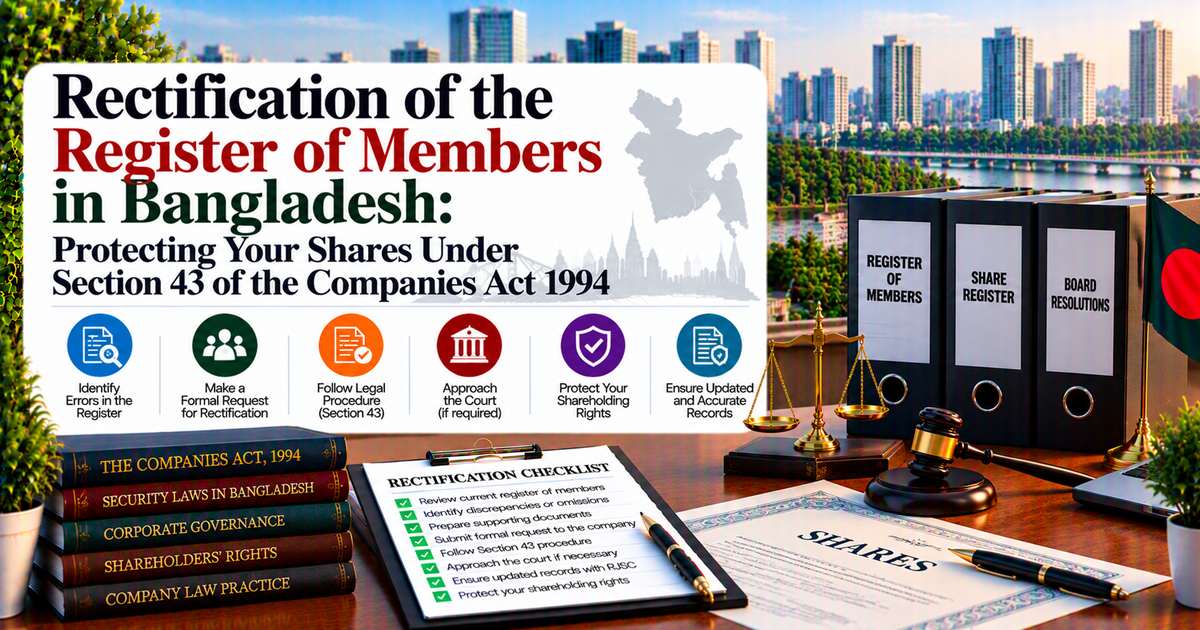
Rectification of the Register of Members in Bangladesh: Protecting Your Shares Under Section 43 of the Companies Act 1994
Imagine you helped set up a company, paid for your shares and kept your share certificate safe for years. One day you learn from the RJSC that your shares now stand in someone else's name. You never signed anything, never received any money, and no one told you. The company stops sending you notices and stops paying you dividends. In the eyes of the company, you are no longer a shareholder.
This happens more often than most people think. It happens in family businesses, in partnerships between friends, and in large companies alike. The good news is that the law gives a strong and direct remedy. This article explains, in plain language:
what the "register of members" is and why it matters so much;
what kinds of wrongs the High Court can correct;
what the Court can order to put you back in your rightful position;
the mistakes that can cause a good case to fail; and
how The Justice Corner can help you protect your shares.
Key terms in plain words
| Term | What it means |
|---|---|
| Register of members | The official list every company must keep of its shareholders. It records each shareholder's name, address and the number of shares held. Whoever is on this list is treated as the owner. |
| Rectification | Correcting that list. It may mean adding a name that was wrongly left out, removing a name that was wrongly put in, or correcting the number of shares. |
| RJSC | The Registrar of Joint Stock Companies and Firms, the government office where companies file their records. |
| Form 117 | The written document used to transfer shares from one person to another. It must be signed by both the seller (transferor) and the buyer (transferee). |
| Schedule X | The annual return a company files with the RJSC, listing its shareholders and their shares. |
| Form XII | The return a company files with the RJSC listing its directors. |
| Succession certificate | A certificate from a civil court naming the heirs who may collect a deceased person's shares and other assets. |
| Company Bench | The judge of the High Court Division who hears cases under the Companies Act. |
The law that protects you: section 43 of the Companies Act 1994
Section 43 of the Companies Act 1994 is the main provision. It replaced section 38 of the old Companies Act 1913, and the courts still follow the decisions made under the old section. Put simply, section 43 says three things.
1. When you can go to Court. You can apply if:
a person's name has been put on the register when it should not have been;
a person's name has been left off or removed from the register when it should be there; or
the company has failed or delayed in recording that someone has become a shareholder or stopped being one.
The law uses the words "without sufficient cause". In everyday language, the entry or removal happened without a proper legal reason.
2. What the Court can order. The Court can correct the register. It can also order the company to pay compensation (damages) for loss caused by the wrong entry, and order the losing side to pay legal costs.
3. What the Court can decide. This is what makes section 43 powerful. The Court is not limited to correcting a clerical mistake. It can decide who actually owns the shares, whether the dispute is between two shareholders or between a shareholder and the company. It can also decide any other question of fact or law needed to put the register right.
Which court hears the case, and why that helps you
The case is filed directly in the High Court Division of the Supreme Court and heard by the Company Bench. It is not an ordinary civil suit that must start in a lower court and climb up through appeals. The courts have described it as a "special statutory proceeding" (Dhaka Stock Exchange Ltd v Motiur Rahman, 7 BLC (2002) 150).
This brings practical benefits:
Speed. Cases are usually decided on sworn affidavits and documents, without a long trial.
Expertise. The judge regularly deals with company law and company records.
Access to official records. The Court can call for the company's complete file from the RJSC and examine it directly.
The courts have read this power widely
The Appellate Division, the highest court in Bangladesh, has confirmed that the Company Judge may decide ownership of shares and order the company to correct the register (Industrial Development Company Ltd v Sukhendu Shekhor Mukherjee, LEX/BDAD/0072/1980). It has also said the Court has "a wide discretion to scrutinise any fraud, error or undue influence or misrepresentation in the matter of transfer of any share" (Ahmed Impex (Pvt) Ltd v Moqbul Ahmed, 56 DLR (AD) 92). The High Court Division has added that the Court is not restricted to simple cases (Sirajul Haque v Apollo Ispat Complex Ltd, 18 BLC (2013) 704).
Who can apply to the Court?
The law allows three kinds of people to apply:
Any person who has been wronged by the entry (the law calls this "the person aggrieved");
Any member (shareholder) of the company, even if the wrong entry concerns someone else's shares; and
The company itself, for example when new management finds the old records are wrong.
In real life, the people who come to Court usually fit one of the situations below. If yours is among them, section 43 is likely open to you.
| Your situation | What has typically gone wrong | Decided case |
|---|---|---|
| "My name has been removed from the register." | Someone used a forged or unpaid share transfer form to move your shares to themselves. | Md. Golam Rabbani v Diamond Egg Ltd (2025) |
| "I bought shares, but the company will not register me." | You hold signed transfer forms and the share certificates, but the company or seller refuses to act. | Iftekhar al-Jamil v Janata Insurance Co Ltd (2014) |
| "My father or mother died, and the company will not recognise us." | The heirs hold a succession certificate, but the company has not entered their names. | Nasrin Sayeed v Broadcast Islamic World Ltd (2013) |
| "New shares were issued and I was left out." | The board gave new shares to insiders without properly offering existing shareholders their share. | Sirajul Haque v Apollo Ispat Complex Ltd (2013) |
| "Others have been given shares they had no right to." | Shares were issued unlawfully to some members, reducing everyone else's percentage. | Rowshan Ara Begum v Doctor's Chemical Works Ltd (1991) |
| "My club expelled me unfairly." | A club or association registered as a company removed you without a fair hearing. | Md. Delwar Khan v RJSC (2019) |
| "The records show fewer shares than I own." | The company's figures understate your holding. | Industrial Development Co Ltd v Sukhendu Shekhor Mukherjee (1980) |
Not only for shares. Many people think this remedy applies only to shares. In Delwar Khan, the Court pointed out that the word "share" does not appear in section 43. Members of clubs, associations and other companies limited by guarantee, which have members but no shares, can use it too.
The applicant must be genuine. In Bangladesh Bank v Eagleway Investment Ltd (2015), three foreign companies obtained rectification orders. The Appellate Division found they had already been dissolved in Hong Kong before they applied, and that the orders were obtained by fraud without informing Bangladesh Bank. It cancelled the orders. The remedy is there to protect real owners, not to help others take what is not theirs.
What kinds of wrongdoing can the Court correct?
The Court can correct any entry made, or any name removed, without a proper legal reason. The decided cases show ten common situations. For each one, we explain what happened, what the Court did, and what it means for you.
1. A forged share transfer form
What happened. In Golam Rabbani v Diamond Egg Ltd (2025), a founding director held 10% of a poultry company. The managing director and his wife filed documents with the RJSC showing that he had sold all his shares to the wife. When he objected, papers appeared in his name withdrawing the objection and "confirming" the sale.
What the Court did. The judge compared his genuine signatures with those on the disputed papers and found the later documents were forged. The respondents had even applied during the case to "buy" his shares, which showed he had never sold them. His name was restored and he was awarded the dividends he had missed.
What it means for you. A forged signature cannot pass ownership. The Court will examine signatures itself, so you do not always need a separate criminal case or handwriting expert. The Appellate Division approved this method in Reza Bin Rahman v A.T.G. Mortaza, 7 LM (AD) 8.
2. A sale where the price was never paid
What happened. In the same case, the Court accepted that the director had at one stage signed a transfer form. He was never paid, changed his mind, and promptly told the RJSC not to record the transfer.
What the Court did. It held that the transfer was not genuinely completed, and the later papers used to force it through were forged.
What it means for you. If you signed but were never paid, act quickly and object in writing. Your prompt objection can become key evidence.
3. A broken chain of ownership
What happened. In S.M. Habibur Rahman v Banani Pictures Ltd, 72 DLR (2020) 565, one brother claimed his siblings' shares had passed to their father in 2000, and then from the father to him. The siblings said the 2000 transfers were forged.
What the Court did. It traced every step of ownership and found clear signs of forgery:
one person shown as selling shares had died five years earlier;
two others were in the USA on the date they supposedly signed;
the companies that held shares had passed no board decisions approving any sale; and
the company's own rules required shares to be offered first to existing members, and they were not.
The 2000 transfers were void, so everything built on them fell too. The register was restored to how it stood before the forgery.
What it means for you. If a transfer early in the chain is fake, every later transfer based on it fails as well.
4. The company refuses or delays registering a genuine purchase
What happened. In Iftekhar al-Jamil v Janata Insurance Co Ltd (2014), a buyer received signed and verified transfer forms and the original certificates for 20,000 shares. The seller, a director, later claimed she had never been paid, and the transfer was never registered.
What the Court did. The Court reasoned that no sensible seller hands over signed forms and original certificates without being paid. The lack of a money receipt did not change that. The company was ordered to register the buyer within seven days, and to give him the dividends, bonus shares and rights shares from the date of the transfer. The seller was ordered to pay costs.
What it means for you. Keep your signed transfer forms and original certificates safe. They are strong proof of a completed purchase.
5. Heirs not recognised after a shareholder's death
What happened. In Nasrin Sayeed v Broadcast Islamic World Ltd (2013), the founder of a television company died holding 1,06,000 shares. His widow and children obtained a succession certificate and wrote to the company. The company promised to act but never did.
What the Court did. It ordered the company to enter the heirs' names within 15 working days, in the proportions stated in the certificate. The heirs were also to be shown in the company's annual return and sent notice of all future meetings.
What it means for you. Heirs step into the deceased shareholder's shoes. Obtain a succession certificate, write formally to the company, and if it does not respond, the Court can compel it.
6. New shares issued without a fair offer to existing shareholders
What happened. In Sirajul Haque v Apollo Ispat Complex Ltd (2013), a founding director owned 15.88% of a steel company. When the company issued 10.7 crore new shares, his "offer" letter stated the wrong number of shares. It was also said to have been delivered by registered post the very next day, which the Court found doubtful.
What the Court did. Under section 155 of the Companies Act, new shares must first be offered to existing shareholders in proportion to their holdings. The offer must state the exact number of shares and give at least 15 days to accept, counted from when the offer is actually received. A wrong number meant no valid offer at all. The Court ordered the company to allot him 1,69,91,600 shares on payment of the price.
What it means for you. You have a legal right to keep your percentage when a company raises capital. A careless or defective offer does not take that right away.
7. Shares issued by the wrong people or at an invalid meeting
What happened. In Rowshan Ara Begum v Doctor's Chemical Works Ltd (1991), a managing director called general meetings without a proper agenda. He then gave 1,51,000 new shares to himself and two allies, despite objections from shareholders holding 75% of the company.
What the Court did. Only the board of directors can issue new shares, and it must offer them first to existing shareholders. Neither step was taken, so the Court declared the issue void and deleted the shares.
What it means for you. A majority grabbed by issuing fake or unlawful shares can be reversed.
8. Records showing fewer shares than you own
What happened. In Industrial Development Co Ltd v Sukhendu Shekhor Mukherjee (1980), the company showed a shareholder with only 10 shares, although its own records supported 2,510 for him and 1,810 for his wife.
What the Court did. The Appellate Division said that if the company claims shares were transferred away, the company must prove it with a proper transfer document. It could not, and the register was corrected.
What it means for you. Whoever claims you sold your shares must prove it. Your share certificates and the company's RJSC filings are strong evidence.
9. Unfair expulsion from a club or association
What happened. In Md. Delwar Khan v RJSC (2019), a club registered as a company expelled a member for life after a late-night scuffle. Another member involved received only a temporary suspension, which was later lifted. The member who complained was not punished at all, and the expelled member was not given a fair chance to answer the evidence.
What the Court did. It held the expulsion was far too harsh and unfair, and ordered the club to restore his membership.
What it means for you. Clubs and associations must treat members fairly and in proportion to what they did.
10. False filings with the RJSC
What happened. In Golam Rabbani, the respondents obtained certified copies of RJSC records showing the change in shareholding, based on forged papers.
What the Court did. It looked behind the official copies, found they rested on forgery, and ordered correction.
What it means for you. An entry in RJSC records does not settle ownership if it was obtained by fraud. The rule also works the other way. In Bangladesh Bank v Eagleway (2015), the Appellate Division cancelled rectification orders obtained by fraud. Courts protect the genuine owner, whichever side that is.
What can the Court order to put things right?
The Court's goal is to put you back where you should have been, as if the wrong had never happened. That is why its orders go well beyond simply changing a name on a list.
| What the Court can order | What it means in practice | Example from the cases |
|---|---|---|
| Declare who owns the shares | A formal ruling that the shares are yours. | Sirajul Haque: declared owner of 1,69,91,600 shares |
| Put your name back on the register | Your name is restored with the correct number of shares. | Golam Rabbani: 2,500 shares restored; Delwar Khan: club membership restored |
| Correct the number of shares | An understated holding is corrected. | Industrial Development Co Ltd |
| Remove wrongful entries | Names or shares entered without right are struck out, and the related RJSC filings are cancelled. | Rowshan Ara Begum: 1,51,000 unlawful shares deleted |
| Undo a chain of fake transfers | The register is restored to the last genuine position. | Habibur Rahman: register restored to its pre-2000 position |
| Order the company to issue shares to you | Where you were wrongly denied new shares, the company must allot them to you on payment of the price. | Sirajul Haque: allotment within 60 days |
| Order a transfer or inheritance to be registered | The company must act within a fixed time. | Iftekhar al-Jamil: 7 days; Nasrin Sayeed: 15 working days |
| Pay you what you missed | Dividends, bonus shares and rights shares from the date of the wrong. | Iftekhar al-Jamil; Golam Rabbani |
| Compensation and costs | The company can be ordered to pay damages, and the losing side to pay legal costs. | Iftekhar al-Jamil: Tk 50,000 costs |
| Directions to the company and the RJSC | Update the annual return and directors' list, send you meeting notices, and confirm compliance on affidavit. | Nasrin Sayeed; Delwar Khan |
| Urgent temporary protection | While the case is pending, the Court can stop the disputed shares being sold or diluted, and can freeze major company steps. | Sirajul Haque: transfers and the company's public share offering put on hold |
A note on compensation
Compensation under section 43 is at the Court's discretion. You cannot insist on it in the rectification case. However, if you suffered a real financial loss because your name was kept off the register, you can still bring a separate money suit for damages. In Dhaka Stock Exchange Ltd v Motiur Rahman (2001), a shareholder first got his name restored, then sued for Tk 7.80 crore in lost business. The High Court Division held that the second suit could go ahead.
Mistakes that can cost you your case
Rectification is a strong remedy, but the Court has discretion to refuse it. In September 2026, in Abu Taber v Newtex Group of Companies (Company Matter 191 of 2017), the High Court Division refused relief and explained clearly where the limits lie. These are the six most common reasons a good claim fails.
1. Waiting too long
There is no fixed deadline for filing, because the Limitation Act does not apply to these cases (Tamizul Haque v Shamsul Haque, 43 DLR (AD) 34). But you must still act within a reasonable time. In Sirajul Haque, filing about two years and eight months after learning of the problem was acceptable. In Abu Taber, the transfers had happened sixteen years earlier and other people had since paid for the shares, so relief was refused.
Our advice: act as soon as you discover the problem.
2. A dispute that is too complicated for this kind of case
The Court can decide disputed facts from documents (Rowshan Ara Begum; Golam Rabbani). But some disputes require cancelling old agreements, deciding whether children could legally sign, or settling quarrels between many heirs who are not before the Court. In those cases, the Court may send the parties to an ordinary civil suit instead. This does not mean you have lost your rights; you simply have to pursue them in a different court.
Our advice: the way the case is prepared and presented often decides whether it stays in the Company Court.
3. The company acted honestly on an old succession certificate
If a company dealt in good faith with heirs named in a succession certificate, sections 381 and 386 of the Succession Act 1925 protect that dealing. This holds even if the certificate is later cancelled and other heirs come forward (Abu Taber).
Our advice: if you are an heir left out of a succession case, challenge the certificate and inform the company in writing immediately.
4. Not proving each step of your ownership
Whoever claims a transfer took place must prove it (Industrial Development Co Ltd). If your own ownership came through several transfers, you must prove each one, with signed transfer forms, board approvals and, where challenged, witnesses. In Habibur Rahman, the applicant could not do this. He lost not only his claim but also the shares that were already in his name.
Our advice: gather your documents before you start, and have a lawyer test them for weak points.
5. Leaving out people who will be affected
The company and anyone whose name may be removed must be made parties and given notice. An order obtained without notice can later be cancelled (Bangladesh Bank v Eagleway).
6. Not telling the whole story
The Court expects full honesty. If you took part in the very deal you now challenge, say so and explain why. Hiding it will damage your credibility.
How The Justice Corner protects your shares
The cases above share a clear lesson. Shareholders who act early, keep their papers in order and ask the Court for everything they are owed are the ones who recover their shares. The Justice Corner, led by Barrister Mohammad Imam Hossain (Tareq), Advocate, Supreme Court of Bangladesh, takes clients through each stage below.
Step 1: We find out exactly what happened
We obtain certified copies of the company's complete RJSC file: every annual return, list of directors, record of share allotments and transfer form filed. We compare them with your share certificates, transfer papers and tax returns. Forged signatures, impossible dates (such as a "signature" by someone who had died or was abroad) and missing board approvals often show up at this stage.
Step 2: We stop the damage from spreading
If a suspicious filing is still pending, we lodge a written objection with the RJSC and attend in person. This puts the government on notice and creates a record that you never agreed. In Golam Rabbani, the shareholder's early objections later carried great weight with the Court.
Step 3: We formally demand that the company correct its records
A clear written demand, with your documents attached, sometimes resolves the matter without going to Court, especially in cases of purchase or inheritance. If the company ignores it, that silence becomes evidence of "default or unnecessary delay".
Step 4: We seek urgent protection from the Court
When we file the case, we ask the Court to stop the disputed shares being sold, mortgaged or diluted while it is pending. Where needed, we also ask it to freeze board changes, new share issues or public offerings.
Step 5: We build a case the Court can decide quickly
We prepare the case so it can be decided on documents in the Company Court, without being sent away to a lengthy civil suit. That means:
joining every necessary party and serving them properly;
proving every link in your ownership;
setting out signature comparisons clearly; and
calling witnesses or RJSC officials where the evidence requires it.
Step 6: We ask for everything you are owed
We ask not only for your name to be restored, but for every related order the facts support. That may include a declaration of ownership, removal of wrongful entries, issue of any shares you were denied, past dividends and bonus or rights shares, costs, and directions to the RJSC.
Step 7: We make sure the order is carried out
Winning the case is not the end. We follow up until the company has complied and the RJSC records are updated. If the order is ignored, we take contempt proceedings. If your financial loss goes beyond what the Company Court awards, we advise you on a separate claim for damages.
We also advise companies and directors who need to correct their own registers or defend a challenge. An accurate register protects everyone, including banks and investors.
What to bring to your first meeting with us
☐ Share certificates and allotment letters
☐ Any share transfer forms (Form 117), board resolutions or notarised affidavits about the shares
☐ Any RJSC copies you hold, such as Schedule X or Form XII
☐ The company's Memorandum and Articles of Association
☐ Letters or emails with the company or the RJSC, including any offer of new shares
☐ For heirs: the death certificate and succession certificate
☐ Your income tax returns showing the shares
☐ A short note of when and how you learned about the problem
Conclusion
Your shares are valuable property, and the law protects them. Section 43 of the Companies Act 1994 gives one specialised court the power to decide who owns the shares, reverse fraud and restore what was lost. The courts have used it against forged transfers, unpaid sales, ignored heirs, unfair share issues, invalid meetings and wrongful expulsions.
The same courts have also refused help to people who waited too long, could not prove their ownership, or brought disputes too tangled for this procedure. What usually makes the difference is how quickly you act and how carefully your case is prepared.
If your name has been removed from a company's register, your shareholding has been diluted, or a company refuses to recognise your purchase or inheritance, contact The Justice Corner, Dhaka, for an early review of your documents.
This article gives general information about the law as of October 2026. It is not legal advice on any particular case. The outcome of every case depends on its own facts and evidence.