

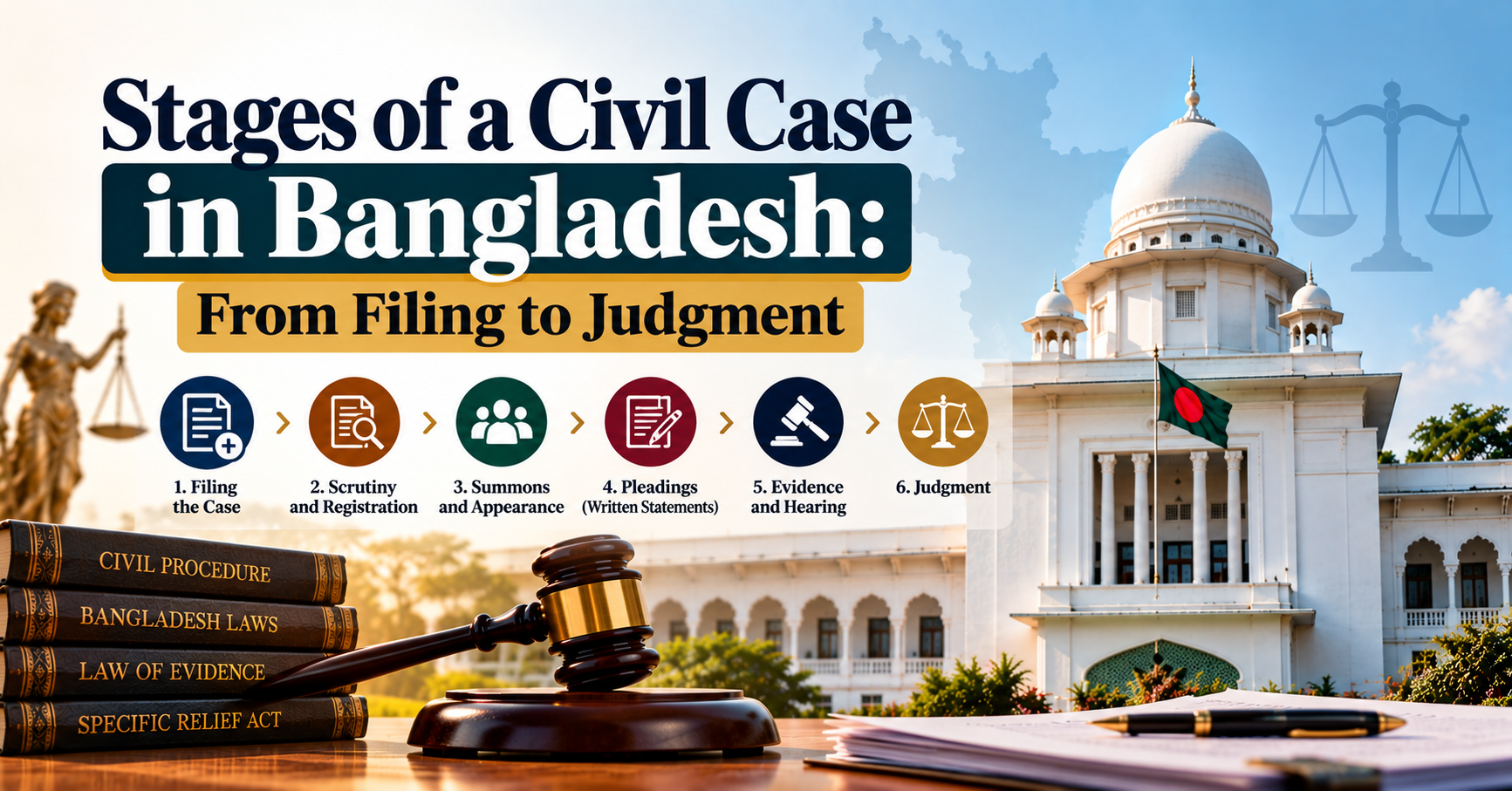
Stages of a Civil Case in Bangladesh: From Filing to Judgment
A civil case in Bangladesh generally passes through several procedural stages, beginning with the filing of a plaint and ending with the delivery of judgment and preparation of a decree. Depending on the nature of the dispute, the case may subsequently proceed to execution, appeal, revision, or review.
The main procedural framework is the Code of Civil Procedure, 1908 (CPC), which applies throughout Bangladesh, subject to specialised laws and statutory exceptions. The CPC provides the framework for jurisdiction, institution of suits, pleadings, summons, evidence, judgment, decree and other stages of civil litigation. Bangladesh Laws
This guide explains the stages of a civil case in Bangladesh in a simple, step-by-step format.
What Is a Civil Case?
A civil case is a legal proceeding concerning civil rights, obligations, property, contracts, possession, money claims, injunctions, declarations and other matters of a civil nature.
Under Section 9 of the Code of Civil Procedure, 1908, civil courts generally have jurisdiction to try suits of a civil nature unless their jurisdiction is expressly or impliedly barred by law. Bangladesh Laws
Common examples include:
- Land and property disputes
- Ownership disputes
- Possession claims
- Money recovery
- Breach of contract
- Partition suits
- Declaration of legal rights
- Permanent injunctions
- Temporary injunctions
- Specific performance
- Compensation and damages
- Certain succession and inheritance disputes
Not every dispute, however, is filed before an ordinary civil court. Some matters are assigned by law to Family Courts, Artha Rin Adalats, specialised tribunals, or other statutory forums.
Overview of the Civil Case Process in Bangladesh
A typical civil case can be broadly represented as:
Cause of action → Choosing the proper court → Drafting plaint → Filing suit → Registration → Summons → Written statement → Issues → Evidence → Arguments → Judgment → Decree → Execution → Appeal/revision/review, where applicable
The actual procedure can vary depending on the type of case and the applicable legislation.
Stage 1: Cause of Action Arises
A civil case begins with a cause of action.
A cause of action refers to the material facts that give a person the legal basis to approach a court for relief.
For example:
Agreement → contractual obligation → breach → legal injury → right to seek remedy
Suppose A agrees to sell property to B but later refuses to complete the transaction despite fulfilling the contractual conditions. Depending on the facts and applicable law, B may have a cause of action for an appropriate legal remedy.
The plaintiff's case must identify the material facts forming the basis of the claim.
Stage 2: Determine the Appropriate Court
Before filing a case, the plaintiff must determine which court has jurisdiction.
This generally involves considering:
- Territorial jurisdiction
- Pecuniary jurisdiction
- Subject-matter jurisdiction
- Nature of the relief
- Applicable special legislation
Territorial Jurisdiction
Under Section 20 of the CPC, certain suits may generally be instituted where the defendant resides or carries on business, or where the cause of action wholly or partly arises, subject to the statutory requirements. Bangladesh Laws
For disputes involving immovable property, Sections 16–19 contain additional rules concerning where the suit should be instituted. Bangladesh Laws
Pecuniary Jurisdiction
The value of the subject matter may determine which civil court can hear the case.
The Bangladesh Judiciary currently identifies the ordinary civil court structure as including:
- District Judge Court
- Additional District Judge Court
- Joint District Judge Court
- Senior Assistant Judge Court
- Assistant Judge Court
The judiciary's published jurisdiction information identifies different monetary ranges for several of these courts. Because statutory jurisdictional limits can be amended, the current applicable law and court notifications should be checked before filing. Slot
Lowest Competent Court
Section 15 of the CPC provides that a suit should generally be instituted in the court of the lowest grade competent to try it. Bangladesh Laws
Therefore, a plaintiff should not simply choose any court that appears convenient.
Stage 3: Check the Limitation Period
Before filing a civil case, the plaintiff should determine whether the claim is within the applicable limitation period.
Limitation varies according to the type of legal proceeding.
For example, the limitation period for:
- Recovery of money
- Possession of property
- Specific performance
- Declaration
- Cancellation of an instrument
may not be the same.
The Limitation Act, 1908 is therefore an important statute in civil litigation.
A limitation issue can become one of the most significant legal questions in a case, so it should be examined before filing.
Stage 4: Gather Documents and Evidence
Before drafting the plaint, the plaintiff should collect relevant documents and evidence.
Depending on the case, these may include:
- Sale deeds
- Contracts
- Khatian records
- Mutation documents
- Land tax receipts
- Bank records
- Receipts
- Notices
- Correspondence
- Photographs
- Maps
- Government records
- Previous court orders
- Expert reports
- Other relevant documents
The documents should be organised chronologically where possible.
For a property dispute, for example, the relevant title documents and land records may be particularly important.
Stage 5: Draft the Plaint
The plaint is the principal document through which an ordinary civil suit is instituted.
Section 26 of the CPC provides that every suit shall be instituted by presenting a plaint or in another prescribed manner. The current provision also provides that facts stated in every plaint are to be proved by affidavit. Bangladesh Laws
A properly drafted plaint generally identifies:
- The court
- Plaintiff
- Defendant
- Material facts
- Cause of action
- Jurisdiction
- Valuation
- Relief claimed
- Relevant documents
- Other legally required particulars
The pleading should clearly explain what happened, why the plaintiff has a legal claim, and what remedy is being requested from the court.
Stage 6: Filing the Plaint
After the plaint has been prepared, it is presented to the appropriate court or authorised officer.
The CPC's Order IV provides that a suit is commenced by presenting a plaint to the court, together with the required copies for service upon defendants. It also contains requirements concerning summons copies and prepaid registered acknowledgment covers. Bangladesh Laws
The plaintiff must comply with applicable:
- Court-fee requirements
- Filing requirements
- Document requirements
- Copy requirements
- Procedural rules
Once the plaint is admitted and registered, the case receives a case number and enters the court's procedural system.
Stage 7: Scrutiny and Registration of the Suit
The court office examines the filing for compliance with applicable requirements.
Issues may arise concerning:
- Court fees
- Valuation
- Jurisdiction
- Required documents
- Signatures
- Copies
- Pleading requirements
- Identification of parties
If procedural defects are identified, the plaintiff may be required to correct them.
Once the case is properly registered, it proceeds to the next stage.
Stage 8: Issuance and Service of Summons
After a civil suit has been duly instituted, summons may be issued to the defendant.
Section 27 of the CPC provides for issuance of summons requiring the defendant to appear and answer the claim. Bangladesh Laws
The current procedural rules also prescribe requirements concerning the timing and service of summons. Order V deals extensively with the issue and service of summons. Bangladesh Laws
The purpose of summons is to provide the defendant with formal notice of the case and an opportunity to respond.
Stage 9: Appearance of the Defendant
After receiving summons, the defendant may appear before the court personally or through a properly instructed pleader, subject to the applicable procedural rules.
The Bangladesh Judiciary states that a defendant receiving a summons from a Civil Court or Family Court should submit a written statement to contest the suit. Slot
Failure to respond appropriately can have serious procedural consequences.
Stage 10: Filing of Written Statement
The written statement is the defendant's principal pleading in response to the plaint.
The defendant may:
- Admit allegations
- Deny allegations
- Explain the defendant's version of events
- Raise legal objections
- Raise relevant defences
- Challenge the plaintiff's entitlement to relief
The written statement helps identify the areas where the parties agree and disagree.
For example, in a land dispute:
Plaintiff: "I am the lawful owner of the property."
Defendant: "The plaintiff does not have valid title, and the defendant has a superior legal claim."
The disputed questions then become matters for determination by the court.
Stage 11: Additional Pleadings and Procedural Applications
Depending on the circumstances, the parties may submit additional pleadings, applications or objections.
These may concern:
- Amendment of pleadings
- Addition or deletion of parties
- Discovery
- Production of documents
- Temporary injunction
- Appointment of commissioner
- Local investigation
- Other interlocutory matters
The CPC gives courts powers concerning discovery, inspection, production of documents and other procedural matters. Bangladesh Laws
Some applications may need to be resolved before the main trial progresses.
Stage 12: Framing of Issues
Once the pleadings are complete, the court identifies the issues that need to be determined.
An issue may concern a question of:
- Fact
- Law
- Mixed fact and law
For example, in a property case, the issues may include:
- Whether the plaintiff has valid title.
- Whether the defendant is in possession.
- Whether the plaintiff is entitled to recovery of possession.
- Whether the suit is barred by limitation.
Issues provide the framework for the trial.
Stage 13: Discovery and Production of Documents
Where necessary, the parties may be required to disclose, produce or respond to requests concerning relevant documents.
Section 30 of the CPC gives courts powers concerning matters such as:
- Interrogatories
- Admission of documents and facts
- Discovery
- Inspection
- Production of documents
- Production of other material objects
The court may also issue summons to persons whose attendance is required to give evidence or produce documents. Bangladesh Laws
Stage 14: Plaintiff's Evidence
The plaintiff normally presents evidence supporting the claims made in the plaint.
Evidence may include:
- Oral testimony
- Documentary evidence
- Expert evidence
- Government records
- Photographs
- Contracts
- Receipts
- Other admissible evidence
The plaintiff's witnesses may be examined and cross-examined according to the applicable procedural and evidentiary rules.
The purpose is to establish the facts necessary to obtain the relief claimed.
Stage 15: Cross-Examination of Witnesses
Cross-examination is an important part of civil litigation.
The opposing party may question a witness about:
- Accuracy
- Consistency
- Knowledge
- Documents
- Previous statements
- Relevant facts
The purpose is to test the reliability and evidentiary value of the testimony.
Stage 16: Defendant's Evidence
After the plaintiff's evidence, the defendant may present evidence supporting the defence.
This may include:
- Defendant's witnesses
- Documents
- Expert evidence
- Government records
- Contracts
- Receipts
- Other admissible materials
The plaintiff may cross-examine the defendant's witnesses.
The exact sequence can vary depending on the circumstances and procedural orders of the court.
Stage 17: Final Hearing and Arguments
After the evidence is completed, the parties present their final arguments.
The lawyers may address:
- Facts established by evidence
- Reliability of witnesses
- Documentary evidence
- Applicable legislation
- Previous judicial decisions
- Issues framed by the court
- Relief sought
The court then considers the pleadings, evidence and legal arguments before reaching its decision.
Stage 18: Judgment
After hearing the case, the court pronounces its judgment.
Section 33 of the CPC provides that after the case has been heard, the court shall pronounce judgment and a decree shall follow on that judgment. Bangladesh Laws
The judgment explains the court's determination of the relevant issues and the basis for its decision.
The result may include:
- Suit decreed
- Suit dismissed
- Suit partly decreed
- Other relief according to law
Stage 19: Decree
A decree is the formal expression of an adjudication that conclusively determines the rights of the parties concerning matters in controversy in the suit.
The CPC defines a decree as potentially being preliminary or final. Bangladesh Laws
This distinction matters because some cases require further proceedings before the parties' rights are completely worked out.
For example, a partition suit may involve a preliminary determination followed by further steps necessary to give effect to the parties' rights.
Stage 20: Execution of the Decree
A successful judgment does not always mean that the winning party immediately receives the relief ordered by the court.
If the losing party does not comply voluntarily, the successful party may need to initiate execution proceedings.
Execution is the process by which the court's decree is enforced.
Depending on the nature of the decree, enforcement may involve:
- Recovery of money
- Attachment of property
- Sale of property
- Delivery of possession
- Other legally authorised measures
Therefore, the civil litigation process does not necessarily end when judgment is pronounced.
Stage 21: Appeal
A party dissatisfied with a judgment or decree may have a right of appeal, where the law provides one.
The appropriate appellate court depends on:
- Which court passed the judgment
- Nature of the case
- Applicable legislation
- Type of decree or order
- Statutory requirements
A first appeal may involve broader examination of the decision than a second appeal.
Second Appeal
Section 100 of the CPC governs second appeals and generally limits them to cases involving a substantial question of law, subject to the statutory requirements.
Therefore, an appeal is not automatically available in exactly the same form at every stage of litigation.
Stage 22: Revision
Revision is distinct from an appeal.
Under the circumstances specified by law, the High Court Division may exercise revisional jurisdiction over subordinate courts.
Revision generally concerns jurisdictional or serious procedural/legal errors within the statutory framework rather than functioning as an unrestricted rehearing of the entire case.
The availability and scope of revision depend on the applicable legislation and circumstances of the case.
Stage 23: Review
A review allows a court to reconsider its own judgment or order where the applicable law permits.
A review is different from an appeal because:
Appeal → usually goes to a higher court
Review → reconsideration by the same court
The grounds for review are limited by the applicable procedural law.
Complete Civil Case Flowchart
The entire process can be simplified as follows:
1. Cause of action
↓
2. Determine jurisdiction
↓
3. Check limitation
↓
4. Collect documents and evidence
↓
5. Draft plaint
↓
6. File plaint and pay applicable fees
↓
7. Scrutiny and registration
↓
8. Issue and serve summons
↓
9. Defendant appears
↓
10. Written statement
↓
11. Applications / additional pleadings, where necessary
↓
12. Framing of issues
↓
13. Plaintiff's evidence
↓
14. Cross-examination
↓
15. Defendant's evidence
↓
16. Cross-examination
↓
17. Final arguments
↓
18. Judgment
↓
19. Decree
↓
20. Execution
↓
21. Appeal / revision / review, where legally available
How Long Does a Civil Case Take in Bangladesh?
There is no single fixed period for completing every civil case.
The duration can depend on:
- Nature of the dispute
- Number of parties
- Difficulty of service
- Number of witnesses
- Volume of documents
- Interlocutory applications
- Court workload
- Adjournments
- Evidence
- Appeals
- Revisions
- Execution proceedings
Consequently, the time required to reach judgment can vary substantially between cases.
It is also important to distinguish filing a case from completing litigation. A case may be formally filed relatively quickly but still require considerably more time to proceed through pleadings, evidence, judgment and any subsequent remedies.
Important Documents in a Civil Case
Depending on the type of dispute, a civil case may involve:
| Stage | Common Documents |
|---|---|
| Filing | Plaint, supporting documents, required copies |
| Summons | Summons and service documents |
| Defence | Written statement and supporting documents |
| Issues | Pleadings and relevant records |
| Evidence | Witness statements, documents, exhibits |
| Hearing | Written submissions and legal authorities where appropriate |
| Judgment | Court's judgment |
| Decree | Formal decree |
| Execution | Execution application and relevant records |
| Appeal | Memorandum of appeal and required documents |
The precise requirements depend on the case and current procedural rules.
Temporary Injunction During a Civil Case
In some civil cases, a party may seek a temporary injunction while the main suit is pending.
For example, a plaintiff involved in a property dispute may seek an order preventing a defendant from taking a particular action concerning the disputed property while the case is being decided.
The CPC contains provisions concerning temporary injunctions, including Order XXXIX.
A temporary injunction does not necessarily decide the final rights of the parties. It is an interim remedy intended to operate during the proceedings subject to the court's order and applicable law.
Judgment vs Decree: What Is the Difference?
The terms judgment and decree are often confused.
Judgment
The judgment contains the court's reasoning and decision.
Decree
The decree is the formal expression of the adjudication determining the rights of the parties in the matters in controversy.
Section 33 of the CPC connects the two by providing that after the case has been heard, the court pronounces judgment and a decree follows. Bangladesh Laws
What Happens After Judgment?
The case may proceed in several different directions.
If the Plaintiff Wins
The defendant may comply with the decree, or the plaintiff may need to initiate execution proceedings.
If the Defendant Wins
The plaintiff may accept the judgment or pursue an available appellate remedy.
If the Case Is Partly Successful
The decree may provide relief on some claims while rejecting others.
If an Appeal Is Available
The dissatisfied party may pursue an appeal within the applicable legal framework.
Common Mistakes in Civil Litigation
Several procedural mistakes can create unnecessary difficulties.
Filing in the Wrong Court
Jurisdiction should be checked before filing.
Ignoring Limitation
A limitation problem can seriously affect the maintainability of a claim.
Poorly Drafted Pleadings
The plaint should clearly establish the material facts and relief claimed.
Failing to Preserve Evidence
Important documents should be preserved carefully.
Ignoring Summons or Court Orders
Failure to respond to court processes can adversely affect a party's position.
Confusing Appeal, Revision and Review
These are different legal remedies with different requirements.
Assuming Judgment Automatically Means Enforcement
A successful party may still need execution proceedings to enforce the decree.
Frequently Asked Questions
What is the first stage of a civil case in Bangladesh?
The process begins with a cause of action, followed by determining the appropriate court, checking limitation and preparing the plaint. The formal civil suit is instituted through presentation of the plaint under Section 26 of the CPC. Bangladesh Laws
What happens after filing a civil case?
After proper institution, the case may be registered and summons issued to the defendant. The defendant then has an opportunity to appear and contest the claim through a written statement. Bangladesh Laws
What happens after the written statement?
The court may identify and frame the issues that need to be decided, followed by evidence, examination and cross-examination of witnesses, and other trial proceedings.
What happens after evidence?
The parties present their final arguments, after which the court considers the case and pronounces judgment.
Is a decree different from a judgment?
Yes. A judgment contains the court's decision and reasoning, while a decree is the formal expression of the adjudication determining the parties' rights. Bangladesh Laws
Does a civil case end with judgment?
Not necessarily. After judgment and decree, there may be execution proceedings, an appeal, revision, or review depending on the circumstances and applicable law.
Can a civil case be settled before judgment?
Yes. Parties may settle a dispute where settlement is legally permissible and the applicable procedural framework allows the settlement to be recorded or otherwise given legal effect.
Conclusion
The stages of a civil case in Bangladesh follow a structured procedural framework primarily governed by the Code of Civil Procedure, 1908. A typical case moves from the cause of action and determination of jurisdiction through filing of the plaint, summons, written statement, framing of issues, evidence, arguments and judgment. A decree then formally expresses the adjudication, and further proceedings may follow through execution, appeal, revision or review. Bangladesh Laws
Understanding these stages is essential for anyone researching civil case procedure in Bangladesh, civil court proceedings, civil litigation, CPC Bangladesh, filing a civil case, civil court jurisdiction, judgment and decree, or the Bangladesh judicial system.
The exact procedure can differ depending on the nature of the dispute and any special legislation applicable to it. For current legal requirements, the official Laws of Bangladesh database and Bangladesh Judiciary portal should be consulted alongside professional legal advice where necessary.