

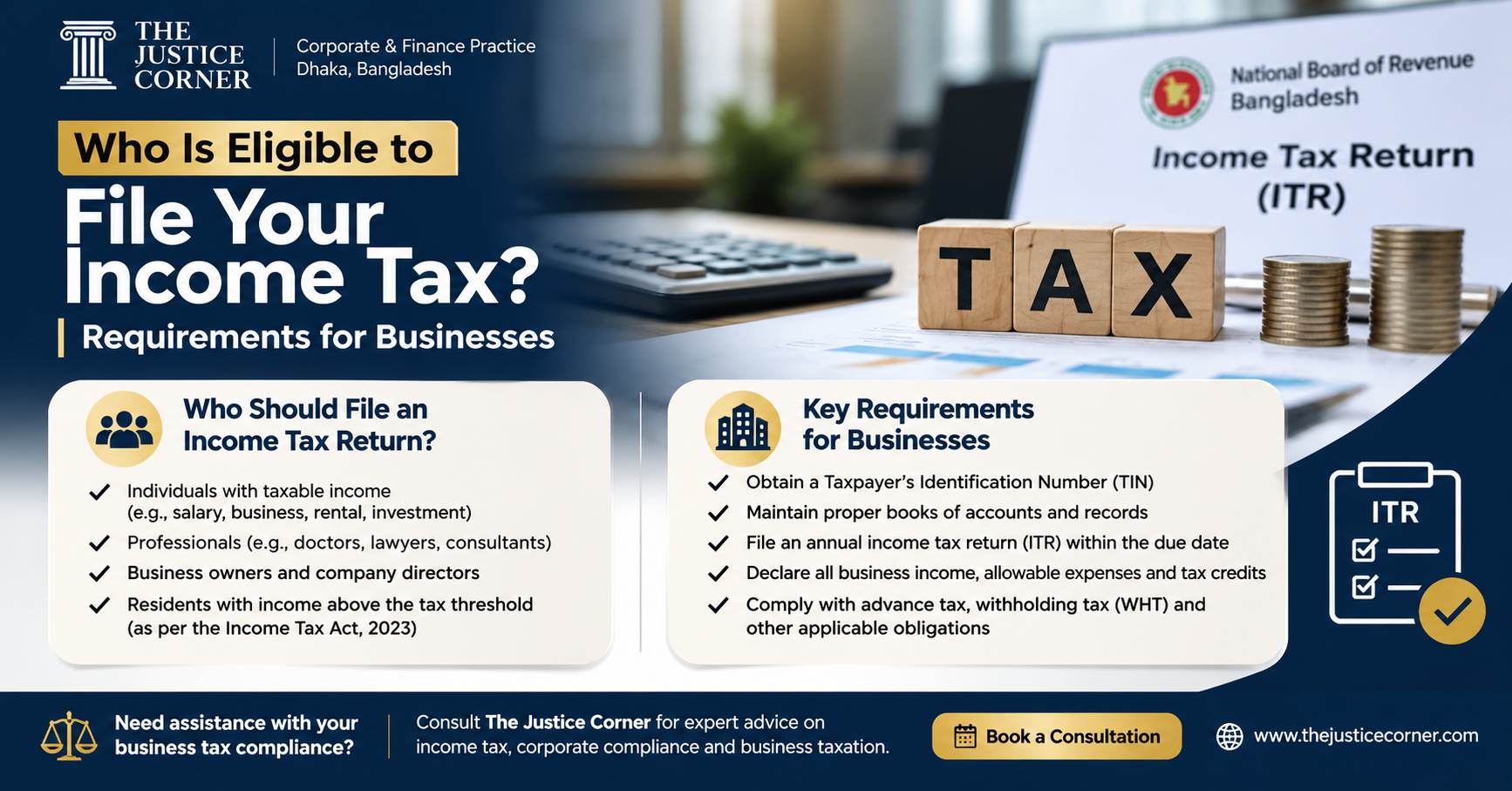
Who Is Required to File an Income Tax Return in Bangladesh? Eligibility and Requirements for Businesses
1. Introduction
Income tax compliance is an essential legal responsibility for businesses operating in Bangladesh. However, not every business owner understands when filing an income tax return becomes mandatory, whether a business must file a return despite making a loss, or whether obtaining a Trade Licence and e-TIN is sufficient to satisfy tax obligations.
The Income Tax Act, 2023 establishes specific circumstances in which individuals, companies, partnerships and other entities must submit income tax returns to the National Board of Revenue (NBR).
Importantly, the obligation to file an income tax return is different from the obligation to pay income tax. A business may be required to submit a return even if it has no taxable profit or has incurred a financial loss.
This article explains who is required to file an income tax return in Bangladesh, the obligations of different business structures and the legal requirements business owners should understand.
2. Who Is Legally Required to File an Income Tax Return in Bangladesh?
Section 166 of the Income Tax Act, 2023 identifies the circumstances in which a person must submit an income tax return.
The filing obligation generally applies where:
Total income exceeds the applicable tax-free threshold.
The taxpayer was assessed to tax in any of the three immediately preceding income years.
The taxpayer is a company.
The taxpayer is a shareholder director or shareholder employee of a company.
The taxpayer is a firm or a partner of a firm.
The taxpayer holds an executive or management position in a business.
The taxpayer is a public servant.
The taxpayer is a non-resident having a permanent establishment in Bangladesh.
The taxpayer has income qualifying for tax exemption or a reduced tax rate, subject to the statutory provisions.
The taxpayer is registered as an assessee under Section 261.
The taxpayer is required to furnish proof of submission of return under Section 264.
These provisions demonstrate that income tax return filing is not exclusively determined by whether a person earns taxable income.
Certain legal statuses and business activities independently create filing obligations.
3. Income Tax Filing Requirements for Different Business Structures
The legal structure of a business plays an important role in determining its income tax filing obligations.
3.1 Private Limited Companies
A company incorporated under the Companies Act, 1994 is required to submit an income tax return under Section 166 of the Income Tax Act, 2023.
This obligation applies to companies irrespective of whether they have generated taxable profits during the relevant income year.
A company should therefore not assume that it is exempt from filing simply because:
It has not commenced commercial operations.
It has incurred a business loss.
It has generated no taxable income.
Its business activities have temporarily stopped.
Unless an applicable statutory exception or other legal provision applies, the company must fulfil its return filing obligations.
Important compliance requirements include:
Valid TIN and taxpayer registration.
Proper accounting records.
Annual financial statements.
Income and expenditure information.
Supporting tax payment records.
Relevant tax audit and assessment documentation.
Submission of the prescribed income tax return.
3.2 Public Limited Companies
Public limited companies are also subject to mandatory income tax return filing requirements.
Their tax compliance responsibilities may involve more extensive financial reporting because of their organisational structure, shareholders, financial activities and applicable regulatory requirements.
Companies should ensure that their tax declarations are consistent with their audited financial statements and other statutory records.
3.3 Partnership Firms
Partnership firms are expressly covered by Section 166.
The firm must consider its own tax return obligations, while its partners may also have individual filing obligations.
A partner's obligation is not automatically removed because the partnership has already submitted its return.
Relevant records include:
Partnership deed.
Firm TIN.
Business income and expenditure statements.
Profit and loss allocation.
Partner remuneration information.
Bank statements.
Tax deducted at source certificates.
3.4 Sole Proprietorship Businesses
A sole proprietorship is not a separate legal person distinct from its proprietor for ordinary income tax purposes.
The proprietor's individual income tax return must reflect the business income and other relevant income.
A sole proprietor may be required to file a return where:
Total income exceeds the applicable tax-free threshold.
The proprietor was previously assessed to tax within the relevant three-year period.
The proprietor is registered as an assessee.
The proprietor is required to furnish proof of submission of return.
Another statutory filing condition applies.
For example, a proprietor operating a trading business in Dhaka may need proof of return submission to obtain or renew a Trade Licence in a city corporation area.
3.5 Foreign Companies Operating in Bangladesh
A non-resident company carrying on business through a permanent establishment in Bangladesh may have income tax return obligations under the applicable provisions of the Income Tax Act, 2023.
The nature of its operations, source of income, permanent establishment status and applicable international tax considerations should be examined carefully.
Foreign businesses should also consider their obligations under relevant corporate, regulatory and withholding tax provisions.
4. Does a Business Have to File a Return if It Makes a Loss?
Yes, where the business falls within a category required to file under Section 166.
This is particularly important for companies and partnership firms.
For example, assume a private limited company generates BDT 50 lakh in annual revenue but incurs BDT 55 lakh in allowable business expenses.
The company records a financial loss of BDT 5 lakh.
Although it may have no taxable profit for that year, its obligation to submit an income tax return does not automatically disappear.
Similarly, a newly incorporated company should not assume that the absence of commercial transactions removes its statutory filing obligations.
5. Business Registration and Income Tax Return Filing: What Is the Difference?
Business owners often confuse different registrations and compliance requirements.
These are separate legal matters.
| Registration or compliance | Purpose |
|---|---|
| Trade Licence | Local authority permission to conduct business |
| e-TIN | Taxpayer identification and registration |
| BIN/VAT registration | VAT-related identification and compliance where applicable |
| RJSC registration | Company incorporation and relevant corporate filings |
| Income tax return | Annual declaration of income and relevant financial information |
Having a Trade Licence does not automatically satisfy income tax filing obligations.
Similarly, having a BIN does not replace the requirement to submit an income tax return where required by law.
6. When Is Proof of Submission of Return Required for Businesses?
Section 264 of the Income Tax Act, 2023 identifies specific transactions and activities for which proof of submission of return must be furnished.
Relevant business-related situations may include:
Obtaining or renewing a Trade Licence in a city corporation or municipality.
Obtaining or maintaining an Import Registration Certificate.
Obtaining or maintaining an Export Registration Certificate.
Obtaining or maintaining a VAT registration or turnover tax enlistment in specified circumstances.
Obtaining certain bank loans exceeding the statutory threshold, subject to applicable conditions.
Obtaining or maintaining credit card facilities.
Participating in specified contractual or regulatory activities.
The precise requirement depends on the statutory category and applicable conditions.
Business owners should review Section 264 before applying for a licence, certificate or regulated service.
7. Documents Businesses Should Prepare for Income Tax Filing
Companies, partnership firms and sole proprietorships should maintain accurate financial records.
Commonly required information and supporting records include:
Business registration documents
Certificate of incorporation, where applicable.
Memorandum and Articles of Association.
Trade Licence.
e-TIN certificate.
Partnership deed, where applicable.
Financial records
Annual financial statements.
Balance sheet.
Profit and loss statement.
Cashbook and general ledger.
Bank statements.
Sales and purchase records.
Expense vouchers.
Tax-related records
Tax deducted at source certificates.
Advance tax payment records.
Tax payment challans.
Previous income tax returns.
Relevant tax assessment orders.
Additional records
Fixed asset register.
Depreciation schedule.
Loan agreements.
Director remuneration details.
Related-party transaction information, where applicable.
The exact documentation requirements depend on the taxpayer's legal structure and applicable NBR instructions.
8. What Are the Consequences of Failing to File a Business Income Tax Return?
Failure to submit a return when legally required can expose a taxpayer to statutory consequences.
Depending on the applicable circumstances and provisions, these may include:
Monetary penalties.
Additional tax and interest.
Tax assessment proceedings.
Difficulties obtaining proof of submission of return.
Problems renewing licences and registrations.
Additional compliance and regulatory complications.
NBR's published guidance identifies penalties for failure to file returns under relevant provisions of the Income Tax Act, 2023.
Business owners should therefore treat income tax filing as a continuing compliance responsibility rather than an optional annual activity.
9. How Can Businesses Maintain Proper Income Tax Compliance?
Businesses should implement a structured tax compliance system.
Recommended practices include:
Maintain accurate accounting records throughout the year.
Reconcile business bank accounts regularly.
Record sales, purchases and expenses properly.
Maintain relevant invoices and supporting vouchers.
Track tax deducted at source.
Maintain fixed asset and depreciation records.
Review previous income tax assessments.
Identify applicable return filing deadlines.
Prepare annual financial statements.
Obtain professional advice where necessary.
For companies, coordinating tax preparation with financial statement preparation and corporate secretarial compliance can reduce inconsistencies.
10. How Can Professional Legal Guidance Help Businesses?
Income tax compliance involves more than calculating annual taxable income.
Businesses may need assistance with:
Corporate tax compliance.
Tax registration and documentation.
Business restructuring.
Tax assessment and appeals.
Regulatory compliance.
Director and shareholder tax obligations.
Cross-border business taxation.
Tax-related disputes.
A properly structured compliance process can help businesses identify potential risks before they develop into disputes with regulatory authorities.
Businesses seeking professional assistance with corporate, commercial and financial legal matters may explore the services of The Justice Corner.
11. Frequently Asked Questions (FAQs)
Q1. Is every company in Bangladesh required to file an income tax return?
Generally, yes. Companies are expressly covered by Section 166 of the Income Tax Act, 2023. The obligation does not automatically disappear because a company has no taxable profit.
Q2. Does a small business need to file an income tax return?
A small business must assess its filing obligation based on its legal structure, income, taxpayer registration and applicable statutory requirements. Small size alone does not create a general exemption.
Q3. Does a sole proprietorship need a separate income tax return?
A sole proprietorship's business income is generally included in the proprietor's individual income tax return. It is not treated as a separate company merely because it has a Trade Licence.
Q4. Are partnership firms required to file income tax returns?
Yes. Partnership firms are expressly included in Section 166. Their partners may also have individual filing obligations.
Q5. Must a company file a return if it has no business activity?
A company is generally required to file under Section 166 even if it has not commenced operations or generated taxable profits, subject to any applicable statutory exception.
Q6. Does obtaining an e-TIN mean that I have completed my tax compliance?
No. TIN registration and annual income tax return submission are separate obligations.
Q7. Are directors personally required to file income tax returns?
Shareholder directors and shareholder employees are specifically covered by Section 166. Other directors should assess their filing obligations based on their income, employment status, taxpayer registration and other statutory requirements.
Q8. Is a Trade Licence sufficient proof of income tax compliance?
No. A Trade Licence and proof of submission of income tax return are different documents. Where proof is legally required, the appropriate tax acknowledgement or certificate must be furnished.
12. Conclusion
Understanding who is required to file an income tax return is fundamental to operating a legally compliant business in Bangladesh.
Under Section 166 of the Income Tax Act, 2023, companies, partnership firms, partners, certain company directors and other specified categories have statutory filing obligations.
Importantly, a business's filing obligation should not be confused with its final tax liability. A company may have to submit a return even when it reports a financial loss or has no taxable income.
Businesses should maintain proper financial records, monitor their tax obligations and obtain appropriate professional guidance where necessary.
Disclaimer: This article provides general legal and tax information and does not constitute individual legal or tax advice. The applicable requirements should be verified against the latest Income Tax Act, Finance Acts, amendments, NBR notifications and rules.